Polly & Ezekiel Slocumb [14&15/250]
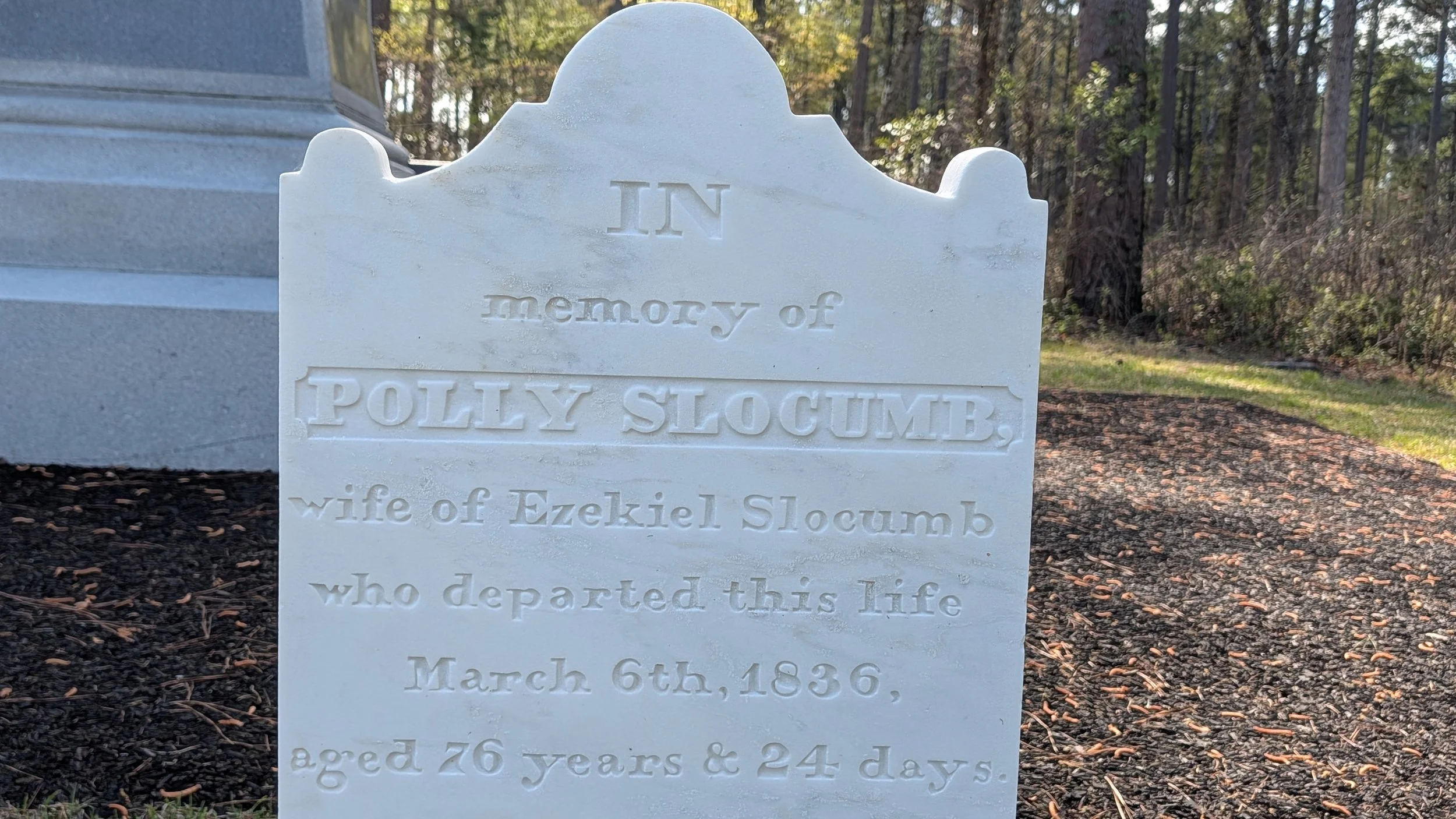
The Graves of Polly Slocumb & Col. Ezekiel Slocumb
Buried at Moore's Creek Battlefield in Pender County, North Carolina
When I visited Moore's Creek National Battlefield for the 250 Years, 250 Graves project, I expected to find the graves of soldiers who had fought and died there during the American Revolution. What I found instead was something far more interesting: a couple who had no direct connection to the battle at all, buried beneath one of the most striking monuments on the grounds, honored for a story that history strongly suggests never happened. The irony runs deep with Ezekiel and Polly Slocumb.
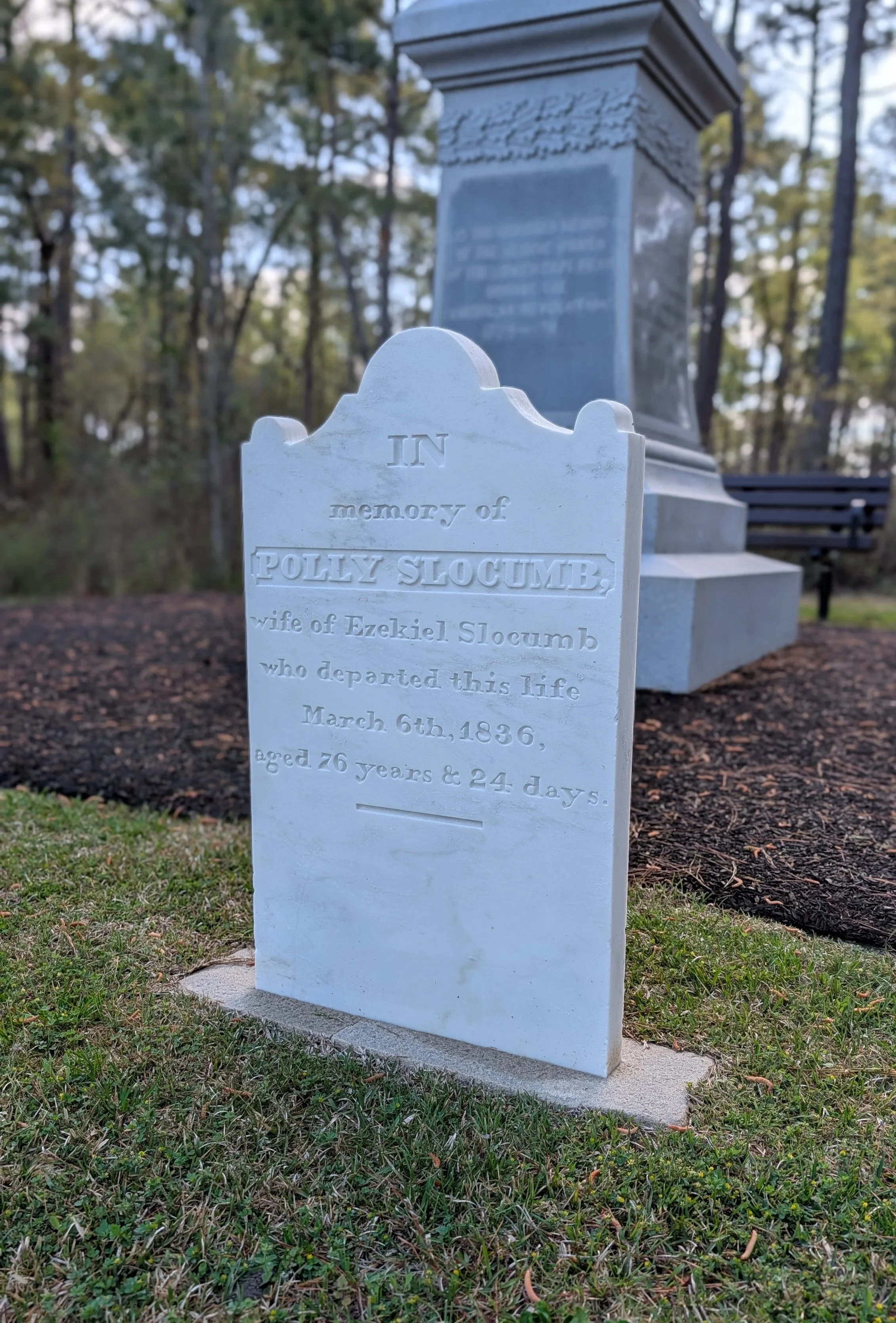
Marble gravemarker for Mary "Polly" Slocumb | Wife of Ezekiel Slocumb, who departed this life March 6th, 1836. | Aged 76 years & 24 days
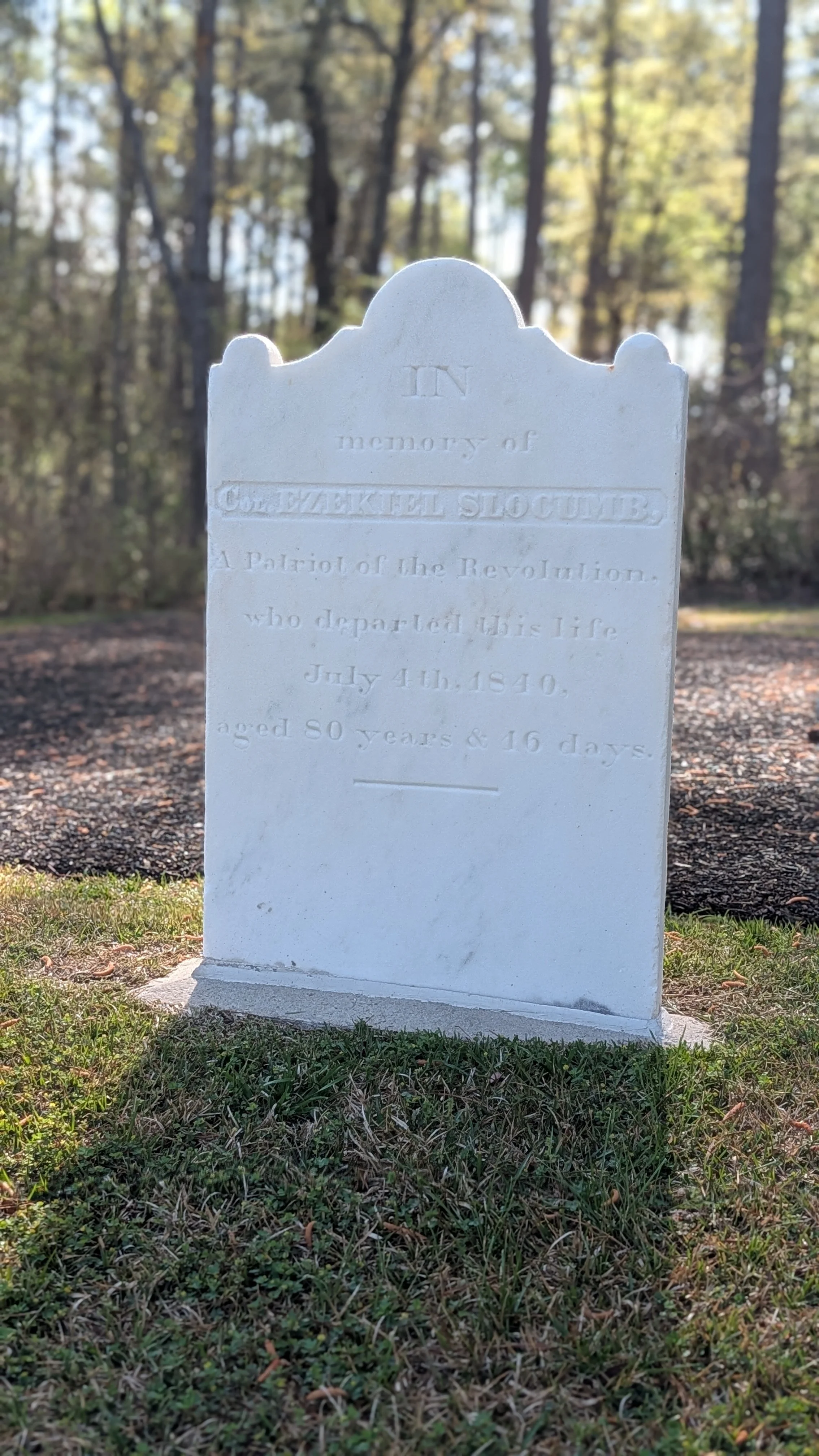
The marble gravemarker for Col. Ezekiel Slocumb | A Patriot of the American Revolution who departed this life July 4th. 1840 | Aged 80 years and 15 days
A Long Way From Home
The two of them spent their lives on a Wayne County, NC plantation near the little community of Dudley, roughly 65 miles inland from the swampy bend in Moores Creek where one of the Revolution's earliest and most decisive Southern battles was fought in February 1776. They died there in Wayne County: Polly in March of 1836, and Ezekiel four years later on the Fourth of July, 1840, at the age of 80. They were buried on their own land, on the property where they had built their lives and raised their children. And there they stayed, for 89 years.
Then, in September of 1929, someone dug them up and moved them.
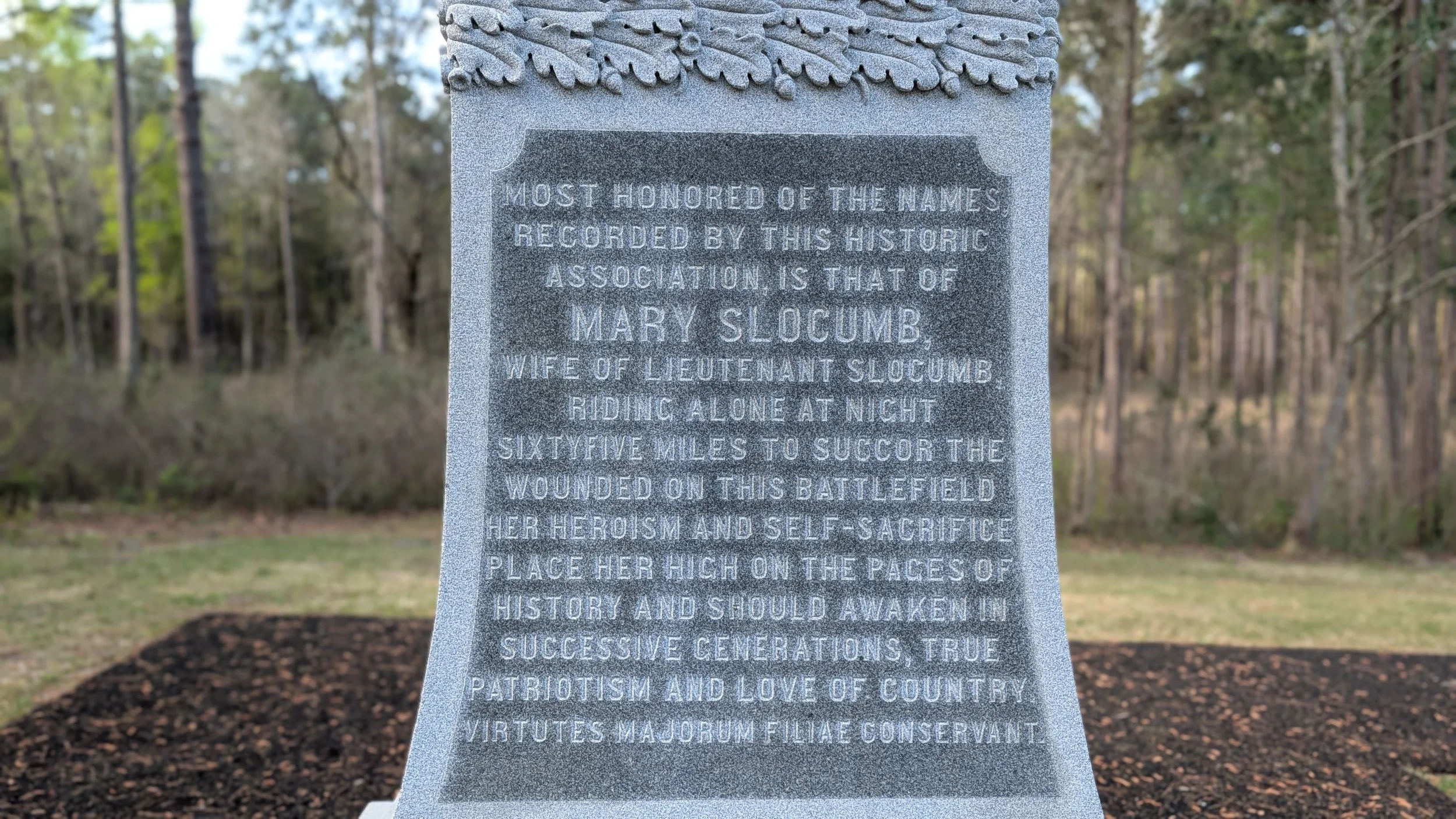
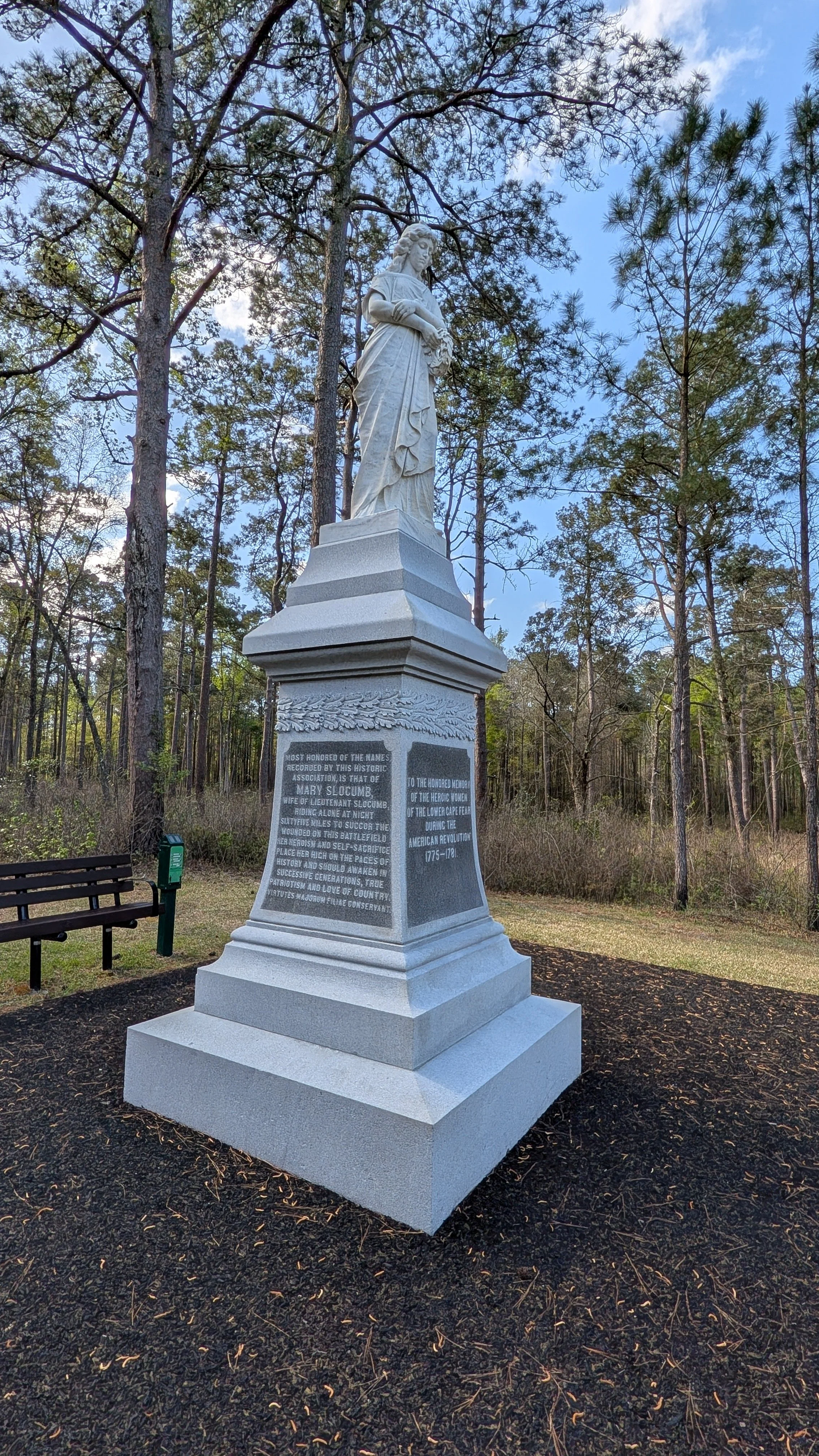
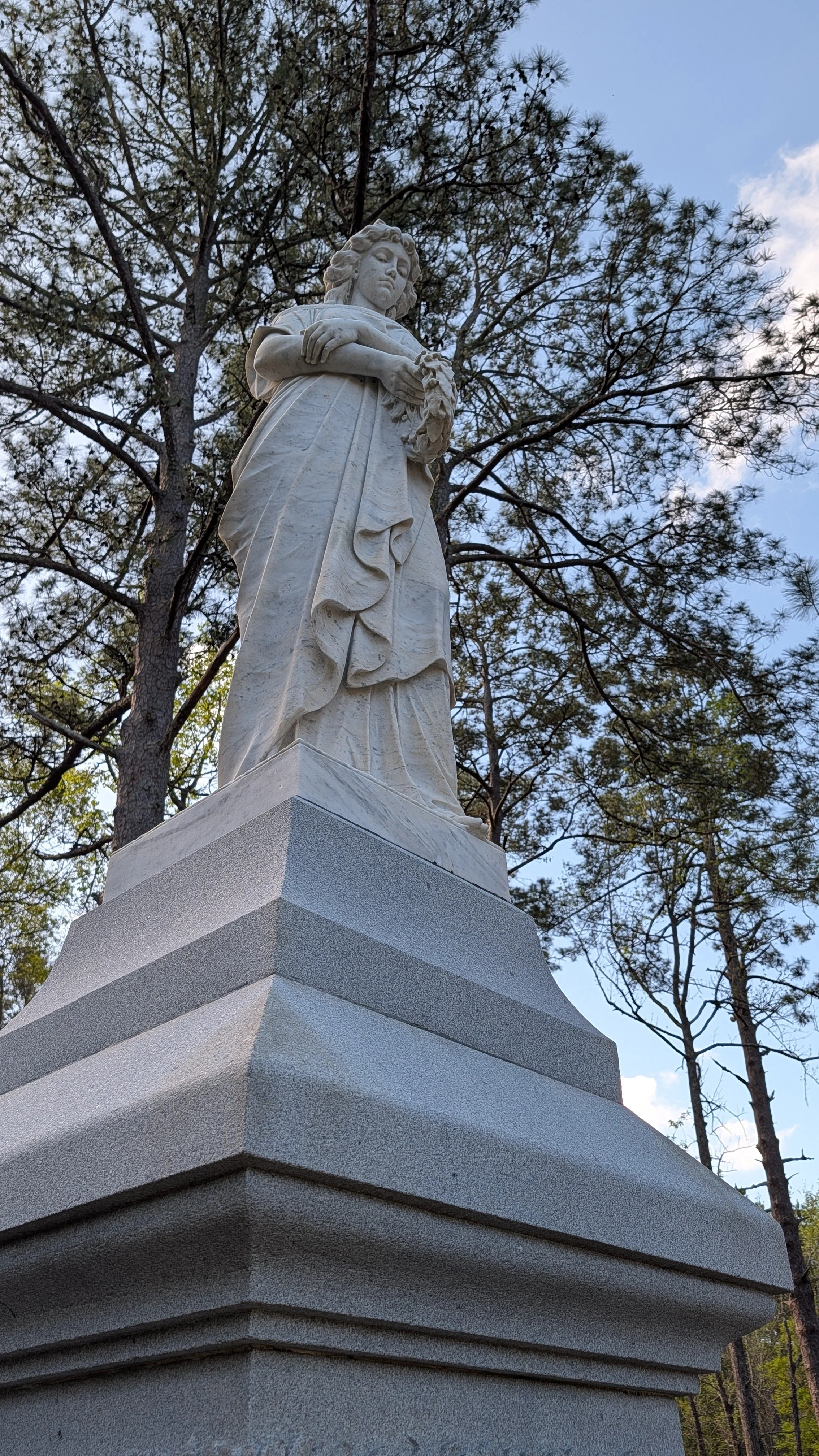
Their remains now rest at the base of a tall marble monument erected in 1907 at Moore's Creek National Battlefield in Currie, Pender County. The monument honors the heroic women of the lower Cape Fear during the Revolution, and Polly Slocumb is singled out by name as "most honored" among them. She was celebrated for a midnight ride to the battlefield that, as it turns out, she almost certainly never took.
This is their story. It is also the story of how history, memory, and myth can become so thoroughly tangled that even the bones end up somewhere they don't quite belong.
Who They Were
Ezekiel Slocumb was born June 18, 1760, in what was then Dobbs County, North Carolina, in the territory that would later be reorganized into Wayne and surrounding counties. He was the eldest son of his household, and family records suggest that as a teenager, the management of the family's land essentially fell to him. By the time he was 18, he had married Mary "Polly" Hooks on Christmas Day, 1775, in Duplin County. Both of them were roughly 15 years old at the time of their wedding.
Polly was born February 11, 1760, the daughter of Thomas Hooks and Anna Belotte, originally of Bertie County. When Polly was about ten, her father moved the family to Duplin County, to a region called "Goshen." She was described in later accounts as spirited and capable. She and her husband settled on a plantation on the Neuse River, and Polly was likely already pregnant with their first child before Ezekiel's military service began. That is a crucial detail we will come back to.
Ezekiel's War
The story that was passed on for years about the Slocumbs frames Ezekiel as a soldier of the Revolution and Polly as his devoted wife, racing to his side at the sound of battle when fighting broke out at Moore's Creek. The actual record differs, though.
According to Ezekiel's pension file, he did not enlist until April of 1780, more than four years after the Battle of Moore's Creek. When he began his first tour, he was two months shy of his 19th birthday, serving as a private under Captains Jernigan and Crawford in the Wayne County militia, under Colonel Exum. He served until November 1780, was discharged, and presumably returned home to Polly and their young children.
His second tour began in August 1781 and lasted approximately ten months. By this point, he had been promoted to sergeant. He rode with a mounted troop of Wayne militiamen through Johnston, Wayne, Lenoir, and Duplin counties, largely engaged in suppressing Tory unrest as the war wound toward its close. He was never on the Moore's Creek muster rolls, because Moore's Creek was fought in February 1776, and Ezekiel Slocumb was fifteen years old and not yet in uniform.
After the war, he became, as one county historian put it, "a man of affairs in Wayne County." He served as a captain of his local militia district and eventually rose to lieutenant colonel, becoming commander of all militia forces in Wayne. By the end of his life, he had earned the title that appears on his gravestone: Colonel. Ezekiel's service and contributions to the American Revolution were real. He is simply buried at a place he never fought.
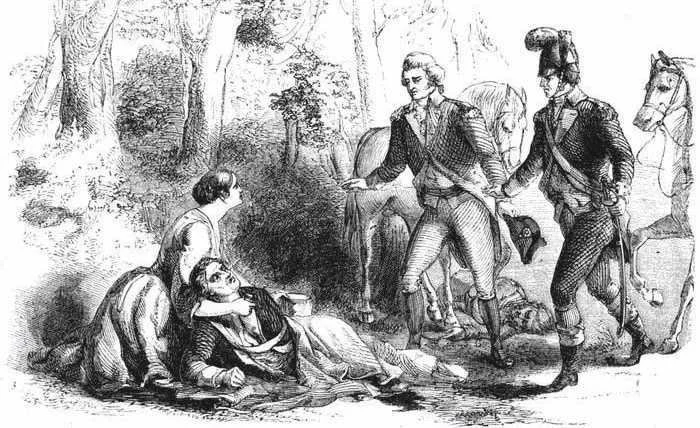
The Legend
Here is the story that made Polly Slocumb famous across North Carolina for nearly two centuries and led to the couple being buried where they didn't really belong.
The legend goes that on the night of February 26-27, 1776, as Patriot forces under Colonel Richard Caswell were moving to intercept a column of Highland Loyalists at Moore's Creek Bridge, Polly Slocumb, still a teenager, with a small child at home, was seized by a vivid dream. In it, she saw her husband lying wounded and bloody on a battlefield, wrapped in his guard cloak. She woke in the dark, saddled her horse, and rode through the night alone, 65 miles or more, following the sound of cannon fire to the battlefield. There she found the Patriots victorious and Ezekiel safe. She tended the wounded, reunited briefly with her husband, then turned her horse around and rode home the same day to be with her child.
It is a remarkable story. It also almost certainly did not happen.
The problems with this legend are numerous. Ezekiel's own pension records show he wasn't at Moore's Creek at all and didn't enlist for another four years. The battle itself was over in minutes, before dawn, and officers' reports recorded just two American men wounded, not the twenty Polly reportedly nursed. There was no cannon fire audible mid-morning because the guns fell silent before sunrise. The son Polly supposedly rode home to be with (a detail emphasized in several versions of the story) wasn't born until August of 1780. And perhaps the biggest red flag: in 1810, the editor of the Raleigh Star asked Jesse Slocumb, Ezekiel and Polly's own son, to write a brief history of Wayne County and comment specifically on the Revolutionary period. Jesse wrote that nothing remarkable had occurred during the Revolution in Wayne County, that the British under Cornwallis had passed through, and that Tories had done some mischief with plundering and livestock. He said nothing about his mother's legendary ride.
The legend didn't enter the written record until 1848, when New York writer Elizabeth Ellett published it in her book Women of the American Revolution, attributed to an account Polly had supposedly given her doctor. Ellett's book appeared the same year as the Seneca Falls Convention, a moment of intense national interest in women's heroism and civic virtue. It was a propitious cultural moment to be publishing stories of brave Revolutionary wives. Three years later, historian John H. Wheeler included the tale in Historical Sketches of North Carolina (1851), the first major state history, and from there it passed into the accepted record.
None of this means Polly Slocumb was an unremarkable woman or that her life was untouched by the war. In the spring of 1781, Cornwallis's army passed within a mile or two of the Slocumb plantation in Wayne County, with Tarleton's dragoons ranging ahead. Most Patriot families fled. By several accounts, Polly did not. Whatever happened during that encounter, her composure in the face of the British advance suggests a woman of genuine steadiness. The war came to her doorstep, and she stood her ground. That may not be as cinematic as a midnight ride, but it is a remarkable thing in its own right.
A Monument and a Move
The legend was well established in North Carolina's memory by the time the Moore's Creek Monumental Association began organizing in the early 1900s. In August 1907, a marble monument was dedicated on the battlefield grounds here to honor the women of the lower Cape Fear during the Revolution. The ceremony was attended by state legislators and members of Congress. Thirteen young women, representing the thirteen original states, decorated the monument at its unveiling.
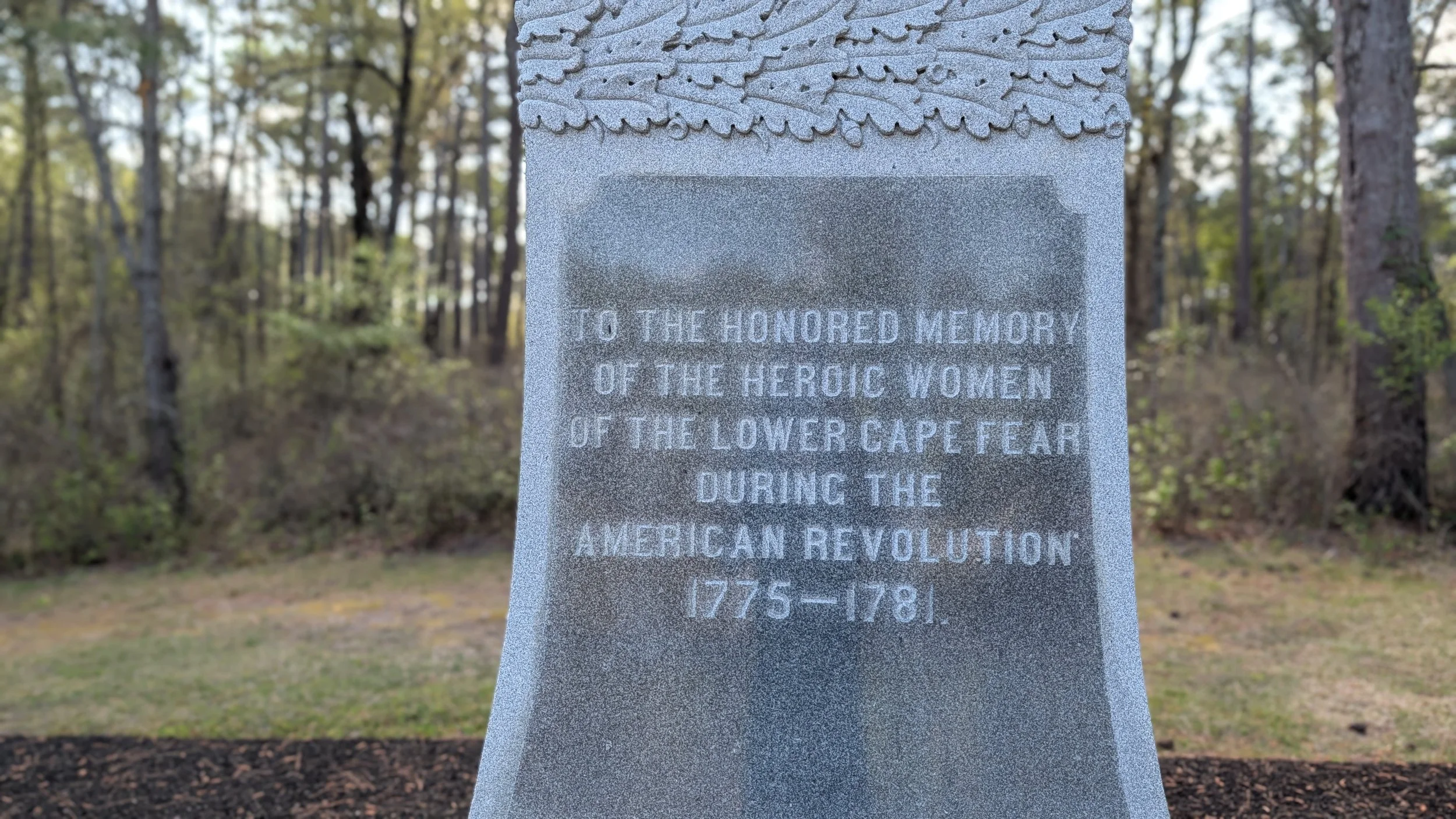
Polly Slocumb was given pride of place on the monument's southwest face. The inscription identifies her as the "wife of Lieutenant Slocumb" (one of his rank designations that appears in the historical record, alongside Sergeant, Captain, and Colonel). The inscription describes her riding alone at night, 65 miles, to care for the wounded on the battlefield. "Her heroism and self-sacrifice place her high on the pages of history," the stone says.
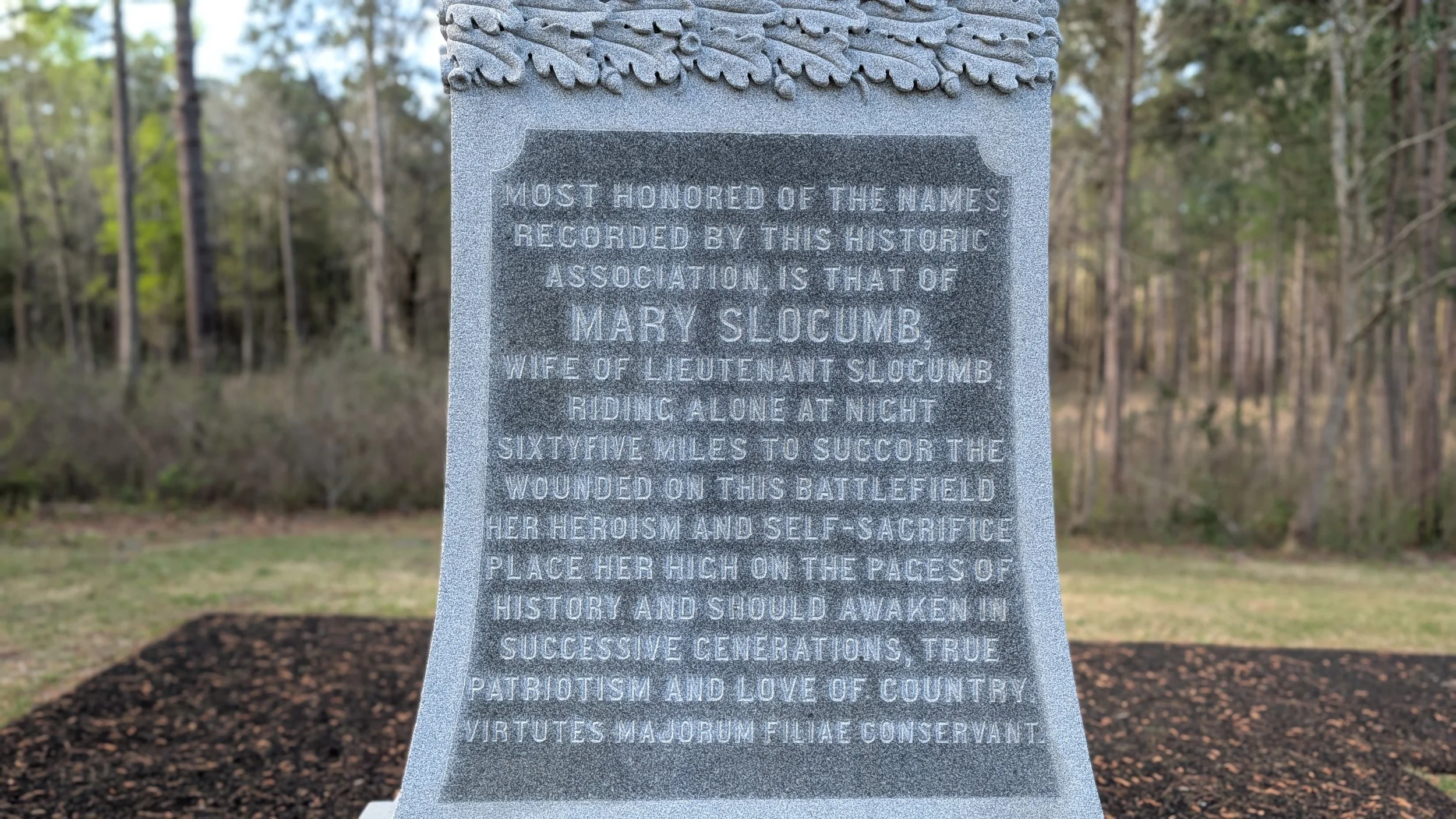
Historians had their doubts even then. Documents in the National Park Service archives suggest that reservations about the legend's accuracy were circulating at the time of the 1907 dedication. The monument went up anyway.
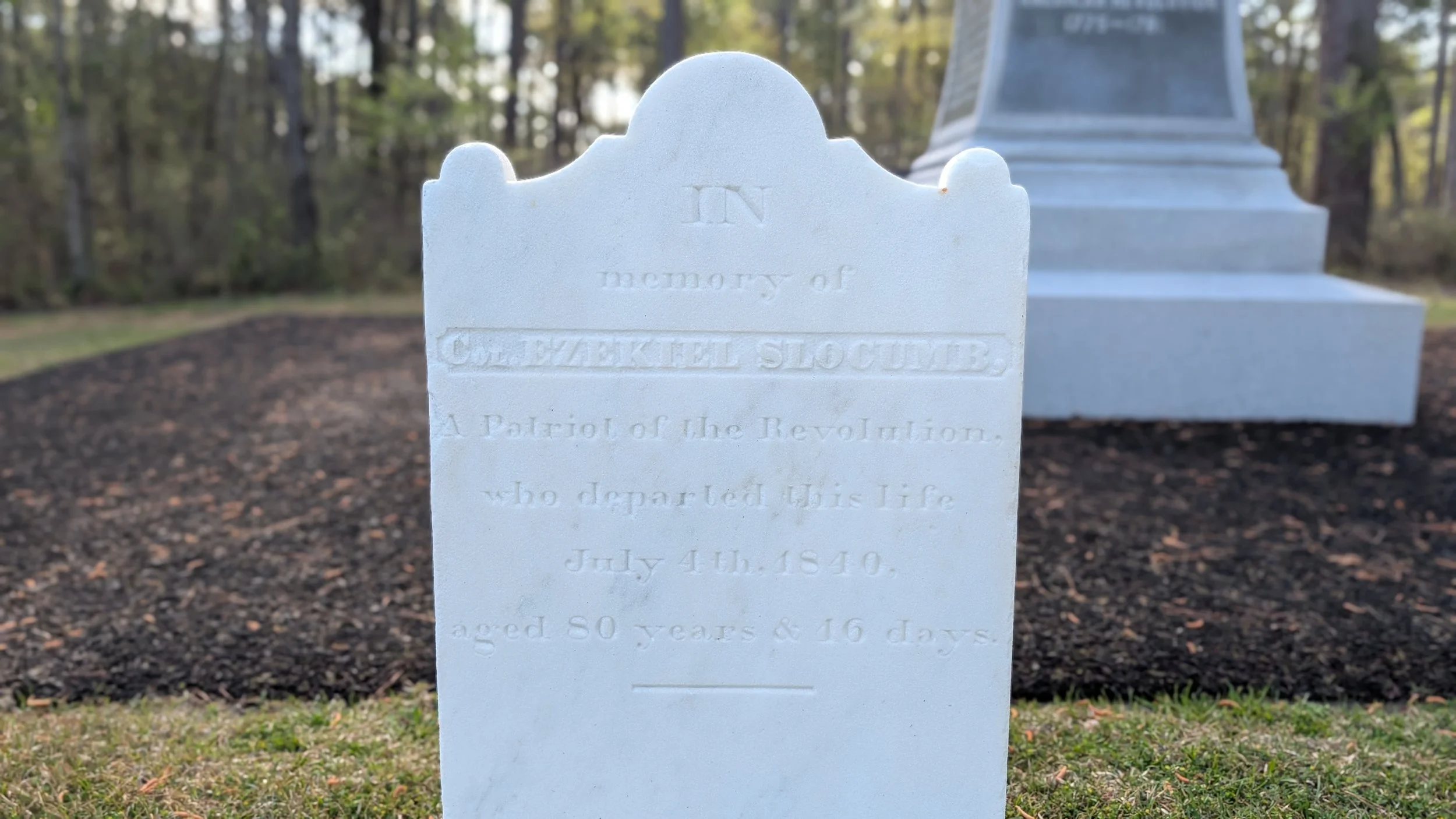
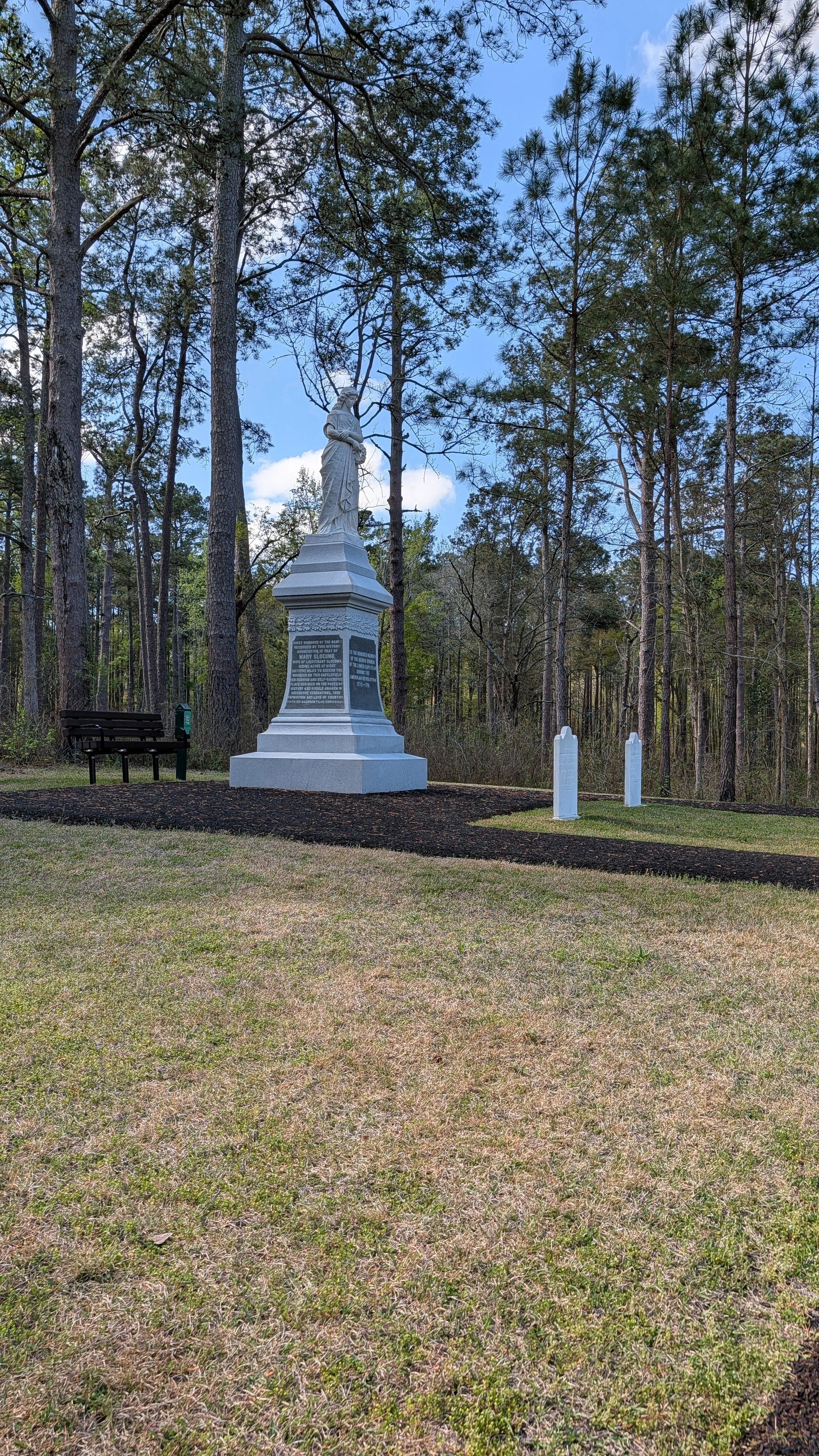
Twenty-two years later, the Slocumbs themselves were relocated to the monument. In September 1929, the bodies of Ezekiel and Polly were exhumed from the family cemetery near Dudley in Wayne County and re-interred at the base of the Women's Monument in Pender County. A DAR marker was later erected at the original home site, acknowledging both the original burial ground and the reinterment site. Their individual headstones now stand in the foreground of the marble column at Moore's Creek.
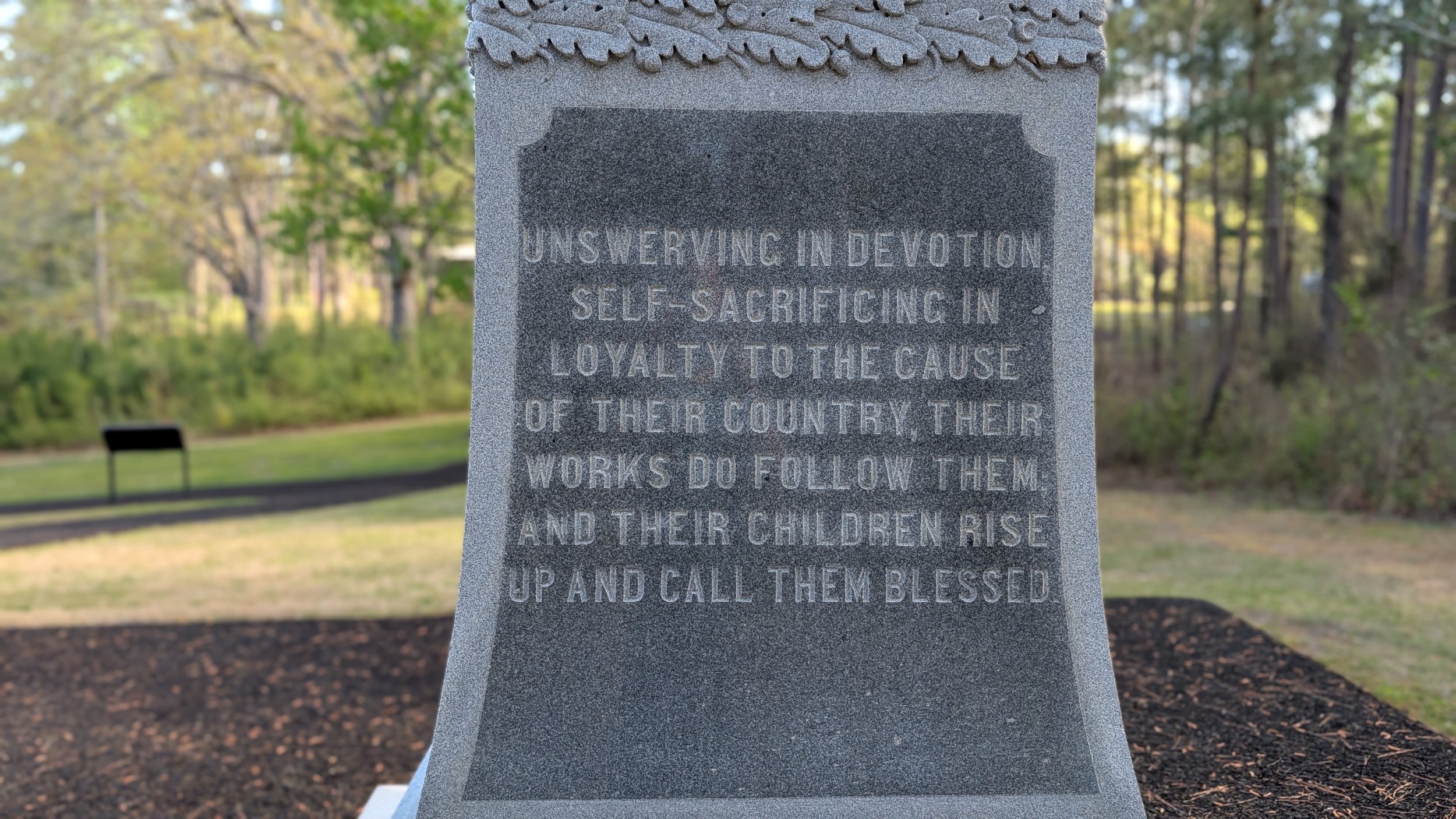
This large monument is believed to be the only one in America dedicated to 18th-century women and their contributions to the Revolutionary War.
Visiting their Graves
Ezekiel and Polly Slocumb are buried at the base of the Women's Monument at Moore's Creek National Battlefield
40 Patriots Hall Drive, Currie, NC 28435. The grave markers stand in the foreground of the monument, Ezekiel to the left and Polly to the right. The monument sits along the park's one-mile interpretive trail, a short walk from the visitor center.
The park grounds are open daily from 9 AM to 5 PM. The visitor center is open Tuesday through Saturday and is closed on federal holidays. Admission is free.
The original home site marker, acknowledging the Slocumbs' actual burial ground and the 1929 reinterment, stands along the 5000 block of South US-117 near Dudley in Wayne County, North Carolina, on the grounds of Southern Wayne High School.
This project is made possible by readers like you.
Your support helps to pay for website costs, gas to travel to these sites, and cleaning supplies for the veteran stones that I’m working to restore.
If you believe this work is important, your support is so appreciated!
Citations
Find A Grave, memorial for Polly Hooks Slocumb, ID 21278323, and memorial for Ezekiel Slocumb, ID 21278120
DAR Patriot Ancestor Record, Ezekiel Slocumb, Ancestor #A105331, Pension# S7526
Elizabeth Ellett, Women of the American Revolution, 1848
John H. Wheeler, Historical Sketches of North Carolina, 1851
American Battlefield Trust, biography of Mary Slocumb, battlefields.org
NCPedia, "Primary Source: Mary Slocumb at Moores Creek Bridge: The Birth of a Legend," ncpedia.org
Flowers, John Baxton, Did Polly Slocumb Ride to the Battle of Moore's Creek Bridge?, self-published
Issuu / Sampson County Historical Society, "The Legend -- The Myth of Polly Slocumb," apg-enc (article by John Baxton Flowers, Nov. 2020)
NC America 250, "Remembering the Ladies," america250.nc.gov, May 2025
National Park Service, Moores Creek National Battlefield, nps.gov
Jesse Slocumb, letter to Thomas Henderson, editor of the Raleigh Star, 1810, Henderson letter book, NC State Archives, Raleigh