“Old Dan Tucker” [22/250]
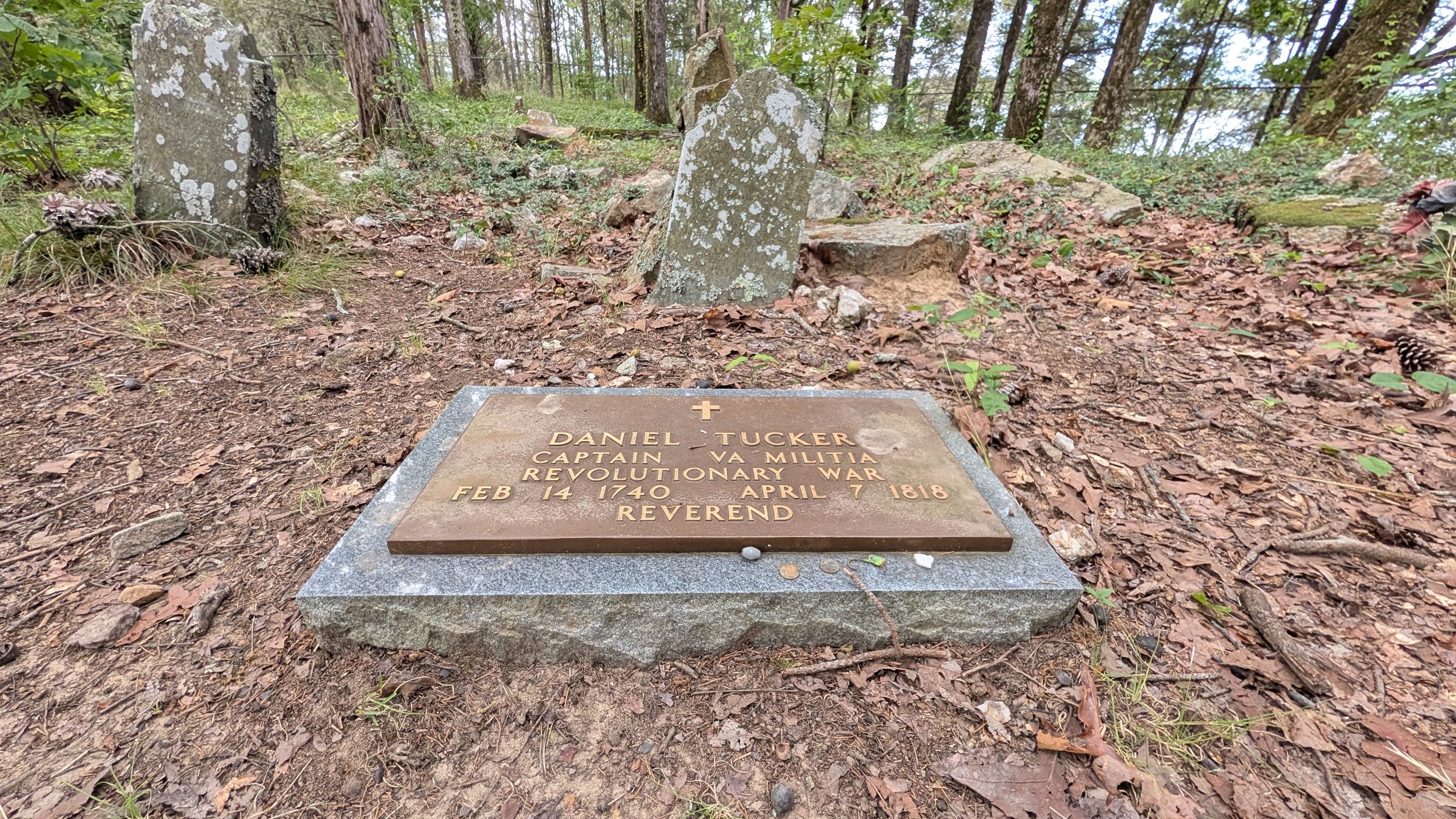
Rev. Daniel Tucker (1740-1818)
Buried at the Tucker Cemetery, Elbert County, Georgia
I hadn't planned on visiting this grave for the 250 Graves project, but when I stopped nearby at the Heard Family Cemetery, a prominent granite marker beckoned me to the spot with a simple inscription: "Dan Tucker's Grave, 2 Miles this way." Situated at the crossroads of two obscure dirt roads in Georgia, beside the banks of the Savannah River, this granite marker was unexpected and obviously required some effort to install, so I figured it was worth the trek to visit Dan Tucker's grave, although I had no idea who he was at the time.
Passing three more giant granite markers along the two-mile stretch, I started to suspect that I would find a remarkable story behind Dan Tucker, because after all, why would anyone go to such lengths to mark the road to a grave so far out in the country? This must be an interesting one, I figured, and continued down a path that, at times, I wasn't sure was even a public road anymore. Nevertheless, I found myself at the end of the two-mile path through the Georgia countryside, where I parked in the woods. I spotted the historical marker, and just beyond it, a small path, mostly obscured by the growth of summer in Georgia.
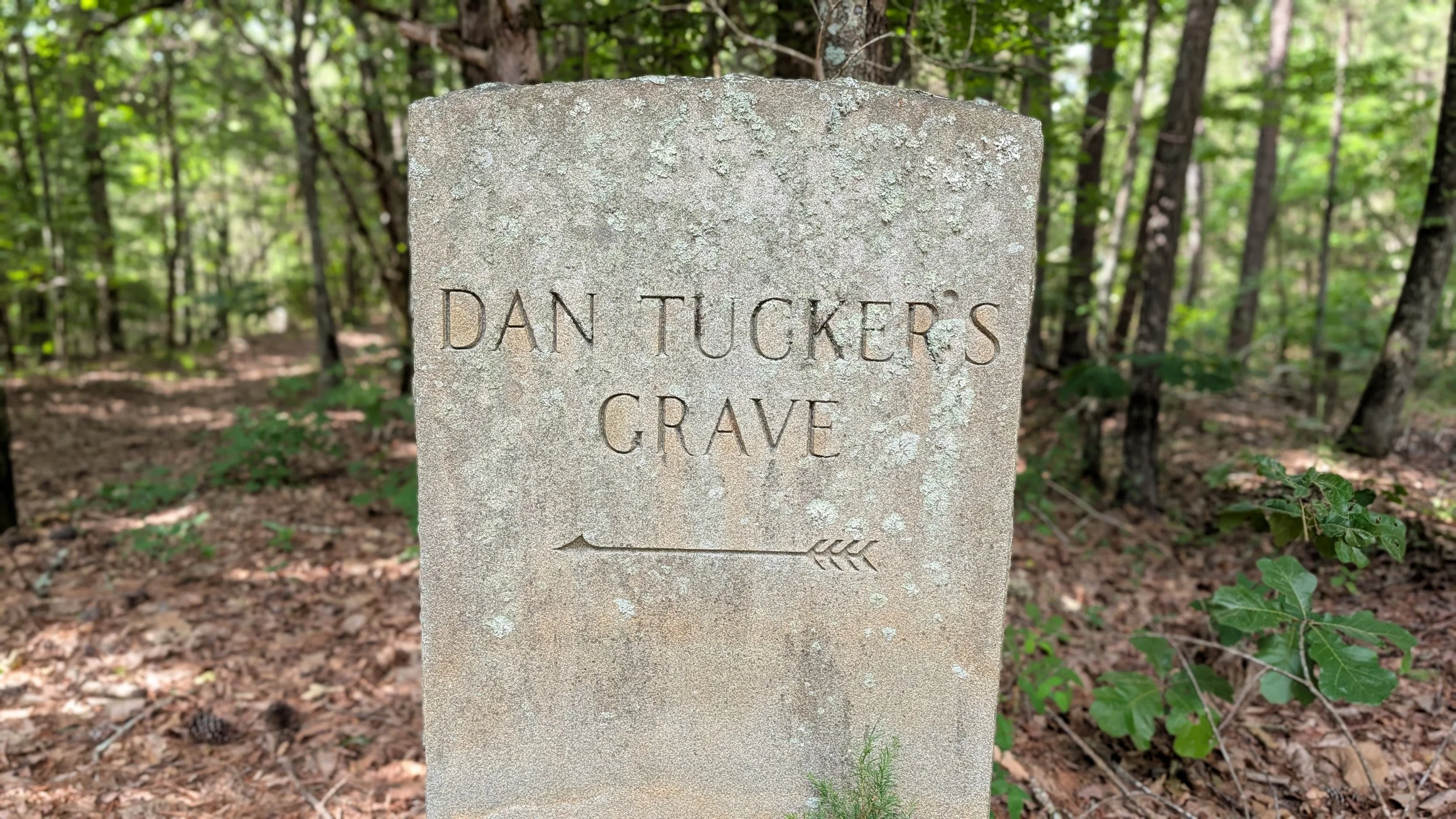
All along the road to Dan Tucker’s grave are these large stone roadside markers pointing you in the direction of his burial site, which is very remote.
I meandered the path, expecting the grave to appear quickly, but the marker doesn't warn you that the grave can only be reached via a mile-long hike through the woods. There, along the banks of the Savannah River, you can visit the grave of "Old Dan Tucker," who served as an ensign in the Amelia County, Virginia militia through the final years of the Revolution before he ever set foot in Georgia, and before he established his plantation here in Georgia, which he called Point Lookout. An obvious name for a place overlooking the waterway that defined his property and parts of his life.
Once I got home, I started to research his story, almost as fascinated by the grave itself as I was by its remote location and the trek it took to find it. As it turned out, the trip here was quite a trek for Dan Tucker, too.
Dan Tucker from Amelia County, Virginia
Daniel Tucker was born on February 14, 1740, in Amelia County, Virginia, in the rolling tobacco country south of Richmond. He grew up in a world that, within his lifetime, would rip itself in two over the question of independence. Around 1767/68, he married Frances Epps (1750-1823) in Virginia, and the couple began a family that would eventually include at least eight children: Reuben, Shem, Ethel, Gabriel, Daniel Jr., Eppes, Frances, and Susanna.
When the Revolution came, Tucker joined in the Amelia County militia under Captains William Munford and John Dennis. Muster and pay records show him with the Virginia Regiments from August 1777 through December 1782, beginning as a private in Captain John Sneed's company of the 4th Virginia Regiment before serving as an ensign in Captain Munford's Amelia County company.
Some later sources describe Tucker as having reached the rank of captain, but the Daughters of the American Revolution's (DAR) ancestor record lists him as an ensign. I can't confirm the captain's claim at this time, but if you have further information, please reach out to me! kelly@theforgottensouth.com
A New Start on the Savannah River
Like many Revolutionary veterans, Tucker was drawn south by the promise of land. Georgia was distributing grants across what had recently been Creek and Cherokee territory, which had been ceded in 1773 and was known as the New Purchase. Tucker took up his grant in the area that was then part of Wilkes County, Georgia's first and largest backcountry county. On December 10, 1790, the Georgia legislature carved Elbert County out of Wilkes, and Tucker's land fell within the new county's bounds, so if you're tracing his earliest Georgia deeds and grants, you will need to look to Wilkes County records for anything predating that split.
He settled along the Savannah River at a place he called Point Lookout, and there he built the life for which he was most remembered. He farmed the rich river bottomland successfully enough that at least one young man was formally bound to him as an apprentice, to learn farming under his direction. In 1798, he purchased the "Cook's Ferry Tract" from John Heard for one thousand dollars in cash, which was a ferry crossing on the Savannah River that linked Georgia to South Carolina. Tucker's Ferry, as it became known, carried travelers across the river for decades, well into the era of automobile bridges.
He was, by all accounts, a well-connected man in his corner of the frontier. His closest friend and neighbor was Stephen Heard, a fellow Revolutionary veteran who had briefly served as Georgia's acting governor during the war and who later helped select the site of the new Elbert County courthouse.
Planter and Minister
Records show that Tucker was also a Methodist minister, and like nearly every planter of his class and era in this part of Georgia, Tucker's farm operated on enslaved labor. Local tradition holds that he spent considerable time teaching and praying with the people he enslaved, and according to famil tales, this ministry earned him real affection among them, althought the people Tucker enslaved left no written record of their own to tell us how they actually felt about him.
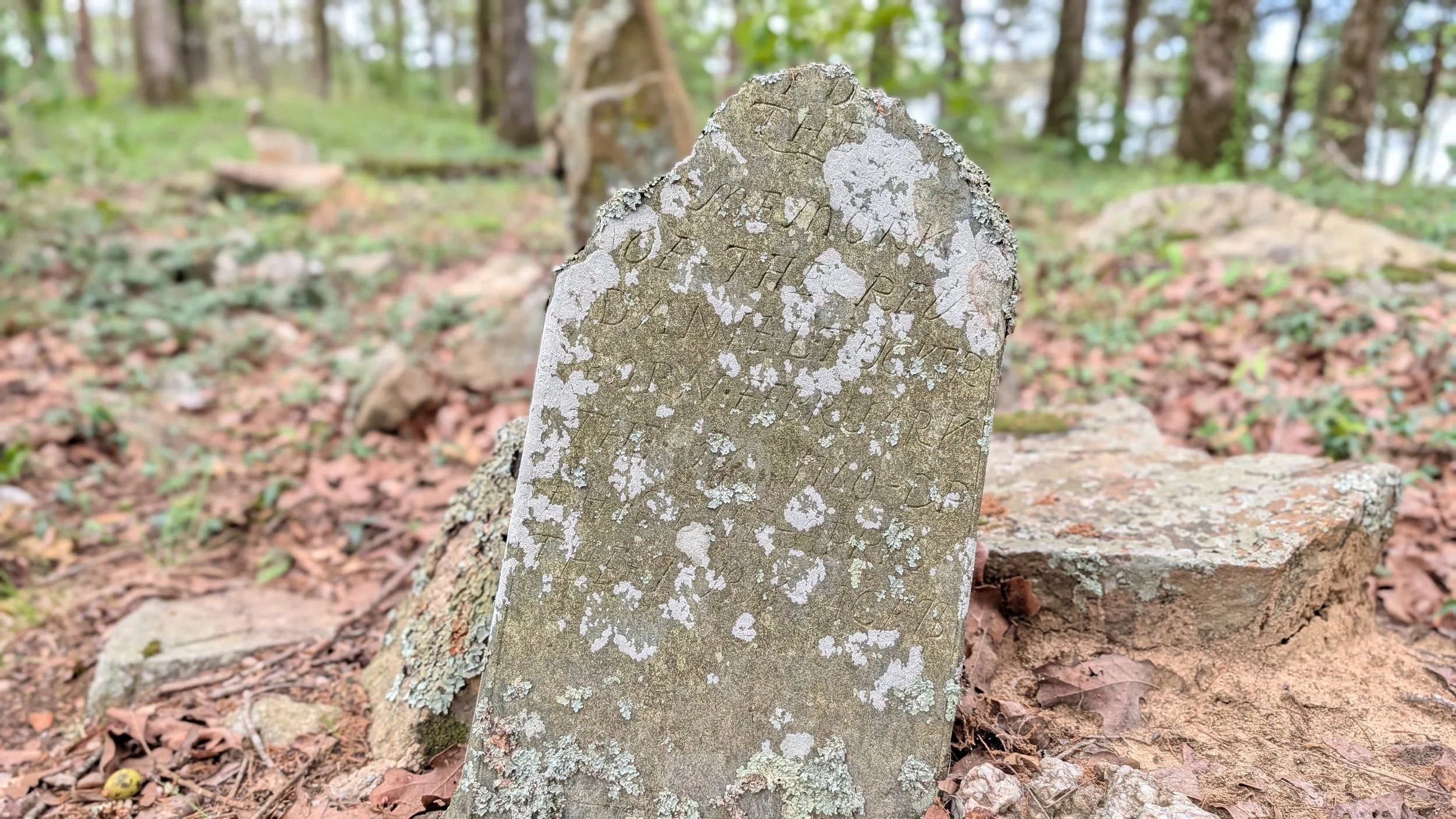
The original, hand-carved stone for Rev. Daniel Tucker.
Death and Burial
Daniel Tucker wrote his last will and testament on April 4, 1818, leaving his property to his wife Frances for her lifetime, with provisions for his unmarried children. He named his sons Reuben and Shem as executors and three days later, on April 7, 1818, he died at his home near Heardmont of natural causes at the age of seventy-eight. He was buried in the small family cemetery near his homeplace overlooking the Savannah River, where his wife Frances, who outlived him by five years, would eventually join him.
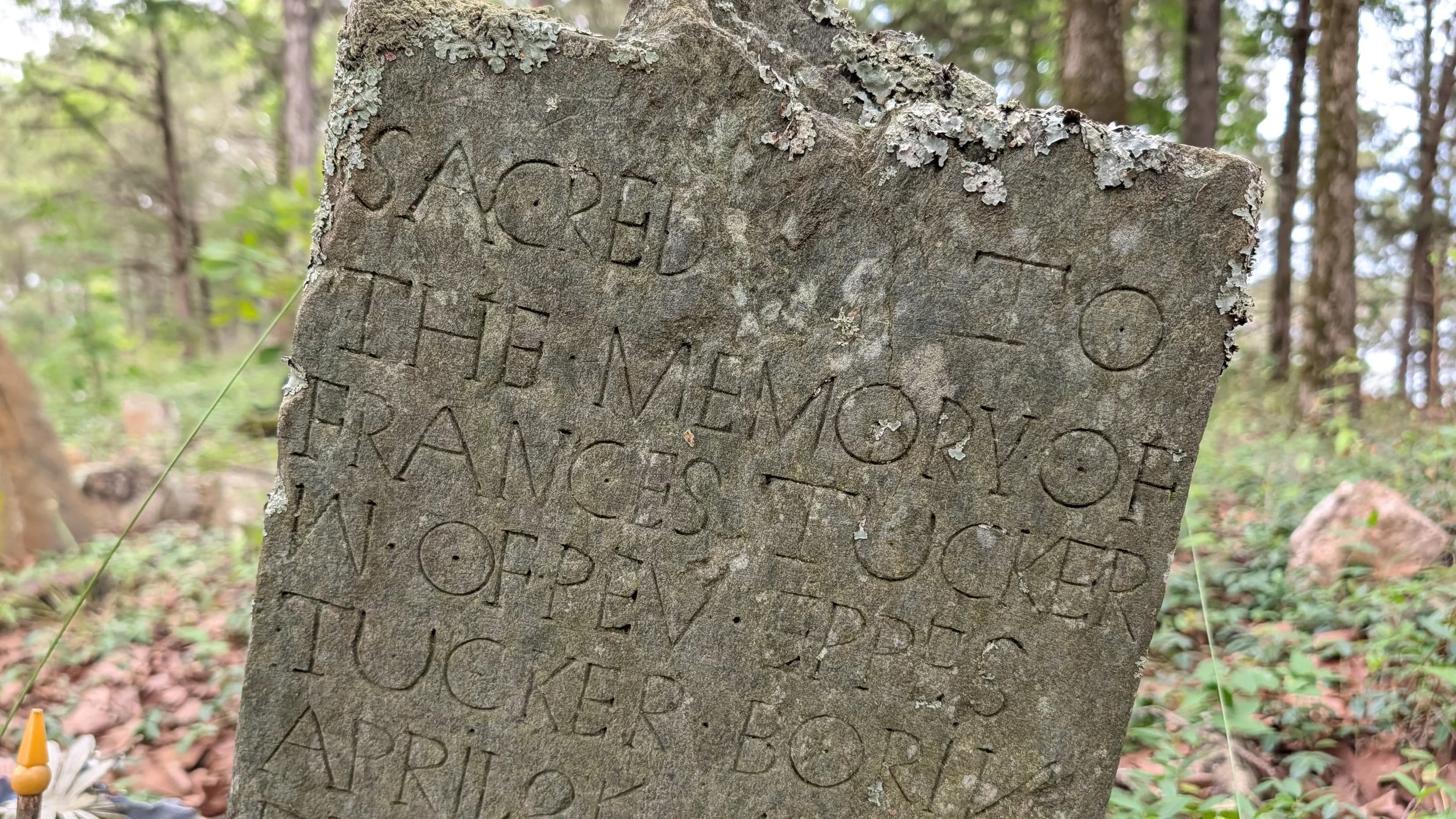
Grave of Frances Epps Tucker
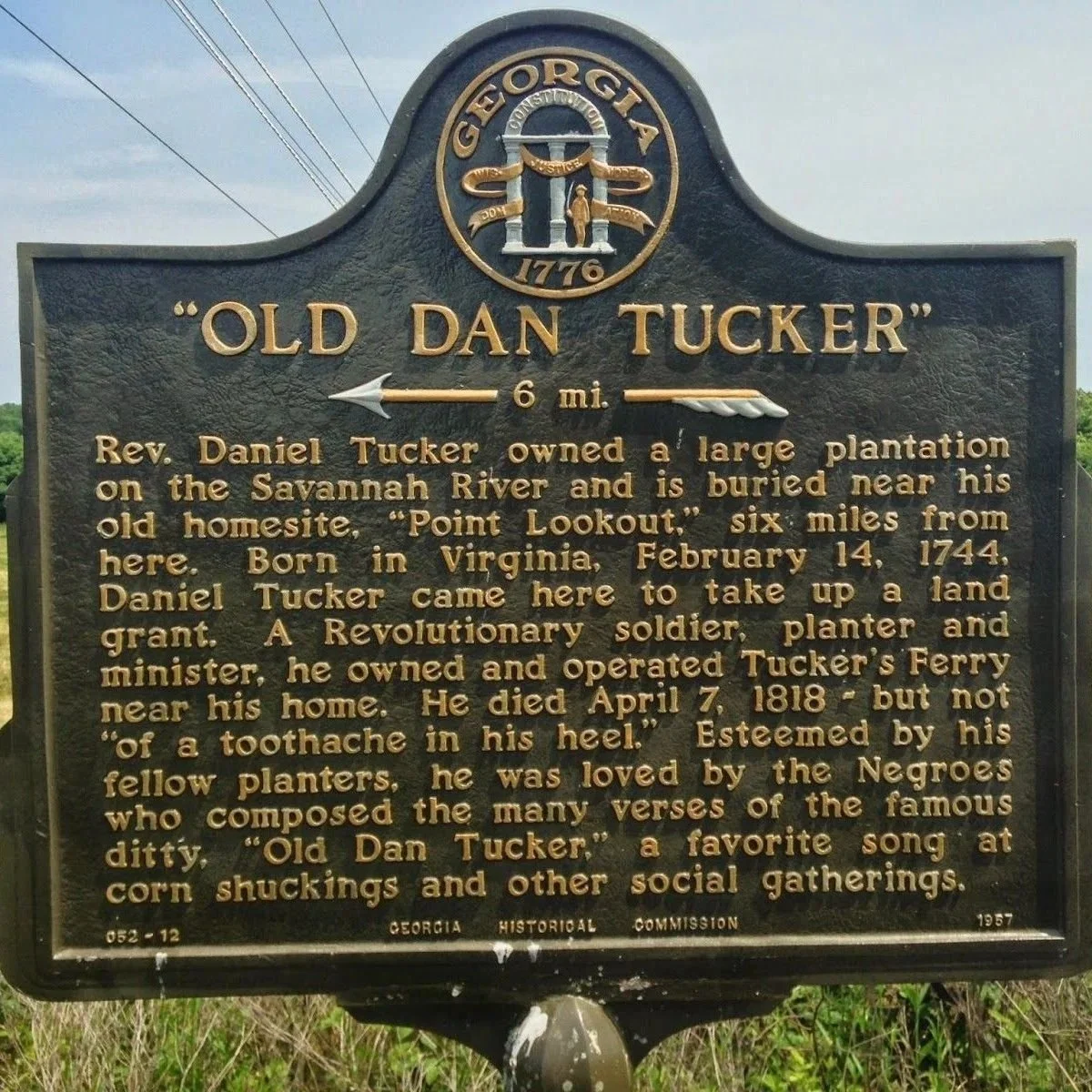
The Savannah River that runs past his grave looks different today than it did in 1818 when Daniel was buried. The construction of the Richard B. Russell Dam in the 1980s flooded much of the surrounding bottomland, and the Tucker Cemetery now sits on a quiet hill overlooking Richard B. Russell Lake rather than the free-flowing river Tucker would have known. A Georgia Historical Marker was erected at the site in 1957, although I couldn't find it at the site it originally stood. But today, a granite trail marker on Pearl Mill Road points visitors (like me) down the gravel road and along a half-mile forest path to the small family cemetery.
'Old Dan Tucker,' The Song
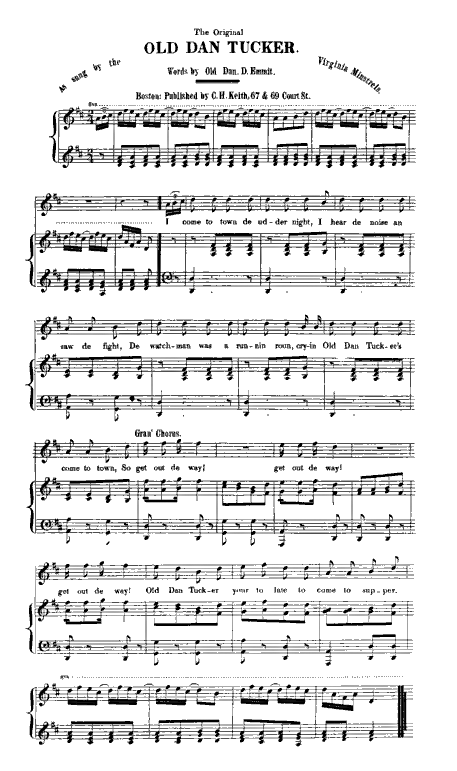
None of this story was particularly special on its own, until I learned that what made his grave a tourist destination is the song: "Old Dan Tucker," one of the most widely sung pieces of American folk music at one point and still played today at square dances and bluegrass jams across the country.
There is debate about the origin and meaning behind the song but records show that "Old Dan Tucker" first appeared in in late 1842 and early 1843, when performer Dan Emmett began including a character by that name in his act. The song was popularized by Emmett's blackface minstrel troupe, called the Virginia Minstrels, and published as sheet music later that year. Music historians today describe the song's actual origins as genuinely obscure: the tune may descend from older oral tradition, the words may be Emmett's own, and some verses appear to borrow from an earlier minstrel number. What is well documented is that the song was written for the blackface minstrel stage, performed in an exaggerated dialect meant to caricature Black speech, and built around a boastful, comic stage character rather than the real person, Daniel Tucker.
In 1965, a story was featured in a Georgia Magazine article by Herbert Wilcox titled "'Old Dan Tucker Was a Grand Old Man': And He Really Lived in Elbert County in the Good Old Days," which claimed that the song had actually been written by the people Tucker enslaved, composed by them out of genuine fondness. This telling was relayed by Mrs. Guy Rucker, said to be the great-great-granddaughter of one of Tucker's neighbors.
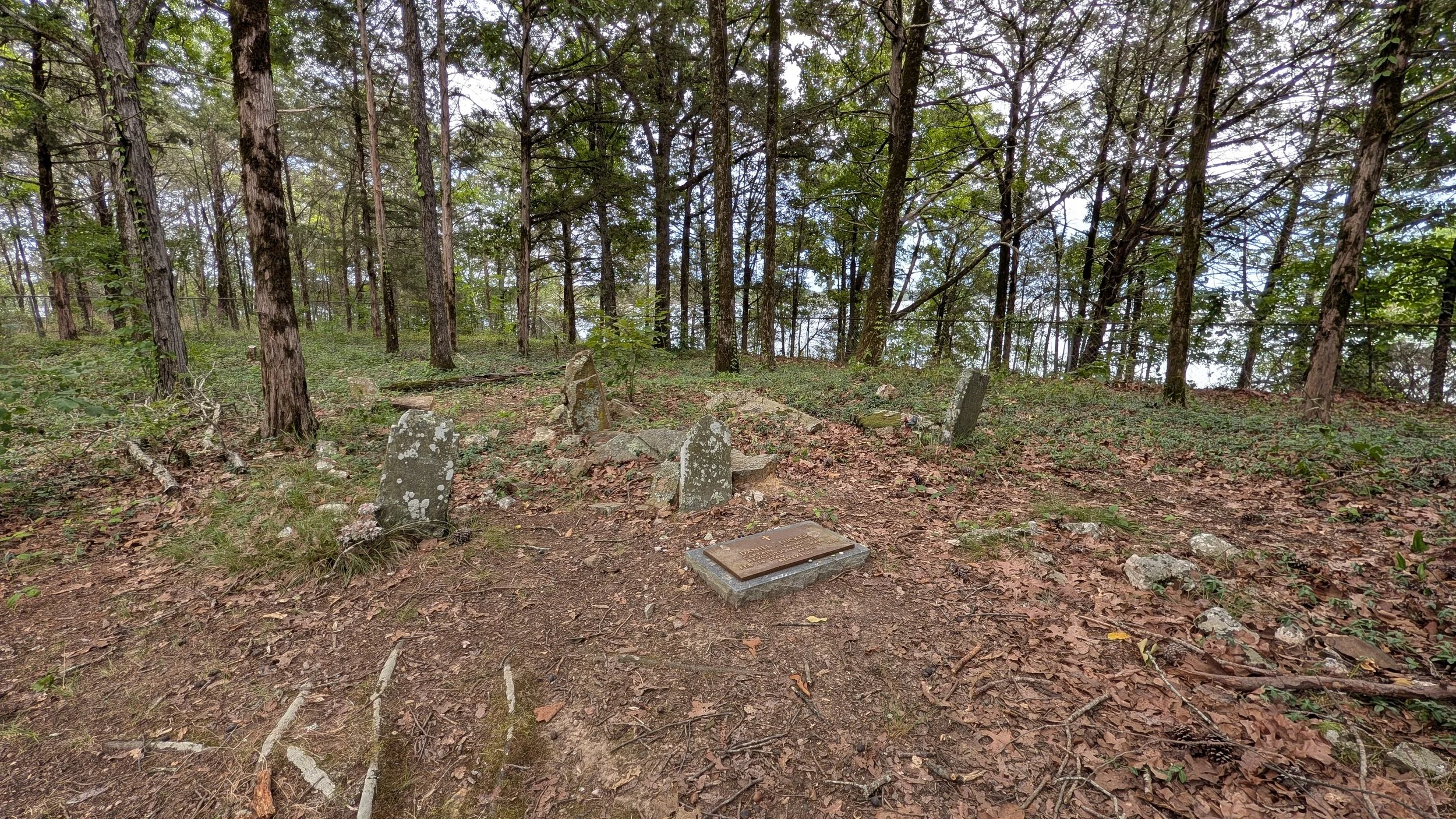
The family cemetery of Rev. Daniel Tucker.
What's Left Behind
Whatever the truth of the song, Daniel Tucker's own record stands on its own: a Virginia-born militiaman who served through the Revolution, who built a working farm and ferry on the Georgia frontier, who ministered as a Methodist preacher, and who, like so many of his neighbors, built that life on the backs of enslaved labor. He is buried today in a quiet cemetery above a lake that did not exist in his lifetime, visited by people who come looking for a folk song and find, instead, a more complicated story waiting for them.
This project is made possible by readers like you.
Your support helps to pay for website costs, gas to travel to these sites, and cleaning supplies for the veteran stones that I’m working to restore.
If you believe this work is important, your support is so appreciated!
Citations
DAR Genealogical Research System, Ancestor #A116608
Find a Grave Memorial #9884, Tucker Cemetery, Heardmont, Elbert County, Georgia
Brian Brown, "Dan Tucker's Grave, Elbert County," Vanishing Georgia (vanishinggeorgia.com)
Wilcox, Herbert. "'Old Dan Tucker Was a Grand Old Man': And He Really Lived in Elbert County in the Good Old Days." Georgia Magazine, Vol. VIII, No. 5, February-March 1965. (Athens Regional Library System, Heritage Room, Athens-Clarke County Library, MSS 010.018)