Gen. Elijah Clarke & Hannah Arrington [20&21/250]
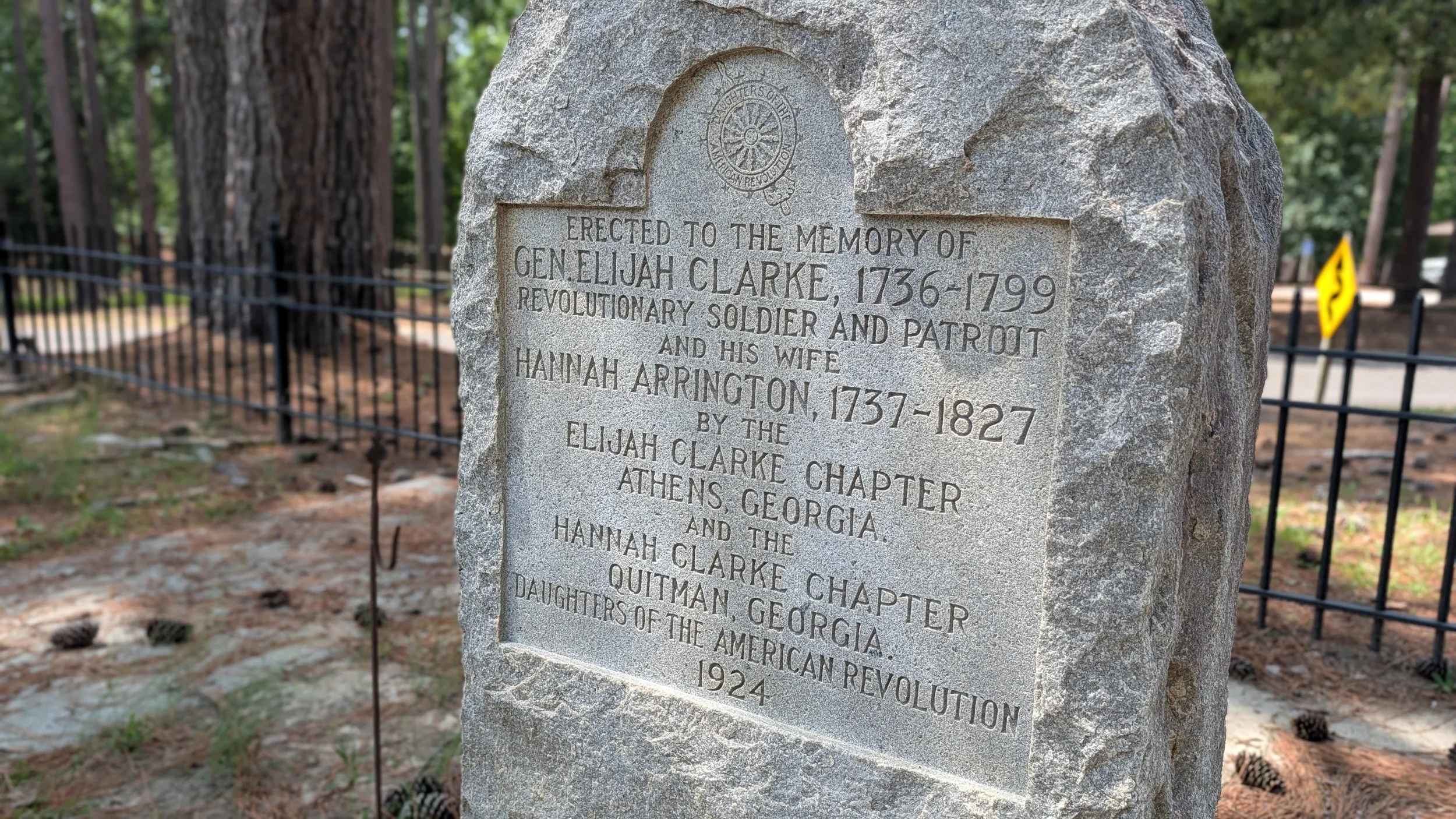
Gen. Elijah Clarke (1733*-1799) and Hannah Arrington Clarke (1737-1827)
Buried at Elijah Clarke Memorial State Park, Lincoln County, Georgia
Elijah Clarke was, by any measure, one of the most important and effective commanders to come out of the Revolutionary War in the South. And his story is a fascinating one of a penniless, illiterate frontiersman, who rose to lead the men who turned the tide in Georgia at one of the darkest moments of the war, when it looked like the Patriot cause might be lost in Georgia.
He survived at least six battle wounds and two near-fatal illnesses without ever stepping back from the fight, and at one point led hundreds of refugee families, soldiers, and civilians, enslaved and free, on a desperate winter march through Cherokee territory and into the mountains rather than surrender to the British and their Loyalist allies. Later in life, his own frontier ambitions would complicate the picture of who he was. But in the context of the war itself, Clarke belongs in the same conversation as better-known partisan leaders of the Southern campaign, men like Francis Marion and Thomas Sumter, even though few people outside of Georgia have heard his name today.
I'll be honest with you. I hadn't heard of him either, not until I started this project this year, and I knew very little about the Battle of Kettle Creek, the fight that made him famous. That gap in my own knowledge is, in a lot of ways, the whole reason this project exists, because I'm guessing many people don't know about these figures, the very ones who got us to where we are today.
It was the hottest day I could remember when I finally stood at his grave, heat rising off the asphalt and cooking me from below. The whole place was wrapped in a damp haze and a blanket of no-see-ums, thanks to the humidity that rolls in off the Savannah River. This is a particular flavor of Southern heat that you simply cannot understand from a description alone. You have to stand (and sweat) in it. I stood in it that day, at the edge of a small fenced cemetery just inside Elijah Clark Memorial State Park, bugs flying into my eyes and nose while I tried to read a granite stone, grateful, genuinely, that this project had given me a reason to be there at all. And grateful that I get to share his story with you. Because once you start pulling on the thread of Elijah Clarke, you find a tale that deserves to be retold.
Early Life on the Frontier
Elijah Clarke's birth year is genuinely up for debate. Many sources list 1733 as the date of his birth, while his own memorial stone says 1736. Another account says he was born in 1742, and since no one can agree on which date is correct, I'll just leave the debate here for you to ponder. What we do know is that he was likely born in Edgecombe County, North Carolina, the son of a backcountry settler named John Clarke. Elijah grew up in a household full of siblings, with no formal education. Histories mention that as a young man, he grew up loving the woods and the freedom of hunting and frontier life. His daughter later described him as handsome, well over six feet tall, with blue eyes and sandy or chestnut hair.
In 1763 (or 1765), he married Hannah Arrington (spelling Harrington in one record), but by the early 1770s, Elijah and Hannah had moved their young family to the Pacolet River area of northwest South Carolina, likely settling on land that had belonged to his father. He didn't stay there long, as one account has it that South Carolina's soil didn't suit him for farming. Around 1773, they pushed on again, this time into Georgia's newly opened "Ceded Lands," which was the frontier territory that would become Wilkes County and, eventually, Clarke County, the county that bears his own name. He and Hannah Arrington Clarke arrived with four children but, notably, no enslaved people of their own. They borrowed money from a Loyalist trader named Thomas Waters just to make the down payment on a modest 150-acre tract. That detail will come back later in this story, because the man Clarke borrowed from would eventually lose everything to him.
Ironically, the man who would become one of Georgia's fiercest rebel commanders started his public life in 1774 by signing a petition in support of the king's government, one signature among many prominent backcountry Georgians at the time. But over time, that support of the king faded, and within a couple of years, war had found Elijah and made him into someone else entirely.
Becoming a Soldier
Clarke's military career started small and local, like many who served on the frontier. By 1776, he was a militia captain, and that July, he was leading a wagon supply train on the Broad River for an expedition against the Cherokee when his party was attacked. He and his men drove the attackers off, but Clarke and three others were wounded, and three of his men were killed. The following year, he was leading militia against Creek raiding parties in the brand new county of Wilkes.
In 1778, Georgia organized two "Minute Man" battalions, and Clarke was commissioned a lieutenant colonel. That June, during a Georgia invasion of British East Florida, he was shot and carried off the field at the Battle of Alligator Creek. It was one of at least six battle wounds he would survive over the course of the war, on top of bouts of smallpox and mumps that somehow didn't kill him either. By the end of 1778, the war had arrived in Georgia in a much bigger way, and within weeks, Clarke would have his moment at the Battle of Kettle Creek.
The Battle of Kettle Creek, and What It Meant
To understand why Kettle Creek mattered, we need to look at how badly the war was going for the American cause in the South at the end of 1778. The British had largely given up on the northern colonies as a lost cause and pivoted to what historians now call the "Southern Strategy," the idea that Georgia and the Carolinas, with their large Loyalist populations, could be pulled away from the rebellion, one colony at a time. On December 29, 1778, British forces captured Savannah. By the end of January 1779, they held Augusta as well, and Loyalist militia were flooding into the backcountry to enlist, by some estimates, 1,400 men in a matter of weeks. For a brief moment, it looked like Georgia might simply fall back under royal control with hardly a fight.
A large column of these newly enlisted Loyalists, several hundred strong and marching under Colonel John Boyd, set out from the Carolinas to join the British garrison at Augusta. If they had made it, the British position in the Georgia backcountry would have been formidable. But thankfully for the Patriot cause, they didn't make it.
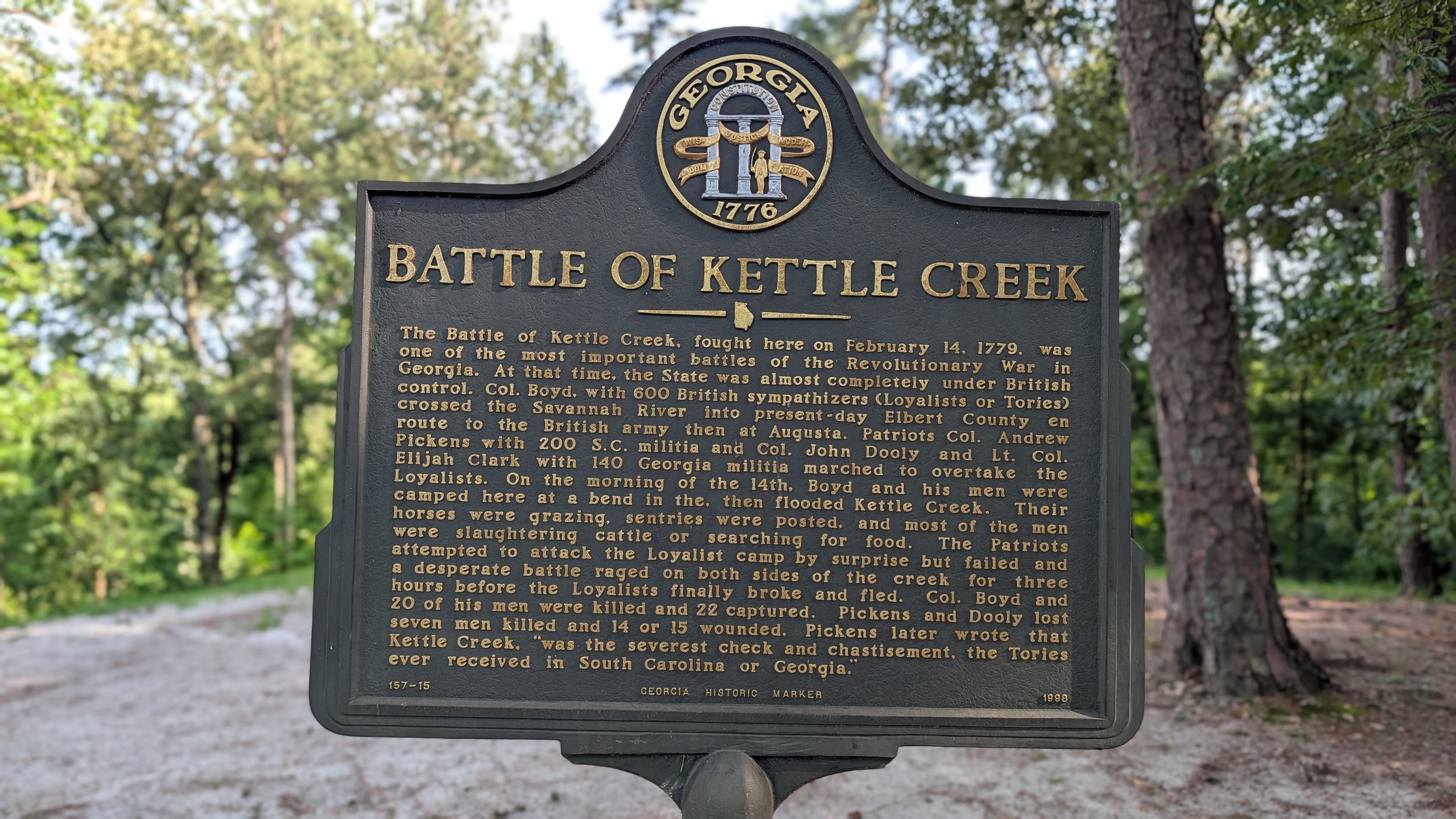
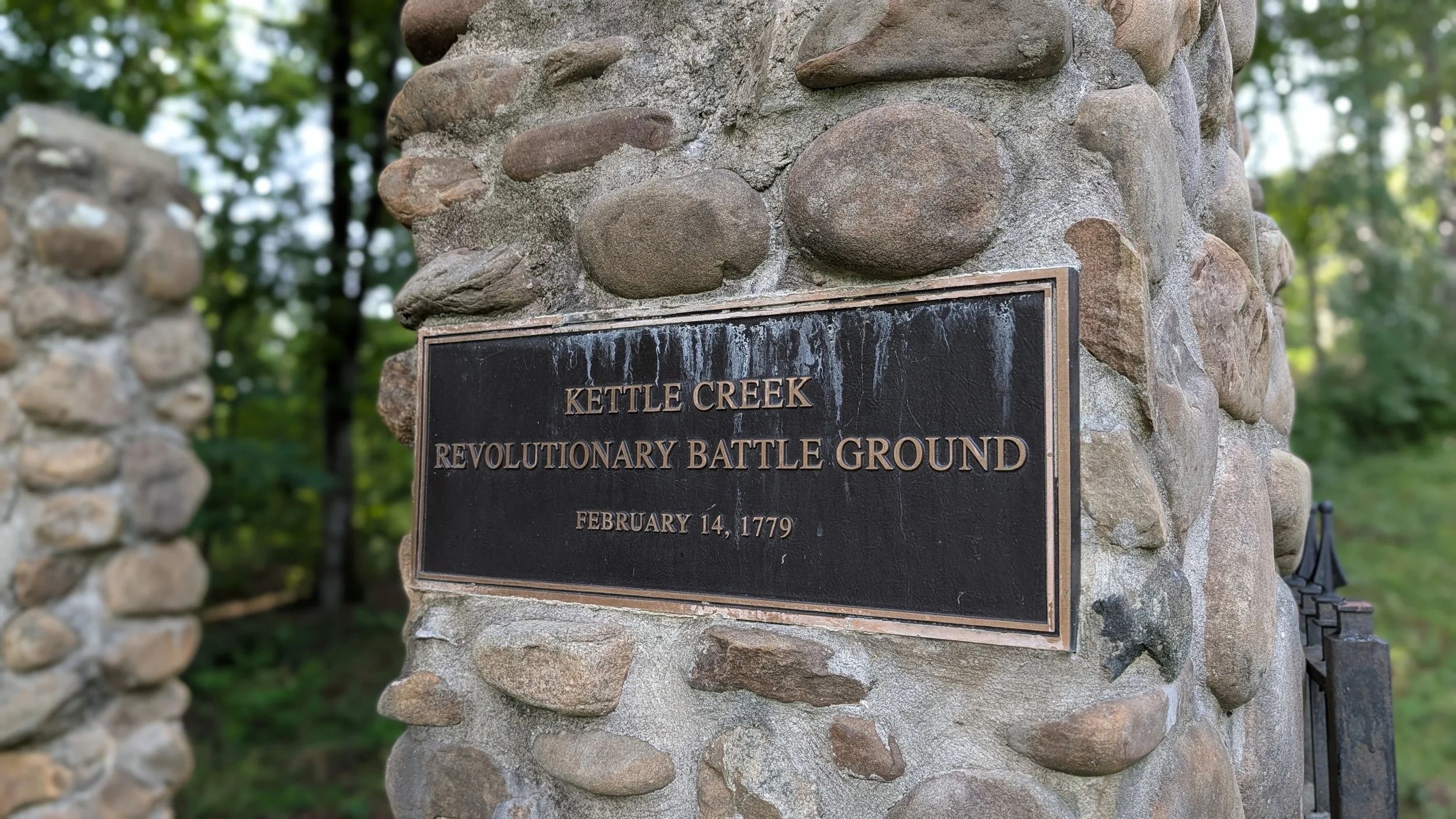
On February 14, 1779, this Loyalist column was caught by a combined force of South Carolina militia under Colonel Andrew Pickens and Georgia militia under Colonels John Dooly and Elijah Clarke at a spot called Kettle Creek in Wilkes County, Georgia, not far from the present-day town of Washington, Georgia. Elijah Clarke commanded the left wing of the Patriot line. In the fighting, he had a horse shot out from under him and personally led a charge across a swamp and up a hill into the heart of the Loyalist position. The Loyalists broke, and their colonel, John Boyd, was killed.
I'm going to leave the full version of this story for a separate post down the road, because it deserves its own telling. But here's why it mattered in the moment. Kettle Creek didn't just win a skirmish; it broke the momentum of Loyalist recruiting in the Georgia backcountry almost overnight. Men who had been lining up to join the king's militia suddenly had a much harder time believing the British could protect them out in the countryside. For an American cause that had just lost a major Southern city without much of a fight, Kettle Creek was proof that the backcountry militia could stand toe to toe with organized Loyalist forces and win. It's one of the battles historians point to, alongside Kings Mountain and Cowpens a year or two later, as evidence that the Southern Strategy was never going to be the easy victory the British expected.
Kettle Creek created Elijah Clarke's reputation, and as a result, he was promoted to colonel not long after the battle. From here forward, his name is all over the Southern campaign of the American Revolution.
Into the Tennessee Wilderness
The British weren't finished with Georgia, though, and 1780 turned into one of the hardest years of Clarke's life. Charleston fell to the British that May, and most of South Carolina went with it. Clarke and a small band of about thirty followers crossed the Savannah River into South Carolina to keep fighting, while inflicting real damage on Loyalist forces at places like Musgrove Mill and Wofford's Iron Works, picking up more wounds along the way at Fort Thicketty and Musgrove Mill itself.
In September 1780, Clarke gathered around 400 men and attacked the British garrison at Augusta under the Loyalist command of Thomas Brown. Brown was wounded early but held out in a fortified trading post, and a relief column arrived in time to drive Clarke's men off. It was a costly failure. The Loyalist troops hanged or handed over wounded patriots to their Creek allies for torture and execution. The Loyalist militia was set loose on Wilkes County itself, burning the courthouse, dozens of forts, and more than a hundred homes in retaliation for the raid.
What followed is one of the more fascinating chapters of Clarke's story, and one I think deserves more attention than it usually gets. Somewhere between 400 and 700 people, men, women, children, enslaved and free, followed Elijah Clarke out of Wilkes County rather than stay and face Loyalist reprisal. They fled through Cherokee territory and over the mountains in the dead of winter with almost no provisions, reaching safety in what is now Tennessee after roughly two weeks on the move. Clarke's own wife, Hannah, had a horse shot out from under her while fleeing with two small children clinging to her back. Twice during this period, Clarke received false reports that his family had been killed. Reading about this part of his life reminds us of the weight of what war looked like for ordinary families on the Georgia frontier, regardless of which side they were on.
Clarke himself wasn't present for everything that followed in late 1780, as he was recovering from near-fatal wounds suffered at the Battle of Blackstock's (South Carolina) that November. The following month, his own Wilkes County men, fighting without him, helped deliver a crushing blow to Loyalist forces at Hammond's Store. His fighters also served as scouts ahead of Daniel Morgan's army in the lead-up to the American victory at Cowpens in January 1781, one of the turning points of the Southern war, even though Clarke wasn't there in person.
Coming Home to Augusta
By May and June of 1781, Clarke was back leading Georgia troops in the long, grinding campaign to finally retake Augusta. It was trench warfare, which was slow and miserable, and not the kind of fighting his restless frontiersmen were built for. In the end, Thomas Brown surrendered not to Clarke but to the higher-ranking Continental officers, "Lighthorse" Henry Lee and Andrew Pickens. Augusta came back into American hands, and Clarke had played a central role in getting it there.
For his wartime service, Georgia rewarded Clarke with the plantation of Thomas Waters, the very Loyalist who had once lent him the money to buy his first 150 acres there. North Carolina chipped in a gratuity of $30,000 as well in recognition for his service in the war. In 1781, he was made colonel of the Wilkes County militia following the murder of his old commander, John Dooly, and Elijah would go on to be commissioned brigadier general in 1786 and major general in 1792.
After the Revolution- Clarke's Land Grab
Clarke had a decorated military career, but his contributions to public service didn't end with the war. He served in the Georgia legislature from 1781 to 1790, sat on the commission overseeing confiscated Loyalist estates, and helped write Georgia's 1789 constitution.
The next era of his life is marked by some stories we find uncomfortable today, but are critical to documenting the full, layered stories of the people who shaped our country. We are complicated, multi-dimensional figures now, and so were they. Honoring the full story reminds us how similar humans are, now and then.
Elijah went on to become one of Georgia's go-to commissioners for negotiating treaties with Native nations, leading militia campaigns against the Cherokee and Creek tribes to secure their land for incoming settlers, during an era when many Georgians saw the acquisition of Native land as "the great object of the revolution." They needed more land, and removing the Natives was the solution they pursued.
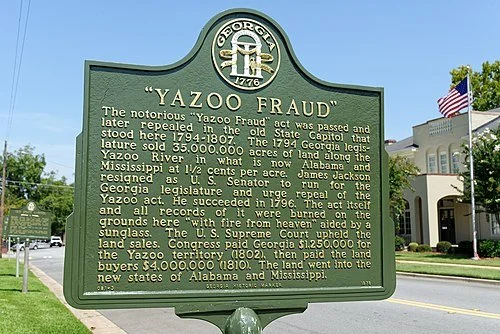
Land became something of an obsession for Clarke in these years, and not always through clean means. He accumulated thousands of acres through grants, some obtained by methods that many historians now feel were questionable, including his involvement as an investor in the infamous Yazoo Land Fraud of the 1790s, a scheme in which a bribed Georgia legislature sold 35 million acres of western land, in present-day Alabama and Mississippi, to four companies for a fraction of its worth. The fraud was so blatant that the Georgia legislature itself voided the sale within a year, though it took the U.S. Supreme Court until 1810 to fully sort out the mess.
Then there's the Trans-Oconee Republic, maybe the strangest chapter of Clarke's life. Frustrated that neither the state nor the new federal government could secure the frontier the way he wanted, Clarke resigned his militia commission in 1794, briefly considered leading a French-sponsored invasion of Spanish Florida (a scheme President Washington personally shut down), and then simply marched his own followers and their families across the Oconee River onto land that belonged to the Creek Nation. They built forts, wrote their own constitution, and tried to establish an independent state. Federal pressure eventually forced Georgia's governor to compel Clarke to abandon the whole project, though Clarke remained so popular that nobody ever charged him for it. He tried something similar against Florida again in 1795, with the same result.
By his final years, Clarke had been discredited in some circles, was nearly bankrupt, and reportedly told a friend he would rather live "a hunter's life in the bleak mountains" than stay among the people who had settled in his frontier Georgia. He died in Augusta on December 5, 1799, while still trying to untangle his finances.
Buried Thrice
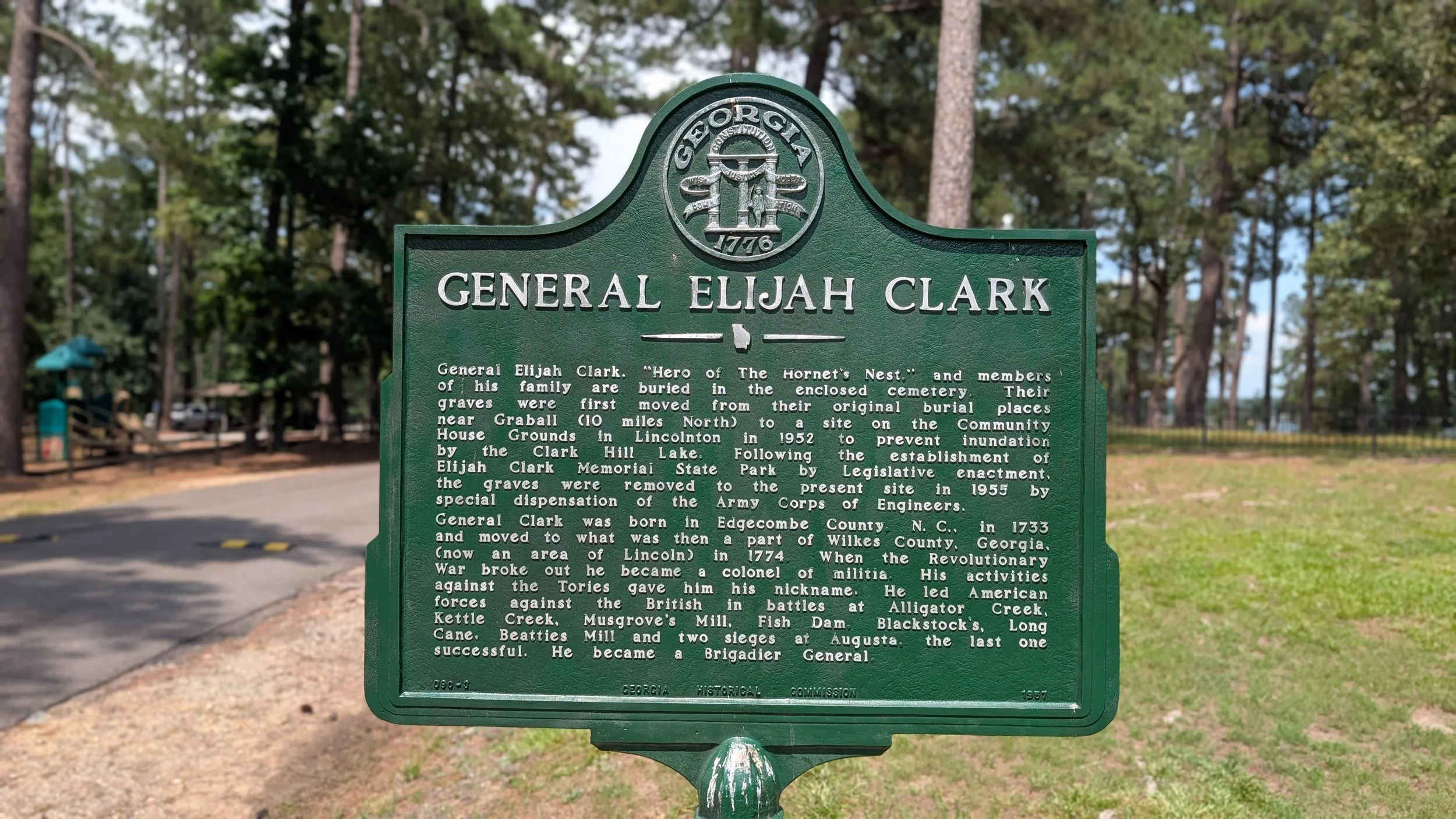
Here's where his story takes another interesting turn. After his death, records indicate that Clarke (and members of his family) were originally buried near a community called Graball, Georgia, about 10 miles north of present-day Lincolnton, Georgia. There they rested for over a century, until the 1950s, when the Army Corps of Engineers dammed the Savannah River to create what was then called Clarks Hill Lake (today J. Strom Thurmond Lake).
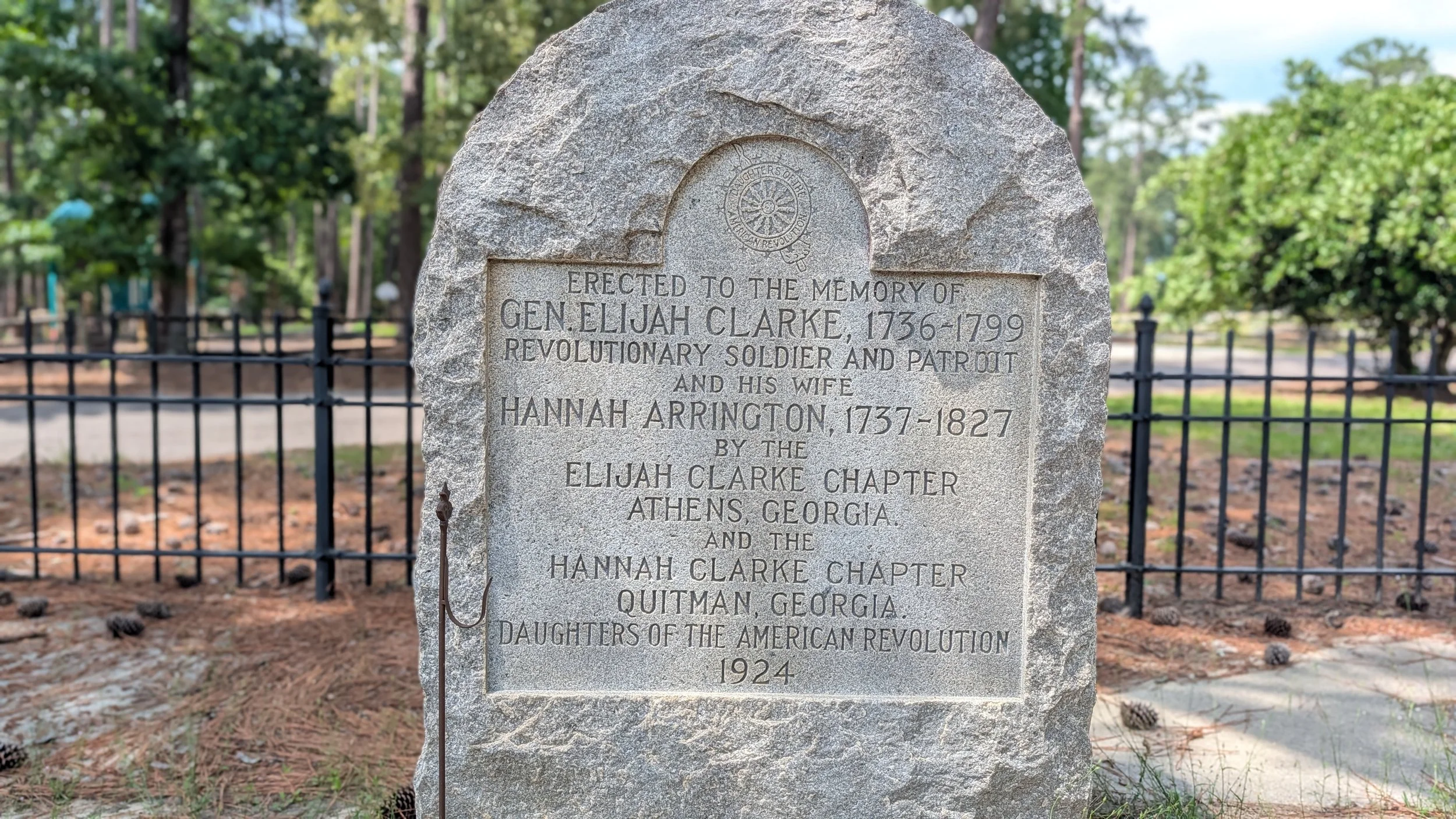
In 1952, the graves were moved to the Community House grounds in Lincolnton, Georgia, to save them from the rising water. Then, once the Georgia legislature established Elijah Clark Memorial State Park, the graves were moved a second time, in 1955, by special arrangement with the Corps of Engineers, to the small fenced cemetery where you can still visit today.
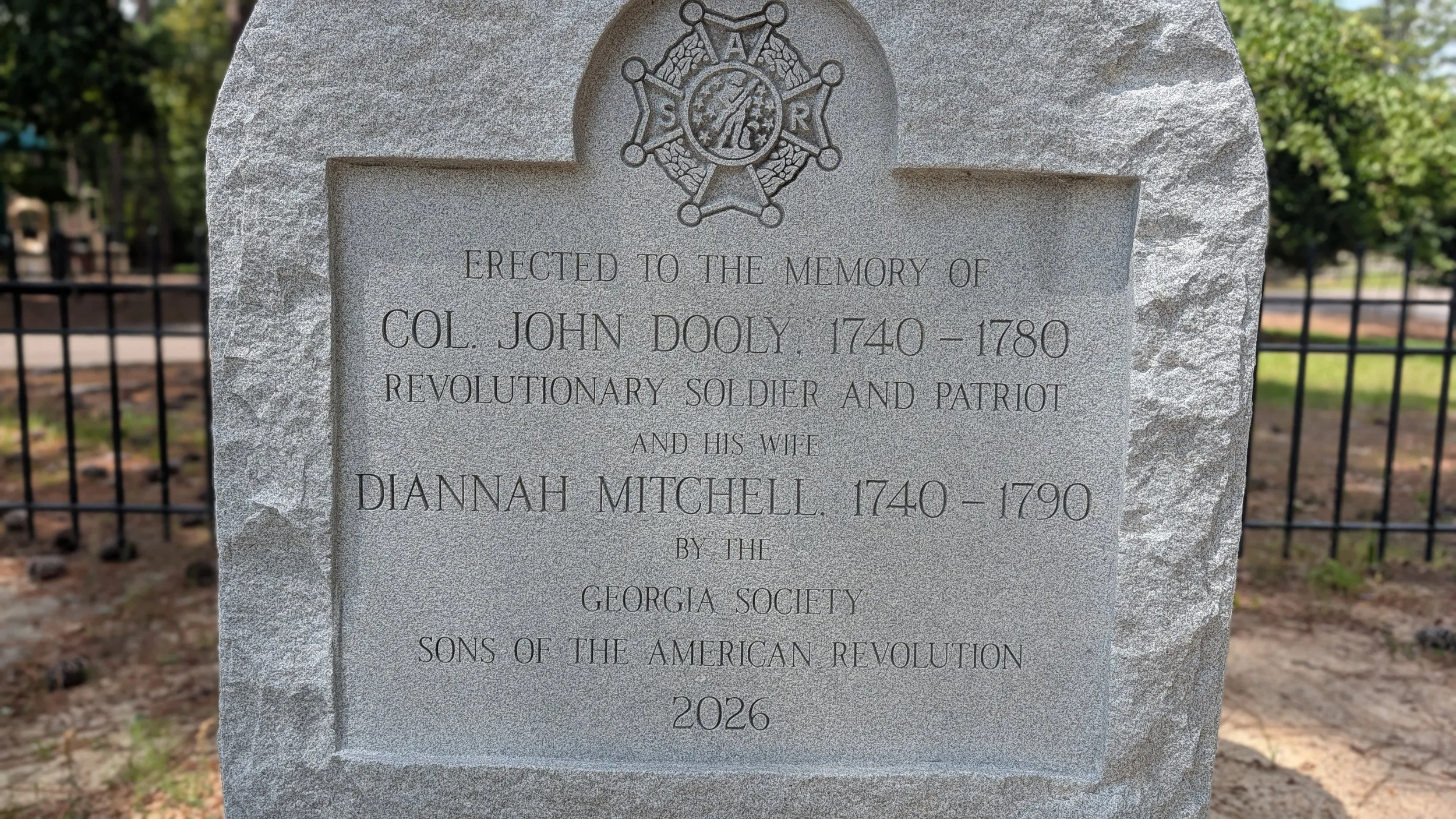
I found it a little ironic that the state park bearing his name isn't actually built on land that ever belonged to Clarke himself. The property where he rests sits on what had been the property of his old commanding officer, Colonel John Dooly, who was murdered by Loyalists in 1780.
After the war, the state assembly actually ordered Clarke to evict Dooly's widow and orphaned children from this same land in a dispute over title. Generations later, his memorial would rise on the very ground his old friend's family was forced off. In 2026, fittingly, the Sons of the American Revolution dedicated a new cenotaph for Colonel Dooly right beside Clarke's grave, a small gesture of historical justice that I happened to catch as I visited just a few months after the installation of the marker.
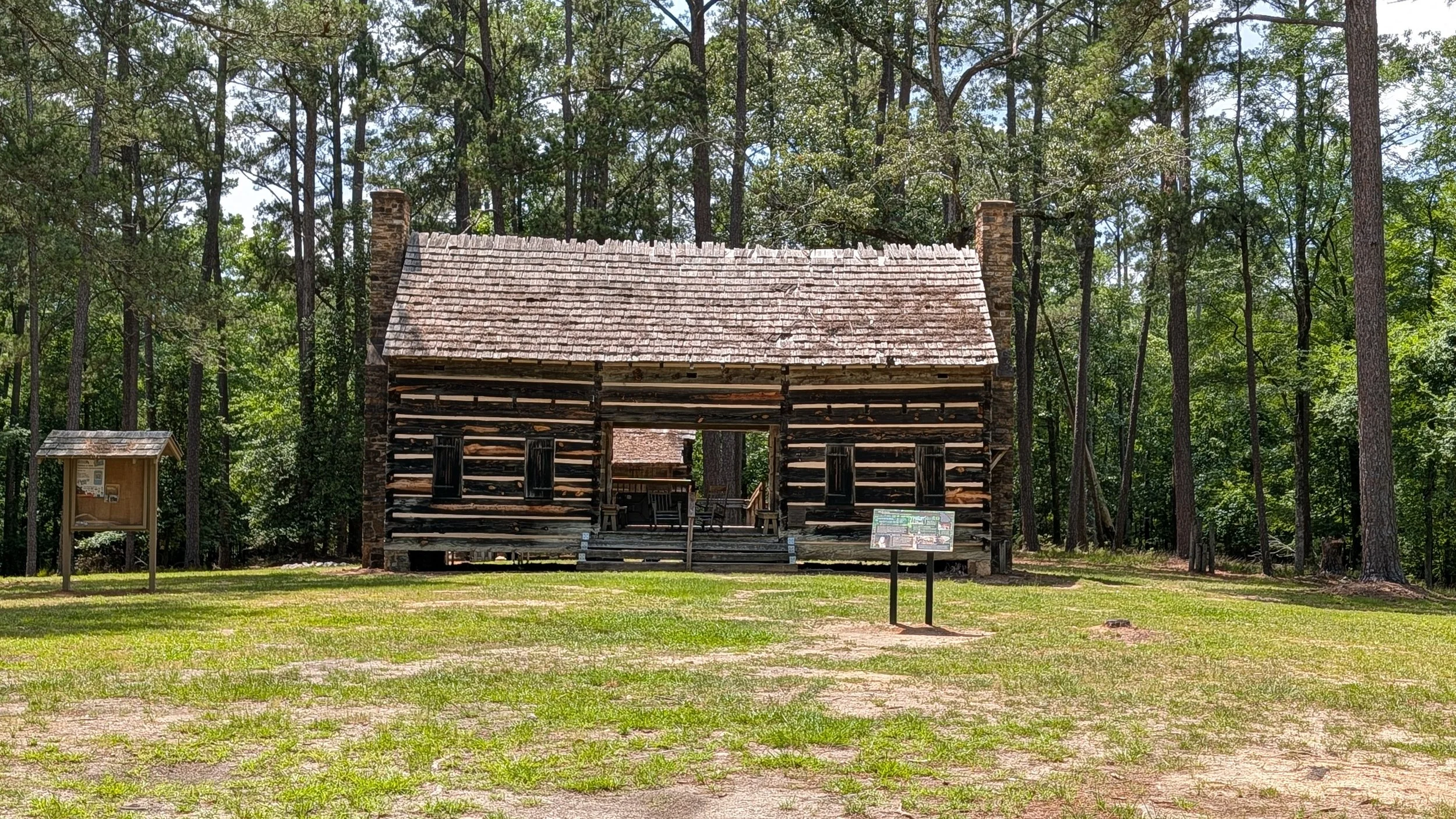
A Dogtrot Cabin on the Savannah River
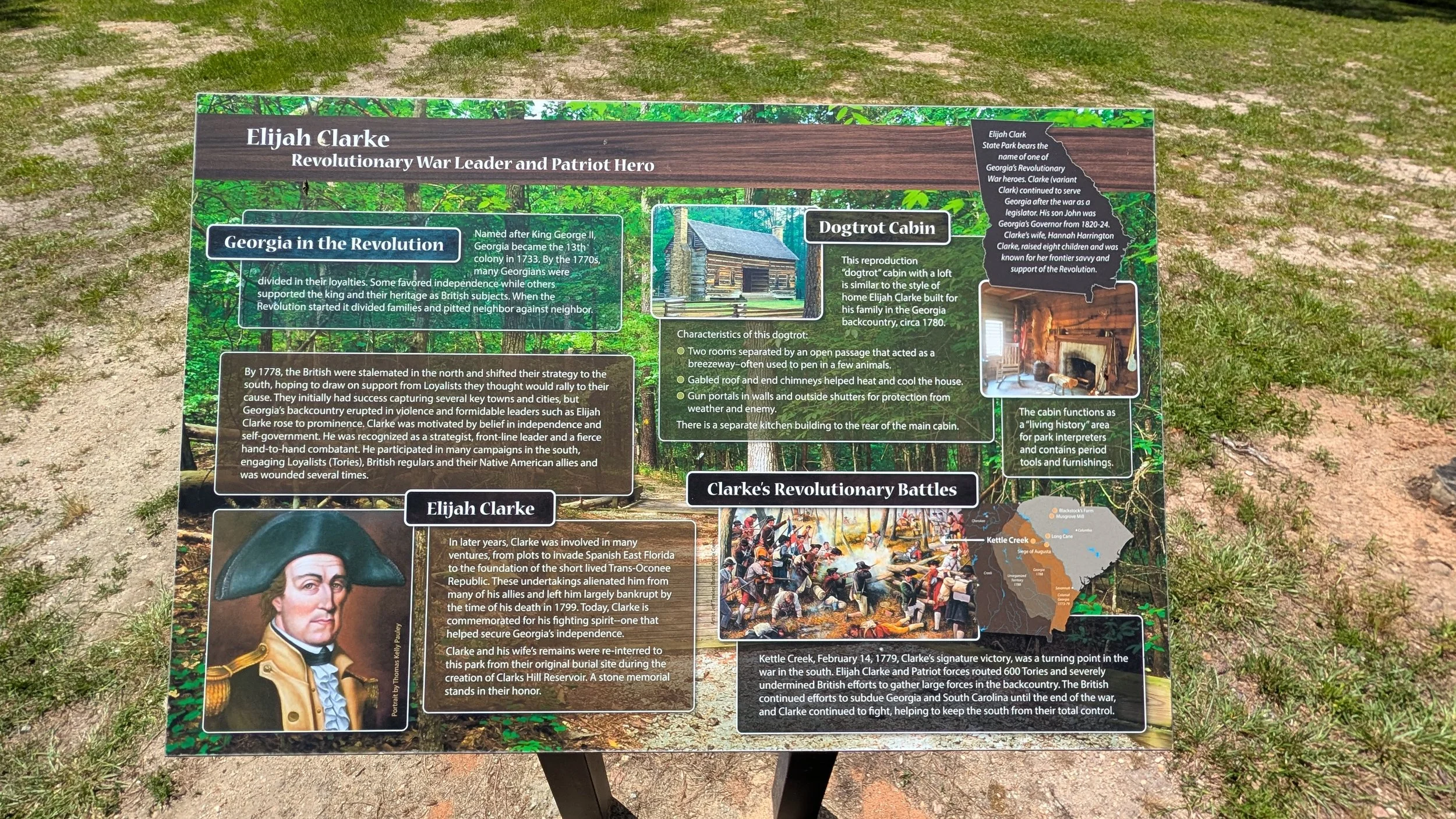
A short walk from the Clarke cemetery sits a log cabin, and while it's not their exact home, it was restored and furnished to represent the kind of frontier home the Clarke family would have lived in. It now serves as a park museum. This was a recreation built from family descriptions of the original dwelling rather than the literal house Clarke himself lived in, since that original homestead, like his original grave, would have been lost beneath the rising waters of the Savannah River when it was dammed in the 1950s.
This was the first Revolutionary grave I've come across in this whole project where the patriot's homestead has been preserved, or in this case, recreated, right alongside the grave itself. What a treat that was, to be able to walk from the cabin to the cemetery, a couple of hundred feet away.
It's worth pausing on the location itself, too. The Savannah River wasn't just scenery for Clarke's family; it was the entire reason this stretch of frontier existed the way it did. The river formed the boundary between Georgia and South Carolina, and Clarke, ever the partisan commander, crossed it constantly during the war, slipping his band of fighters back and forth between the Georgia and South Carolina backcountry to strike, retreat, and strike again, using the river corridor the same way his Loyalist enemies tried and largely failed to use it against him. The same river that shaped his wartime strategy is the one that, two centuries later, would force his grave to be moved and his original home to be lost beneath a reservoir.
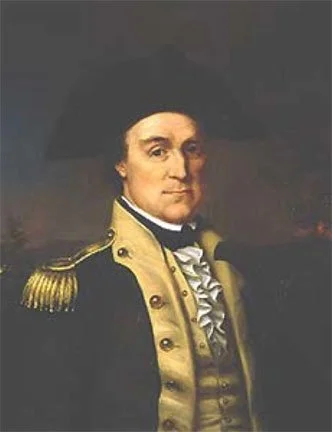
General Elijah Clarke portrait
A Layered Legacy
I try to take an honest look at the real people behind every one of these stories, and Clarke's legacy, like so many others in this series, genuinely doesn't fit in one neat box. He arrived in Georgia with no enslaved people of his own, having borrowed money from a Loyalist just to buy his first small tract of land. But by the time the state rewarded him with Thomas Waters' plantation, that had changed, and Clarke had become a slaveholder, like most prosperous Georgians of his era.
At the same time, there are accounts of him acting in ways that contradict that picture, including accounts of him sending an enslaved girl named Phillis home during a campaign rather than letting his own men claim her as plunder, and personally pushing the Georgia legislature to grant freedom and a pension to Austin Dabney, an enslaved man who served under his command and was wounded in the fighting. This was the first time the American government had taken that kind of action for a Black soldier. One account even has Clarke denouncing slavery as a member of a grand jury. None of that erases that he held people in bondage himself. Both things are true, and I think they belong in the same paragraph rather than separate ones to highlight that our heroes were complicated people.
I don't think any of this means Clarke wasn't, in the context of the Revolutionary War itself, a genuinely effective and courageous commander who survived wound after wound to keep fighting for a cause he believed in. I just think the fuller picture, the land schemes, the broken treaties, the slaveholding alongside the acts of mercy, deserves a place in his story rather than a footnote at the bottom.
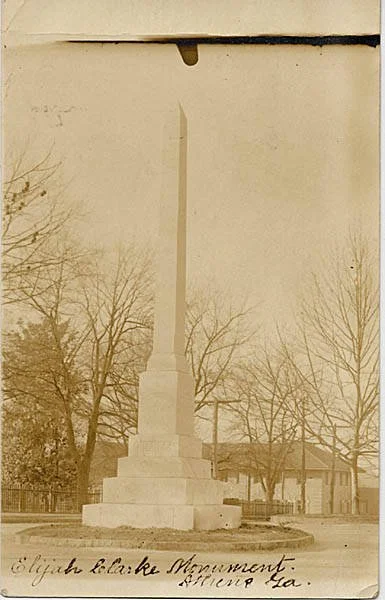
Elijah Clarke memorial in Athens, Georgia
A Note on Austin Dabney
I mentioned Austin Dabney above, and his story deserves far more room than I can include here. He served under Clarke's command, was severely wounded in action, and became, remarkably, the only African American granted land directly by the state of Georgia for Revolutionary War service. Exactly which battle he was wounded in is actually disputed in the historical record, with the popular stories pointing to Kettle Creek, but his own pension file suggests the 1781 fighting around Augusta instead. That kind of discrepancy is exactly the sort of thing I love digging into, so I'm planning to give Austin Dabney his own full entry soon. When I do, I'll link it back here.
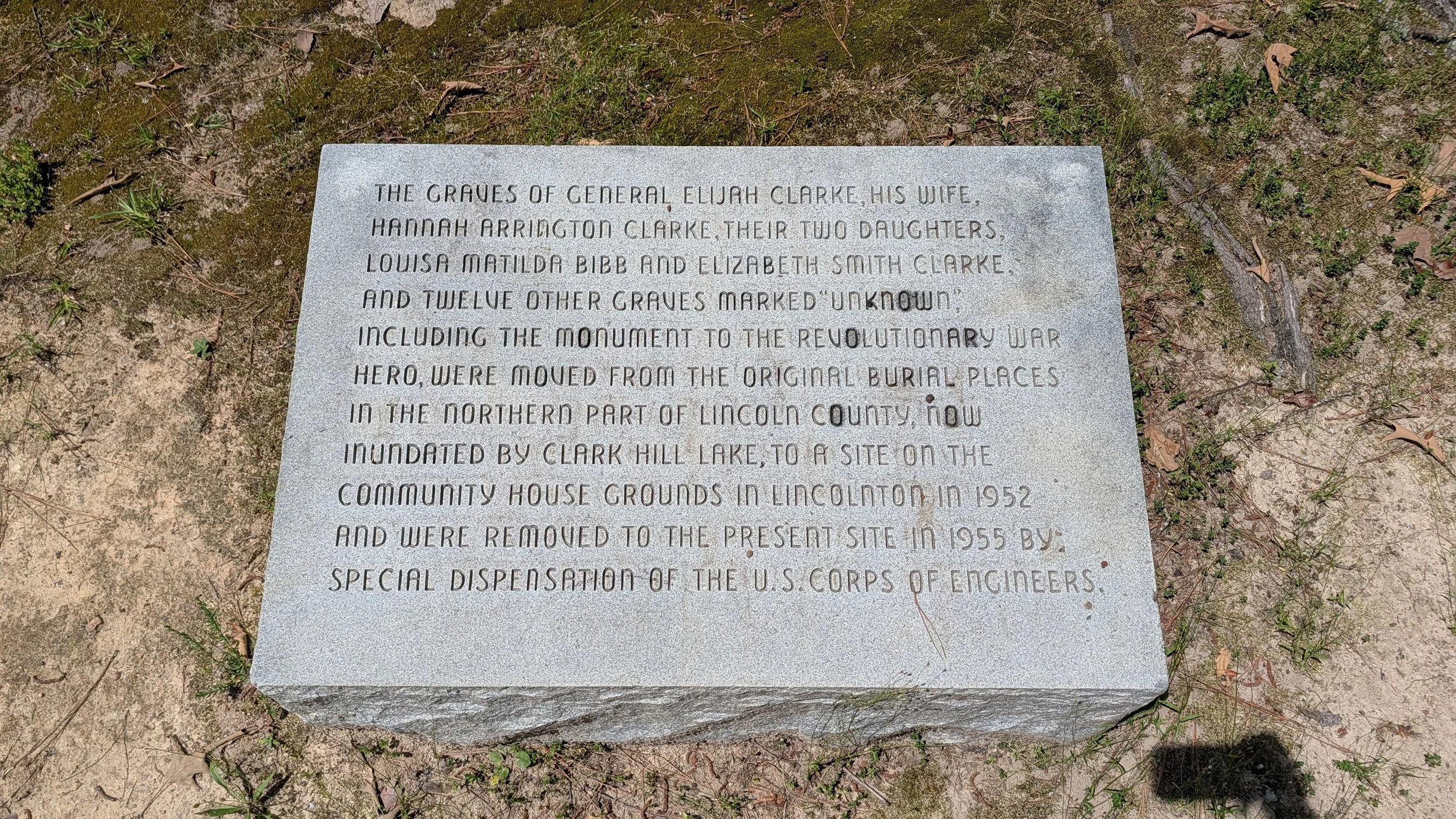
Visiting Elijah & Hannah's Graves
I keep coming back to that heat. Standing at the Clarkes' graves that afternoon, sweating through my shirt with no-see-ums in my ears, I kept thinking about how little I'd known about Elijah a few months earlier, and how many people driving past that state park sign on Highway 378 probably don't know either. That's really the whole reason this project exists. To shed light on the American Revolution through the perspective of individuals who made it possible. The courageous, flawed heroes who laid a path that still connects to us today.
It's worth pausing here on Hannah, too, since she's buried right beside Elijah under that same stone, and these two graves count individually towards this project for good reason. She raised eight children on some of the most contested ground in Revolutionary America, and when Loyalists burned the family out in 1780, Hannah was right there in the chaos of that same flight I described earlier, the one that carried hundreds of refugees into the Tennessee mountains. She had a horse shot out from under her while two small children clung to her back, and somewhere in that same ordeal, word reached Elijah, twice, that his whole family had been killed. Neither report was true, though I can't imagine what those days in between felt like.
She'd lose another horse to outright theft in these same hard years, and yet accounts describe her, not long after, showing kindness to British prisoners taken during the final recapture of Augusta, the same kind of complicated grace under pressure that runs through the stories of many women during the Revolution. Hannah outlived Elijah by nearly three decades, dying in 1827, and today the Hannah Clarke Chapter of the DAR in Quitman, Georgia carries her name forward, right alongside the Elijah Clarke Chapter in Athens that honors his. She earned our acknowledgements as much as her husband.
You can visit their graves at Elijah Clark State Park, 2959 McCormick Highway, Lincolnton, GA 30817
This project is made possible by readers like you.
Your support helps to pay for website costs, gas to travel to these sites, and cleaning supplies for the veteran stones that I’m working to restore.
If you believe this work is important, your support is so appreciated!
Citations
Davis, Robert Scott. "Elijah Clark and the Revolutionary American Frontier." Journal of the American Revolution, March 2025.
Davis, Robert Scott. "Elijah Clarke (1742-1799)." New Georgia Encyclopedia.
Farnham, Thomas J. "Clarke, Elijah." NCpedia, Library of NC.
"Elijah Clarke." American Battlefield Trust.
Find A Grave, memorial #26994641, Gen Elijah Clarke, Elijah Clark State Park, Lincolnton, Lincoln County, GA.
Georgia Revolutionary War Graves database, Person ID I278.
Hays, Louise Frederick. Hero of Hornet's Nest: A History of Elijah Clark, 1733 to 1799. New York: Stratford House, 1946.