Micajah Williamson [23/250]
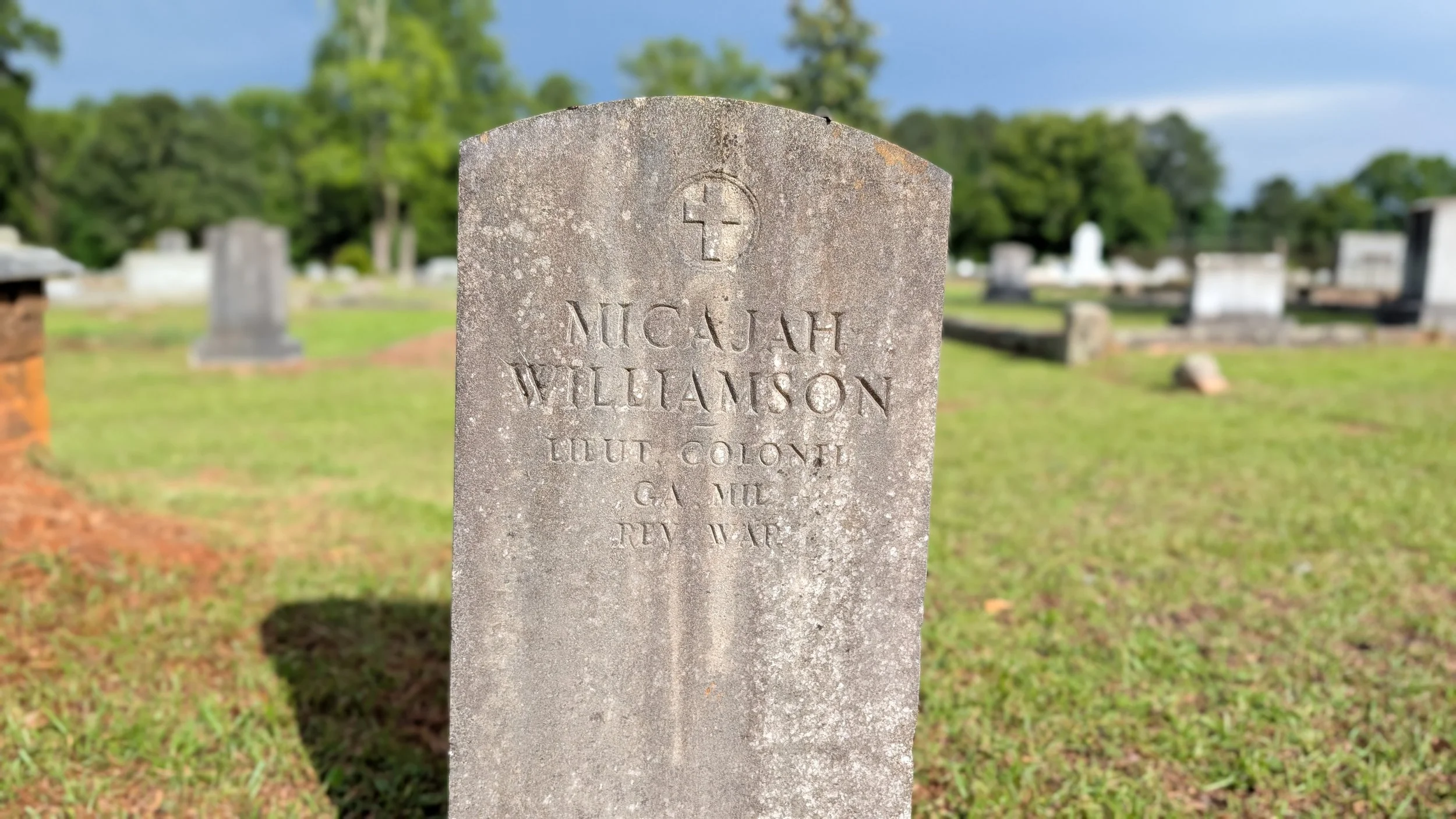
Lieutenant Colonel Micajah Williamson (1744-1796)
Buried at Rest Haven Cemetery, Washington, Georgia
Heroes from the American Revolution are buried all over this part of Georgia, and if you care to pay a visit to these veterans, Micajah Williamson should be high on your list. Many people have never heard his name. I hope to change that.
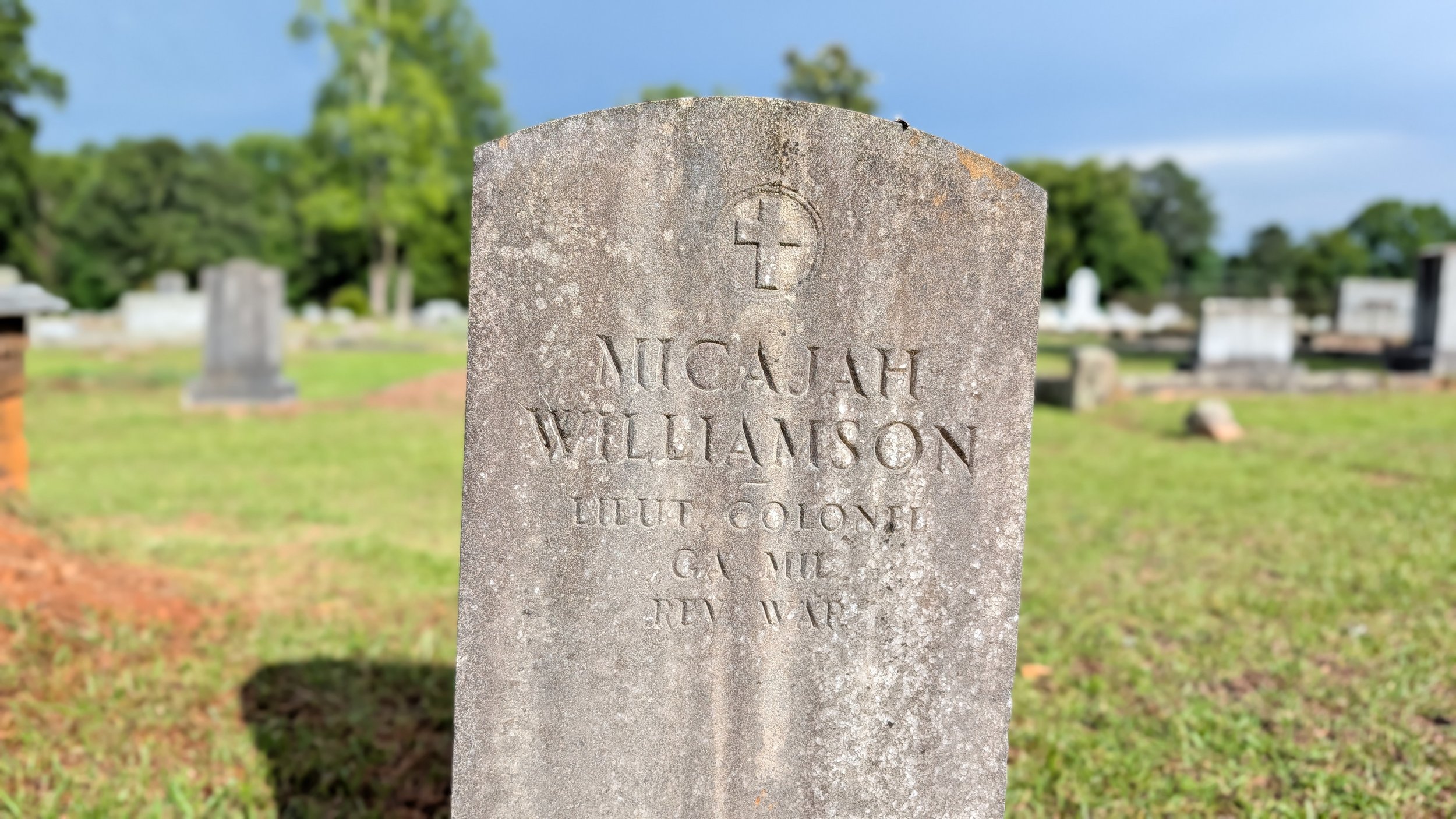
I came looking for Micajah in Washington, Georgia, and found a marker that identifies him plainly: "Micajah Williamson, Lieut. Colonel, Ga. Mil., Rev. War." A simple stone for a man who was anything but.
Washington carries its Revolutionary history just beneath the surface. The streets are lined with old houses, the courthouse square has seen more history than most people realize, and if you know where to look, the founding families are still here, their names carved in stone. Micajah Williamson is buried amongst them, and the people who built this town alongside him.
He was Elijah Clarke's most trusted officer, one of the wealthiest men in upper Georgia before the war, and he spent years fighting across Georgia and the Carolinas in some of the most brutal backcountry combat of the entire Revolution. He helped lay out the town he's buried in. His daughter married the governor. His granddaughter's son sat on the United States Supreme Court. Only so many characters fit on a veteran's stone. I'm glad to fill in the rest.
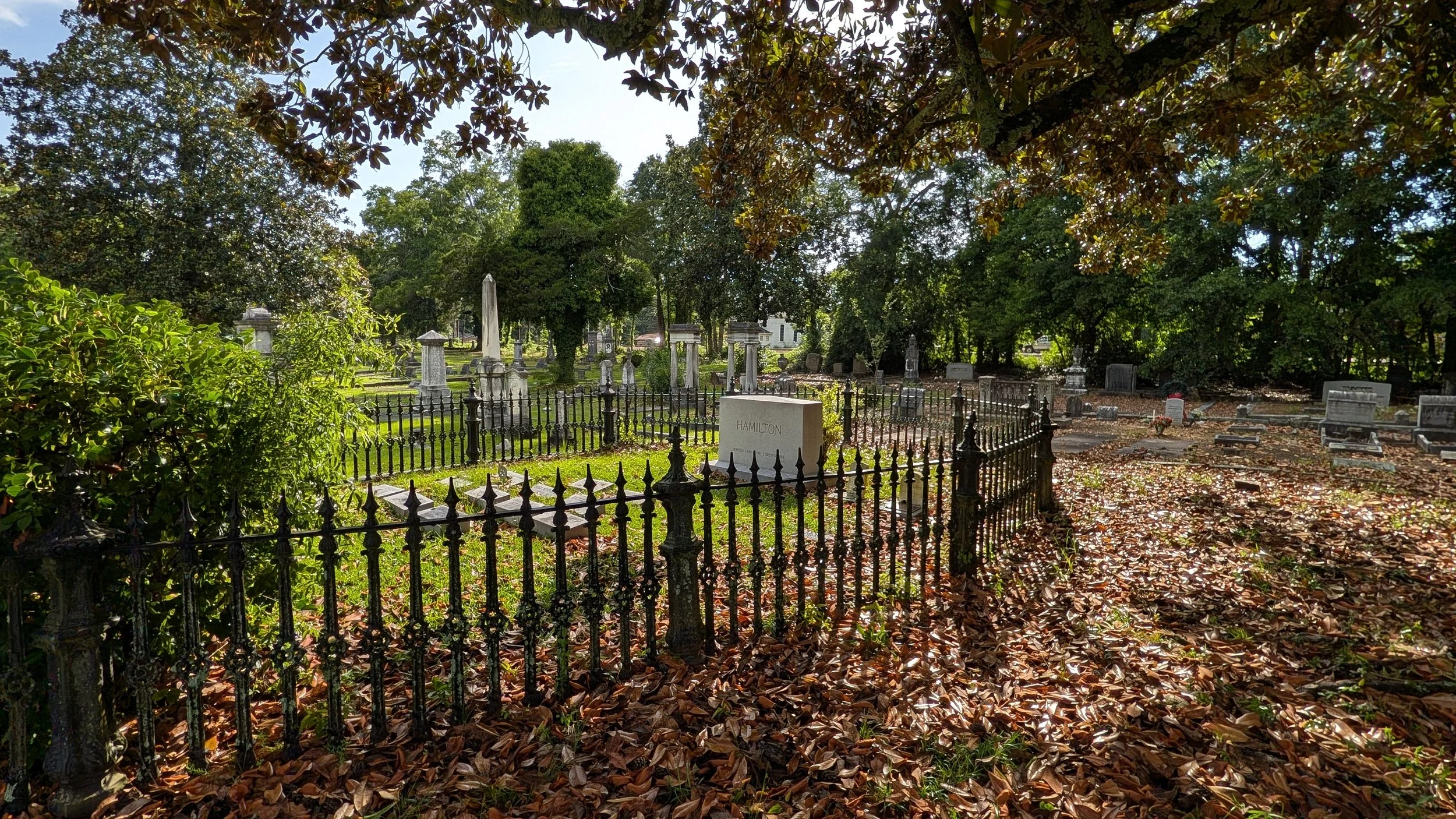
Rest Haven Cemetery in Washington, Georgia, where Micajah Williamson was reinterred.
Virginia Roots
Micajah Williamson was born in Virginia in 1744, most likely in Albemarle County, though some sources place his birth in Bedford County. His family was Scots-Irish, his grandfather having emigrated from the north of Ireland to Virginia, where the family built a comfortable estate over two generations. Micajah grew up with property and standing, and when he came of age, he married Sarah Gilliam, a Virginia woman from a Huguenot line. Her mother was Mary Jarrett, sister of the Reverend Devereux Jarratt, one of the more prominent Episcopal clergymen of the era in Virginia.
Moving to Georgia
In 1768, Micajah and Sarah Williamson made a major move, leaving Virginia for Wilkes County, Georgia, where they bought a plantation from a man named Colonel Alston. The price: 60 enslaved people. At that moment, by any measure, Micajah Williamson was one of the wealthiest men in the upper Georgia piedmont. His plantation sat on the edge of the Indian frontier, and frontier life came with constant friction. He and his family were not far removed from Cherokee lands, and Williamson is recorded as having seen action against the Cherokee at a place called Nomencee before the Revolution ever started.
Those first years in Wilkes County weren't uninterrupted. At some point before the war, fire destroyed the Williamson home. The family took shelter in the mountains of North Carolina for a period before returning to Wilkes County to settle for good. By the time the Revolution came, Micajah Williamson was firmly established as one of the foremost men of his section of Georgia. His relationship with a neighbor and fellow frontier militiaman, Elijah Clarke, had already developed, as the two men had cooperated along the frontier, and a strong friendship had grown between them. That friendship was about to matter enormously.
The Revolution Comes to Georgia
Georgia's Revolution was brutal and deeply personal in ways that the war in the North wasn't. The state was one of the last to join the rebellion and one of the hardest to hold. Its backcountry was a patchwork of Scots-Irish Patriots and Loyalists to the Crown living side by side, and when the British came, neighbor turned on neighbor in ways that made this as much a civil war as a war for independence.
Elijah Clarke became colonel of a Georgia militia regiment, and Williamson became his lieutenant colonel, his right hand, and, in the words of one biographical account, "his chief dependence." Micajah's son would later describe the partnership this way, in remarks preserved through family tradition and the Draper Manuscripts: 'He spoke of them as a rare combination of men who aided one another so that each supplied what seemed to be necessary to efficient command so that together they were perfect.’
Micajah was assigned to the most hazardous operations and, by that same account, was wounded more frequently than any other officer in Clarke's command.
Alligator Creek Bridge, June 1778
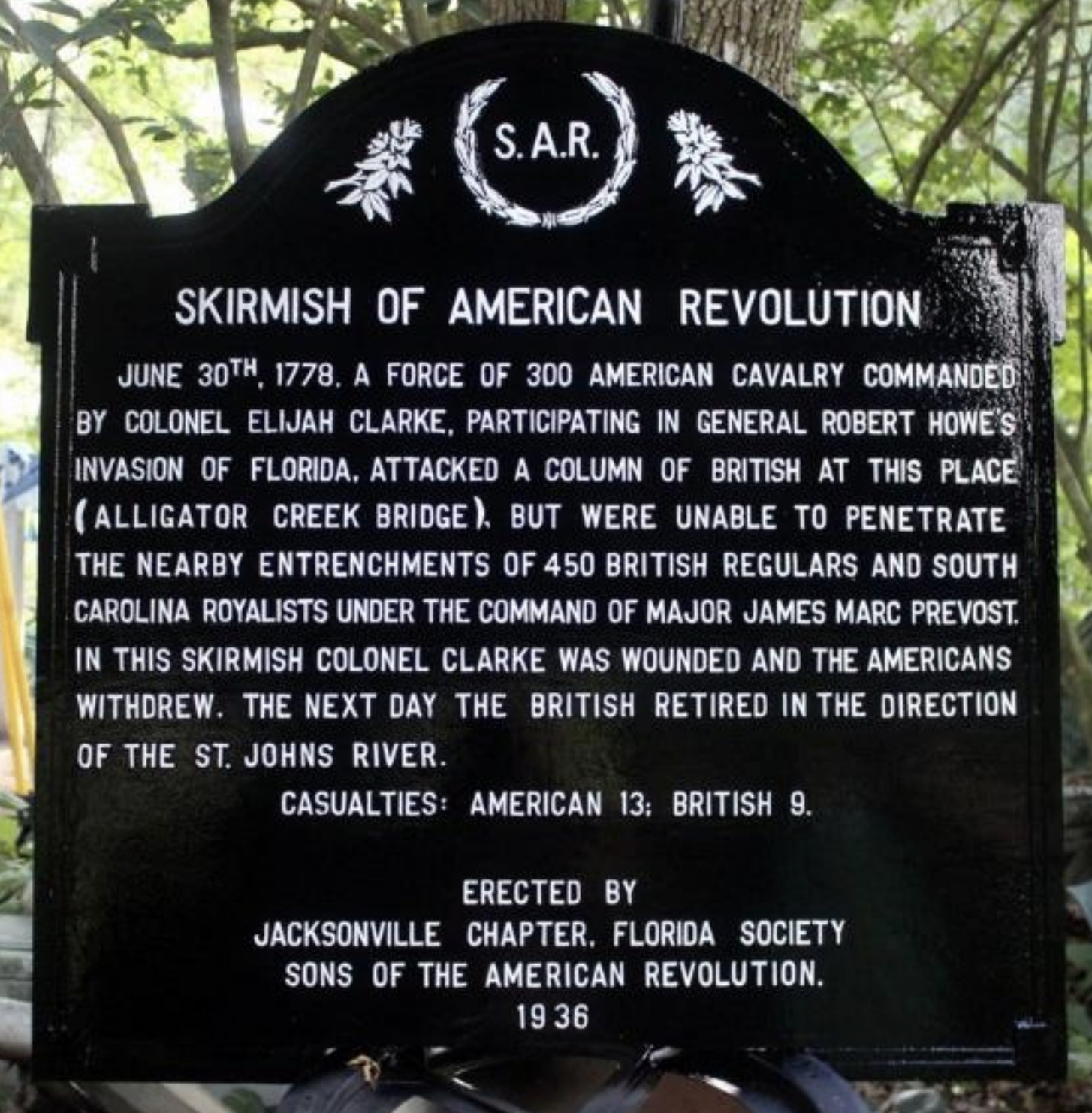
Williamson's first confirmed major action came in the summer of 1778, when Clarke led roughly 300 cavalry in General Robert Howe's invasion of British East Florida, known as the Battle of Alligator’s Bridge.
The Patriots struck the British position at Alligator Creek but couldn't break through. Facing 450 British regulars and South Carolina Royalists dug into entrenchments, the Patriots were repulsed. Clarke was wounded in the fighting.
The Americans withdrew, and the British fell back to the St. Johns River. It was a costly introduction to what war with the British would look like in the South.
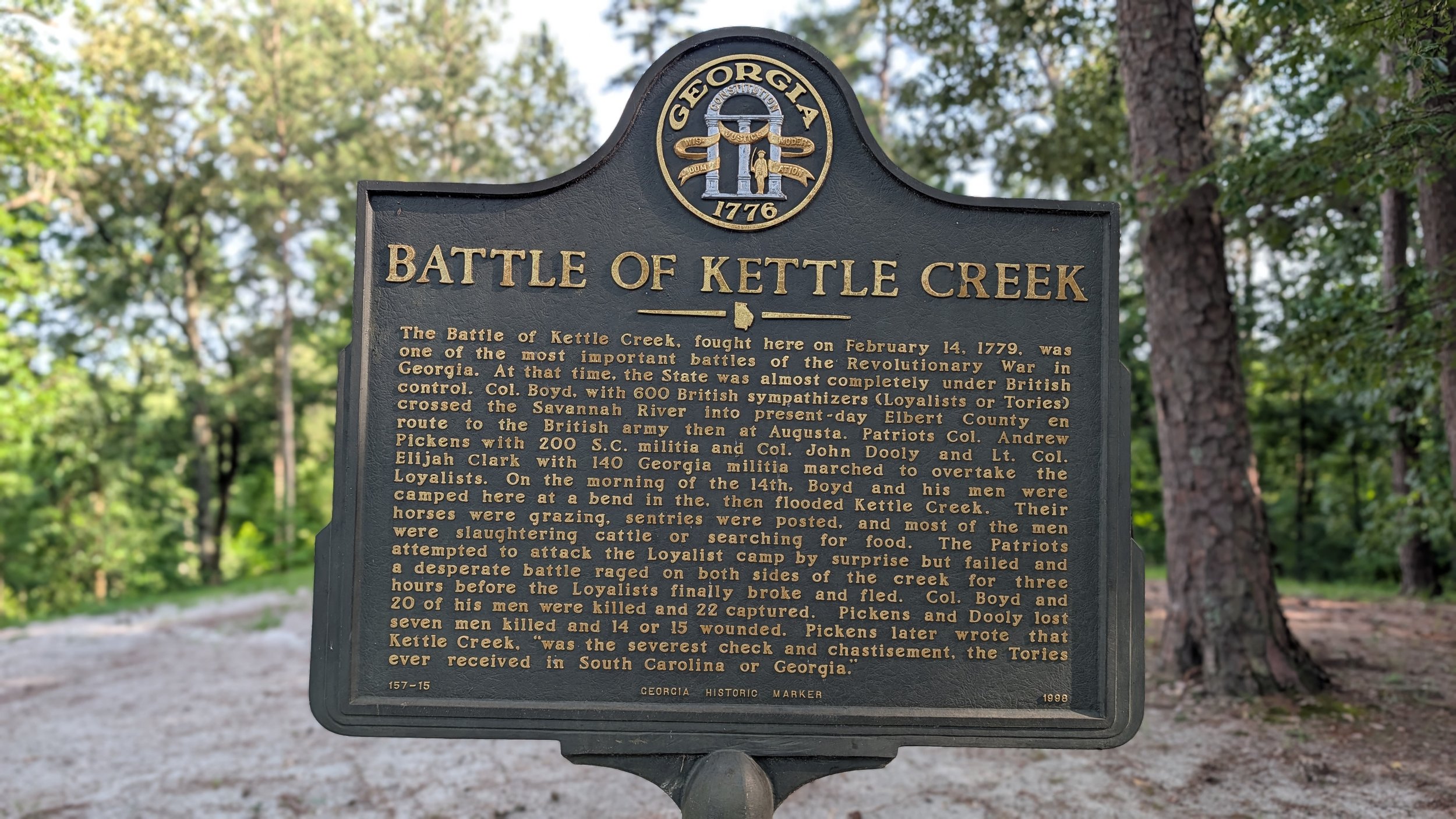
Battle of Kettle Creek, February 14, 1779
This is the battle most associated with Wilkes County, and Williamson was there. By February 1779, Georgia was in serious trouble. The British had captured Savannah in December 1778 and pushed inland to take Augusta in January, and Loyalist recruitment in Georgia's backcountry was surging as a result. A British officer named Colonel James Boyd was marching roughly 650 Loyalist recruits from North and South Carolina through Georgia toward Augusta when Patriots caught up with them near a bend in Kettle Creek, about 11 miles from present-day Washington.
On the morning of February 14, 1779, Boyd's men were camped on a hill, their horses turned out to graze, their attention on cattle they were butchering for food. They did not know they were being followed. Colonel Andrew Pickens of South Carolina commanded the center, with Colonel John Dooly and Lieutenant Colonel Elijah Clarke leading the flanking columns. Micajah Williamson fought under Clarke's command in the Wilkes County Regiments. The Patriots struck hard and Boyd was mortally wounded. His Loyalists were routed, scattered, and never reorganized as a force. Several Loyalist prisoners were subsequently tried and hanged.
This victory mattered well beyond its immediate tactical result. It demonstrated that the British could not safely move Loyalist recruits through the Georgia backcountry unchallenged, and it forced the British commander at Augusta, Lieutenant Colonel Archibald Campbell, to abandon the city. Kettle Creek remains the only Revolutionary War battle in Georgia that the Patriots won outright.
Musgrove's Mill, August 1780
By the summer of 1780, the situation had reversed badly for the Patriot cause. Charleston fell in May. The Continental Army in the South was effectively destroyed. Georgia and South Carolina were under British occupation, and Clarke, Williamson, and their men became a kind of armed refugee column, striking at British and Loyalist positions and then withdrawing, never staying anywhere long enough to be cornered.
In August 1780, Elijah Clarke linked up with Colonel Isaac Shelby's Overmountain Men and Colonel James Williams's South Carolinians to attack a Loyalist outpost at Musgrove's Mill on the Enoree River in South Carolina. Williamson was with Clarke's column. Badly outnumbered after discovering the garrison had been reinforced, the Patriots threw up a hasty breastwork of logs and brush on a ridge above the ford and held their ground, inflicting severe casualties on the Loyalists who charged uphill into their rifles. It was a genuine Patriot victory, though it was overshadowed almost immediately by news of the disaster at Camden three days earlier, which forced the victors to disperse before they could follow up.
King's Mountain and Cowpens
Family accounts and some local retellings hold that Micajah Williamson was present at both the Battle of King's Mountain in October 1780, one of the most decisive Patriot victories of the southern campaign, and at the Battle of Cowpens in January 1781. His participation at King's Mountain is consistent with what we know of Clarke's men joining the coalition of backcountry fighters who came together to destroy Loyalist forces there, and his presence at Cowpens would fit the timeline of his unit's operations during that period. However, I haven't yet been able to confirm his presence at either battle through primary sources. I'll update this entry when I find better documentation, and please share if you have more information about this section of Micajah's service.
Long Cane, December 1780
The Battle of Long Cane in December 1780 was one of Clarke's hardest and costliest fights. It was an engagement in western South Carolina near present-day McCormick County, where Clarke's men stumbled into a larger Loyalist force than expected. Clarke was severely wounded, his fourth wound of the war, and was temporarily removed from command. Williamson was by his side, as he had been from the beginning.
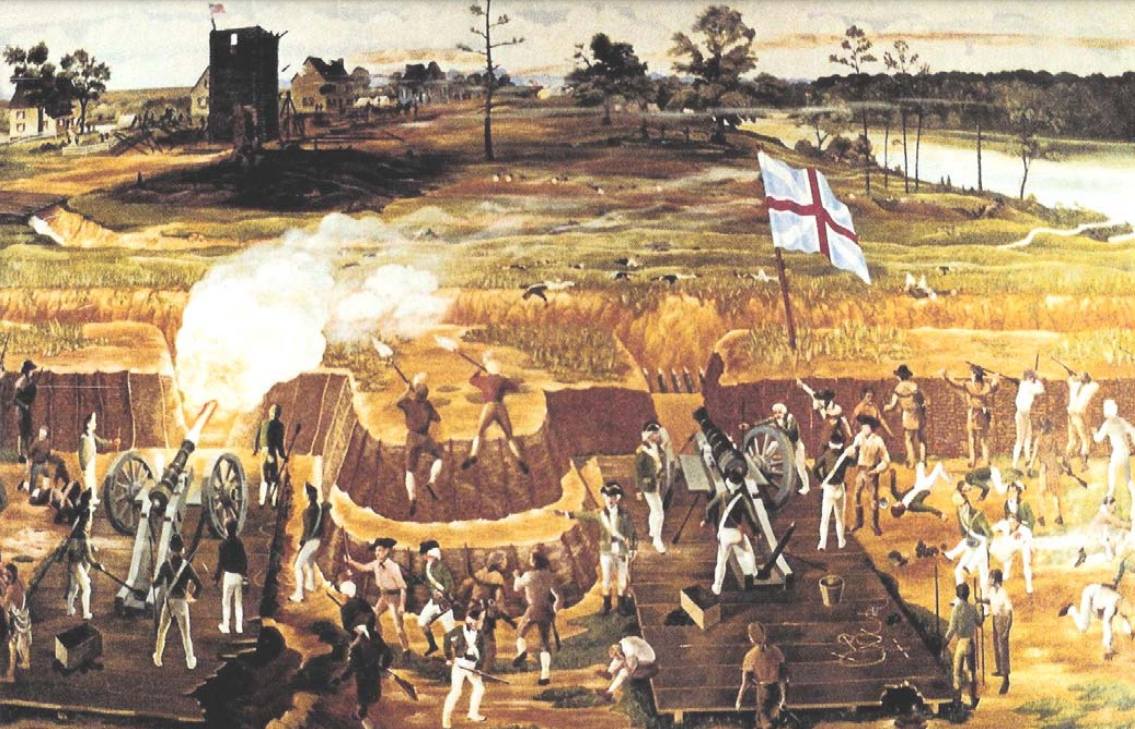
Siege of Augusta, painting by Dick Westcott
The Siege of Augusta, 1781
If Kettle Creek was Williamson's defining battle as part of Clarke's command, the Siege of Augusta was his defining moment as an independent commander.
By the spring of 1781, the tide was turning. Cornwallis had abandoned the Deep South to march into Virginia, and Patriot General Nathanael Greene was working methodically to reduce British outposts across the Carolinas and Georgia. Clarke set his sights on Augusta, held by the Loyalist Colonel Thomas "Burnt-Foot" Brown. There was just one problem: when the time came to move, Clarke had contracted smallpox.
On April 16, 1781, Micajah Williamson led Clarke's militia to the outskirts of Augusta without him, established a fortified camp, and began harassing the Loyalist garrison. He held that position for nearly a month before Clarke recovered enough to rejoin him. General Andrew Pickens arrived with South Carolina militia, and Lieutenant Colonel Henry "Light-Horse Harry" Lee brought Continental regulars. The formal siege began May 22 and ended June 5, when Brown surrendered.
Augusta was free, and for practical purposes, Georgia was free. The capture of Augusta gave negotiators concrete grounds to demand Georgia's inclusion in any peace settlement, even while Savannah remained in British hands.
Obnoxious to the Crown
Here is an insight into how the British viewed Micajah Williamson. When the British occupied Augusta in 1780, they drew up formal lists of men considered enemies of the Crown, men whose property was subject to confiscation and who faced the gravest consequences if captured. Officially designated as “obnoxious to the Crown,” Williamson's name was on that list. The British also, at some point, referred to him as a "rebel general" in their accounting of the Patriot forces, a testament to his prominence in Clarke's command even if his formal rank was lieutenant colonel.
Also worth mentioning about his rank: you'll find him called "Colonel" in many sources, and he seems to have been commonly addressed as Colonel after the war. This appears to have been a common social usage in Georgia, where officers were often elevated. His grave marker uses "Lieut. Colonel," which aligns with his actual commission under Clarke, and that's what I'll use here, while mentioning that "Colonel" is how many people in Washington, Georgia knew him.
After the War: Building Washington
Micajah Williamson came home broken in health and broken in fortune. The war had cost him nearly everything. Loyalist raids on Patriot plantations in Wilkes County had been devastating, and a man explicitly listed as "obnoxious to the Crown" would have been a prime target. He emerged from the Revolution with his land intact, barely, and a small number of enslaved people remaining from the large workforce he had once held. To support his family, he opened a tavern in the new town of Washington, and it was there that county court sessions were held while Georgia sorted itself out after the war. The courthouse records for Washington's early years were kept at Micajah Williamson's tavern. By 1786, a log courthouse had been erected on ground very close to where the current courthouse stands today.
The state recognized his service with a land grant of 12,000 acres in Franklin County, Georgia, and over time he rebuilt his landholdings to somewhere in the range of 30,000 acres, much of it encompassing land where modern Washington now sits. He was appointed by the state to lay out the town of Washington, which had been named for his old commanding general, making it the first incorporated town in the United States to bear George Washington's name. He helped build the Wilkes County Courthouse. He was one of the commissioners who authorized the Wilkes Academy, established under a charter from 1783 as the first public school in Georgia.
He died on November 24, 1796, at 52, twelve years after the close of the war he had sacrificed everything for. He never fully recovered from what the years of service had done to him.
A Legacy That Multiplied
Micajah and Sarah Williamson had somewhere between 11 and 12 children, the exact number varying depending on which source you consult. What is not in dispute is the remarkable reach of their descendants.
Their daughter Nancy married John Clarke, the future Governor of Georgia, and the son of Elijah Clarke, the very man Micajah had served beside through the whole war. Their daughter Mary married Duncan Greene Campbell, and their son John Archibald Campbell rose to become a Justice of the United States Supreme Court. Another daughter, Susannah, became the grandmother of Supreme Court Justice Lucius Q.C. Lamar, Jr. Their daughter Sarah married first Judge John Griffin and then United States Senator Charles Tait of Alabama. Their son Peter became a Methodist preacher known throughout the region as "the Marrying Preacher."
And then there's Robert McAlpin Williamson, Micajah's grandson, who was born right here in Washington in 1806 and grew up to become a legend in the early Republic of Texas. A childhood illness left him unable to straighten one leg, so he wore a wooden peg from knee to ground, earning him the nickname "Three-Legged Willie." He became a lawyer, a judge, a soldier, a newspaper editor, and one of the most colorful figures in Texas history. Williamson County, Texas, is named for him.
The Burial
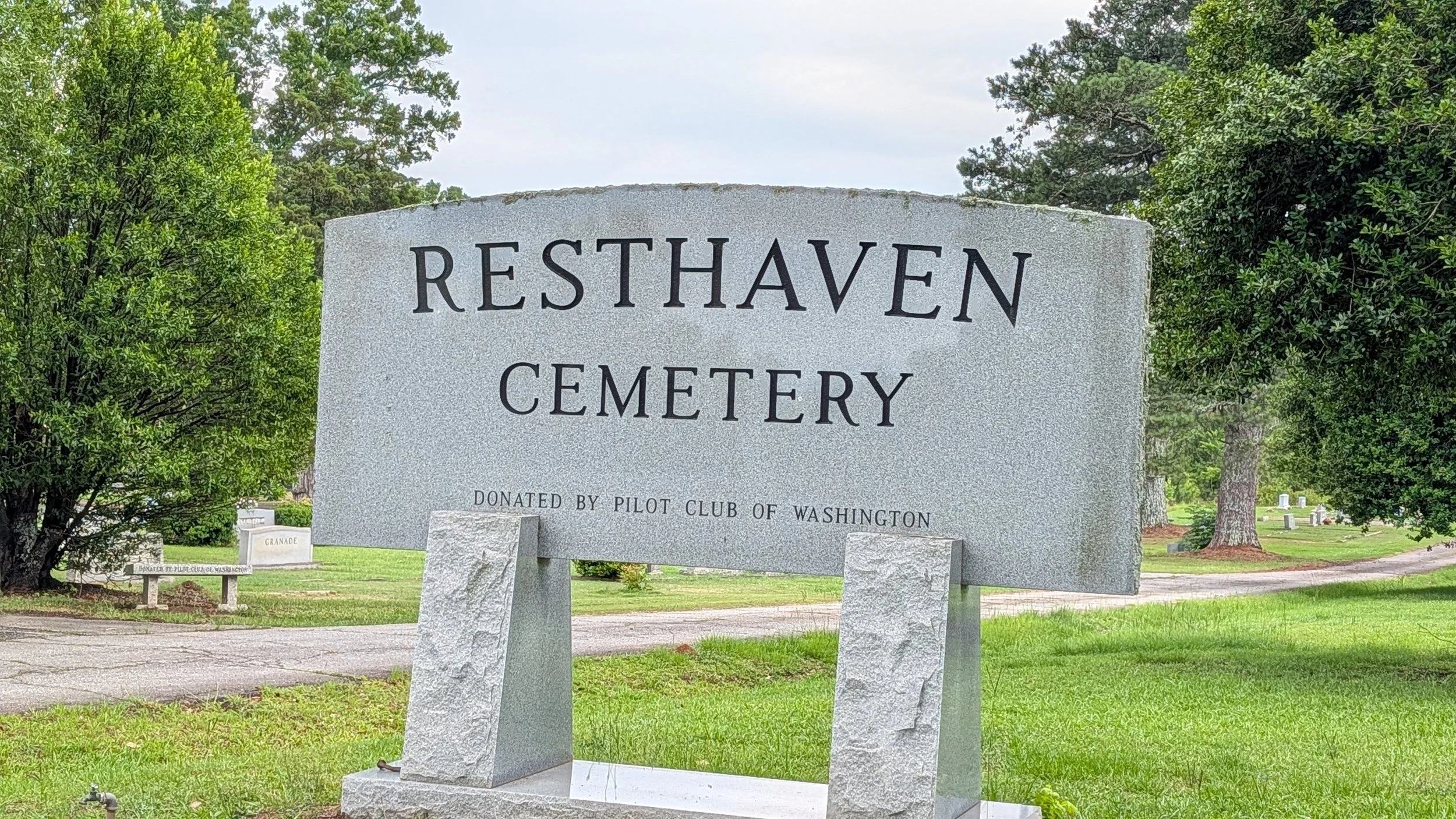
Micajah Williamson was not originally buried at Rest Haven. He was interred on his homestead in Wilkes County, and at some later point in the 19th century, he was moved to this cemetery in Washington. He rests today next to his son-in-law, Colonel Duncan Greene Campbell. The burial location of his wife, Sarah Gilliam, is unknown.
The Washington Historical Museum, worth visiting if you find yourself in Washington, was built around 1835 on land that was part of Williamson's original holdings. The town itself is his legacy made permanent: the courthouse, the Academy, the grid of streets he helped lay out. Micajah Williamson didn't just fight for this ground. He built what grew up on it.
This project is made possible by readers like you.
Your support helps to pay for website costs, gas to travel to these sites, and cleaning supplies for the veteran stones that I’m working to restore.
If you believe this work is important, your support is so appreciated!
Citations
DAR Genealogical Research System, Ancestor #A116608
Find a Grave Memorial #9884, Tucker Cemetery, Heardmont, Elbert County, Georgia
Brian Brown, "Dan Tucker's Grave, Elbert County," Vanishing Georgia (vanishinggeorgia.com)
Wilcox, Herbert. "'Old Dan Tucker Was a Grand Old Man': And He Really Lived in Elbert County in the Good Old Days." Georgia Magazine, Vol. VIII, No. 5, February-March 1965. (Athens Regional Library System, Heritage Room, Athens-Clarke County Library, MSS 010.018)