Anselmn Bailey [24/250]
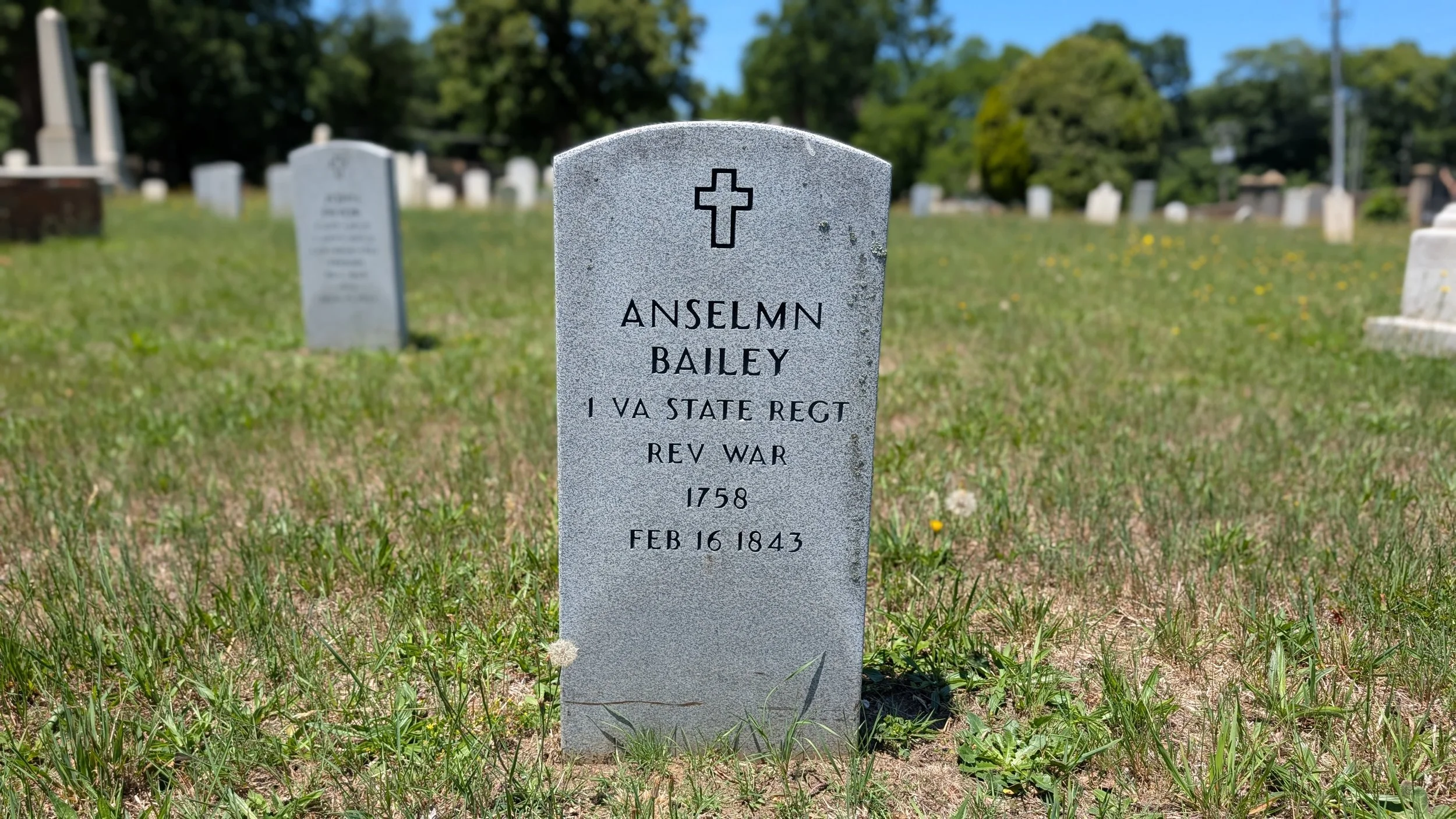
Anselmn Bailey (1758-1843)
Buried at Shockoe Hill Cemetery, Richmond, Virginia
Shockoe Hill Cemetery sits on the north side of Richmond, and on the extremely hot day that I visited, I was enthralled by the large collection of burials here, among them some very famous names: Chief Justice John Marshall, Union spy Elizabeth Van Lew, and Revolutionary War hero Peter Francisco. With such a famous roster, I would guess that many people come here to visit the celebrities, missing the lesser-known names entirely.
But that is exactly the trap this project exists to avoid: to seek out the stories of the people we haven't read about in history books and to see the American Revolution through their contributions.
And that's what brings us to the story of Anselm Bailey (also spelled Ansolem and Ansolam in some records). Not yet recorded in a book, the story of his service was captured in a remarkably detailed pension file that paints a vivid picture of his life during the Revolution. Pension files, when they survive, are among the most intimate documents the war left behind.
They were not written for posterity. They were written by desperate men, most of them old and sick and poor, trying to convince a skeptical government that they had, in fact, served their country decades earlier and deserved some help because of it. These files describe battles from the ground level, from the perspective of the private soldier who was there not as a commander but as a body in the fight. They record wounds. They record poverty. And occasionally, if you are lucky, they contain the sworn testimony of someone who witnessed the applicant's service firsthand.
Thankfully, Anselm's pension file survives, and now we can read his story.
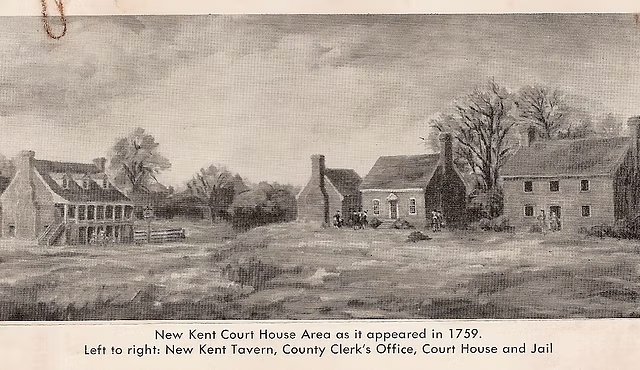
New Kent County, Virginia in the years before the American Revolution.
A New Kent County Man
Anselmn Bailey was born around 1758, most likely in New Kent County, Virginia, the same county where he would later enlist and where he would spend much of his life. I say "most likely" and "around" with intention: his stated age shifts slightly across the various documents in his pension file, ranging across different declarations that point to a birth year somewhere between roughly 1752 and 1760. For men of his background, precise birth records simply did not exist, so the 1758 figure is the one most commonly associated with him, and it is consistent with at least some of his sworn statements.
What we know about his early life before the Revolution is essentially nothing. No church records, no family papers, no mention in any document I have found that predates 1776. He leaves no paper trail until the war comes looking for him. That is not unusual for men of ordinary means in colonial Virginia. What matters is what he did when the moment arrived.
Into the Fight: 1776
On November 21, 1776, Anselmn Bailey enlisted in the First Virginia Regiment, signing himself into service with an X mark, likely because he could not write his own name. He enrolled in the company of Captain Abner Crump of New Kent County, a unit that fell under the command of Colonel George Gibson and was part of General Peter Muhlenberg's brigade. He was, by his own account, about 18 years old.
The timing placed him almost immediately into the thick of the northern campaign. His regiment marched to Pennsylvania and entered the Continental Army's main force the day after the Battle of Germantown, on October 5, 1777. Bailey arrived to find an army battered and regrouping after a hard fight. What came next was the legendary winter at Valley Forge, and Bailey was there for it.
He also had an experience at Whitemarsh, in the weeks between Germantown and Valley Forge, that he would describe decades later in plain but striking language. He was taken prisoner, along with several other American soldiers, and it was largely through his own efforts, he said, that the group managed to escape and return to report to General Muhlenberg at Valley Forge. He does not elaborate on how this happened, but the fact that he reported it at all, years later, suggests it was one of the moments that stayed with him.
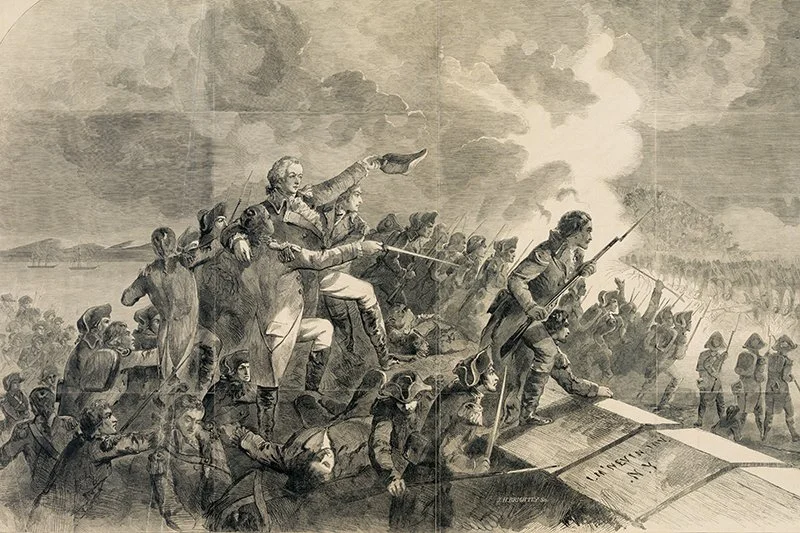
Painting of the Battle of Stony Point, courtesy of the Library of Congress.
Monmouth, Paulus Hook, and Stony Point
The three battles that Anselm Bailey names consistently across his declarations are Monmouth, Paulus Hook, and Stony Point. Together they paint a picture of a private soldier who spent the middle years of the war in some of its most intense engagements.
The Battle of Monmouth, fought in New Jersey on June 28, 1778, was one of the largest battles of the war and the last major engagement in the northern theater. Bailey was there, and he paid for it. A physician who examined him in Richmond in 1820 noted a scar on the back of his right leg and recorded Bailey's account that it was the entry wound of a musket ball received at Monmouth. He carried that scar for the rest of his life.
Paulus Hook, New Jersey, fell on August 19, 1779, in a bold night raid led by Lieutenant Colonel Henry "Light-Horse Harry" Lee. Bailey was part of that action. Six days earlier, on July 16, 1779, American forces under General Anthony Wayne had stormed the British fortification at Stony Point, New York, in a night assault with unloaded muskets, relying entirely on the bayonet. Bailey was there too, and the sworn testimony of one of his fellow soldiers makes what he did that night considerably more vivid.
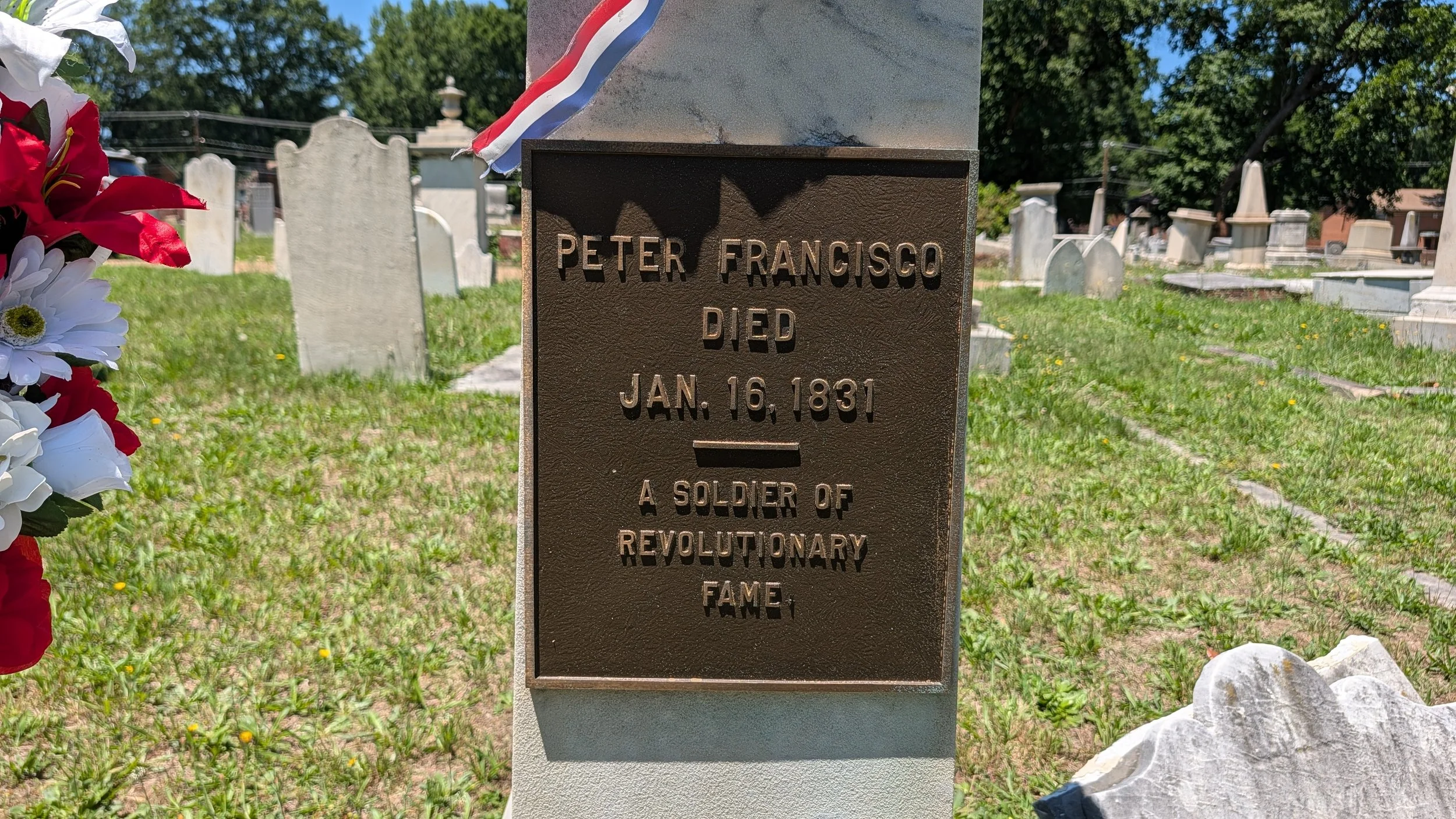
The Francisco Affidavit
On January 8, 1830, a man named Peter Francisco appeared before a justice of the peace in Buckingham County, Virginia, and gave a sworn statement on Anselmn Bailey's behalf. Francisco was, by that point, one of the most famous veterans in Virginia, a man of legendary physical strength whose exploits at Stony Point and elsewhere had made him something of a folk hero. He was serving as Sergeant at Arms to the Virginia House of Delegates.
What he said about Bailey is worth reading closely.
Francisco stated that he and Bailey had both been part of what he called "the Forlorn hope" at the storming of Stony Point. The Forlorn Hope was the advance assault party, the men sent in first to draw fire and clear the way. Francisco said Bailey had been his left-hand man in "the hottest of the fight and in the thickest of the Slaughter," and that they had also served together at Monmouth and at the storming of Fort Mifflin on Mud Island in November 1777. He concluded that in all of those actions, Bailey had "conducted himself like a good and brave soldier," and that he had never heard any complaint of him in the army or anywhere else.
It is a remarkable document. It places Anselm Bailey, a man who signed his own name with an X and whose life left almost no other traces, at the absolute center of one of the most celebrated assaults of the Revolutionary War, standing next to one of the war's most famous enlisted men, and holding his own.
Peter Francisco, it is worth noting, is also buried at Shockoe Hill Cemetery, and his story is coming up in this series as well. The two men who stood together on the ramparts at Stony Point on the night of July 16, 1779, ended their days within a short distance of each other in the same Richmond burial ground.
Home Again: The Long Postwar Years
Bailey was discharged on December 22, 1779, after just over three years of service. Captain Crump certified the discharge in a document dated October 1783. In December of that same year, Bailey received a military land warrant for 100 acres for his three years of service in the state line. He also served several subsequent tours of militia duty during the final years of the war, and he was present in service during the siege of Yorktown in the fall of 1781.
After that, he disappears again from the record until 1818, when poverty drove him to apply for a federal pension.
The picture that emerges from his pension declarations is of a man who had spent forty years farming in New Kent County and had very little to show for it. When his property was appraised in 1820, the total value came to $95.75. The list included a grey mare, a bay colt, a cow and calf, a heifer, 13 hogs of various sizes, a cart and plough, and some household furniture. That was everything he owned in the world.
He was also, by this point, a much older man married to a much younger woman. His wife Susannah was born around 1792, making her roughly 34 years his junior. In 1820, she was about 28 years old with three young children: Rebecca, age 6; Martha, age 4; and a baby boy named Ansolem, age 1. A free boy of 16 was also part of the household. By 1830, Bailey describes his family as including a wife and seven small children, suggesting several more had arrived in the intervening decade.
The Pension Fight
Anselm Bailey's struggle to secure his pension was long, frustrating, and revealing of how the bureaucratic machinery of the early American republic could grind against the men it was supposed to reward.
He first applied for a federal pension in July 1818, citing his service in Colonel Gibson's regiment. The pension was granted. Then, in October 1819, it was abruptly suspended when federal officials determined that Gibson's regiment had been part of the Virginia State Line rather than the Continental establishment, and the act of 1818 only covered Continental service. Bailey, who was nearly 60 years old, had his income cut off on a technicality.
What followed was years of petitions to the Virginia legislature, to the United States Congress, and to the federal pension office. Each time, Bailey laid out the same basic facts: he had served, he had fought, he had been wounded, he was poor, he had a large young family and no way to support them. A physician's examination in 1820 documented not only the bullet wound scar from Monmouth but also a severe rupture that had grown, in the doctor's words, to an extraordinary size and left Bailey barely able to work.
He eventually prevailed and his pension was restored after it was established that his State Regiment had been directed to replace the shattered 9th Virginia Continental Regiment, essentially functioning as Continental troops. He was able to draw his pension for the rest of his life.
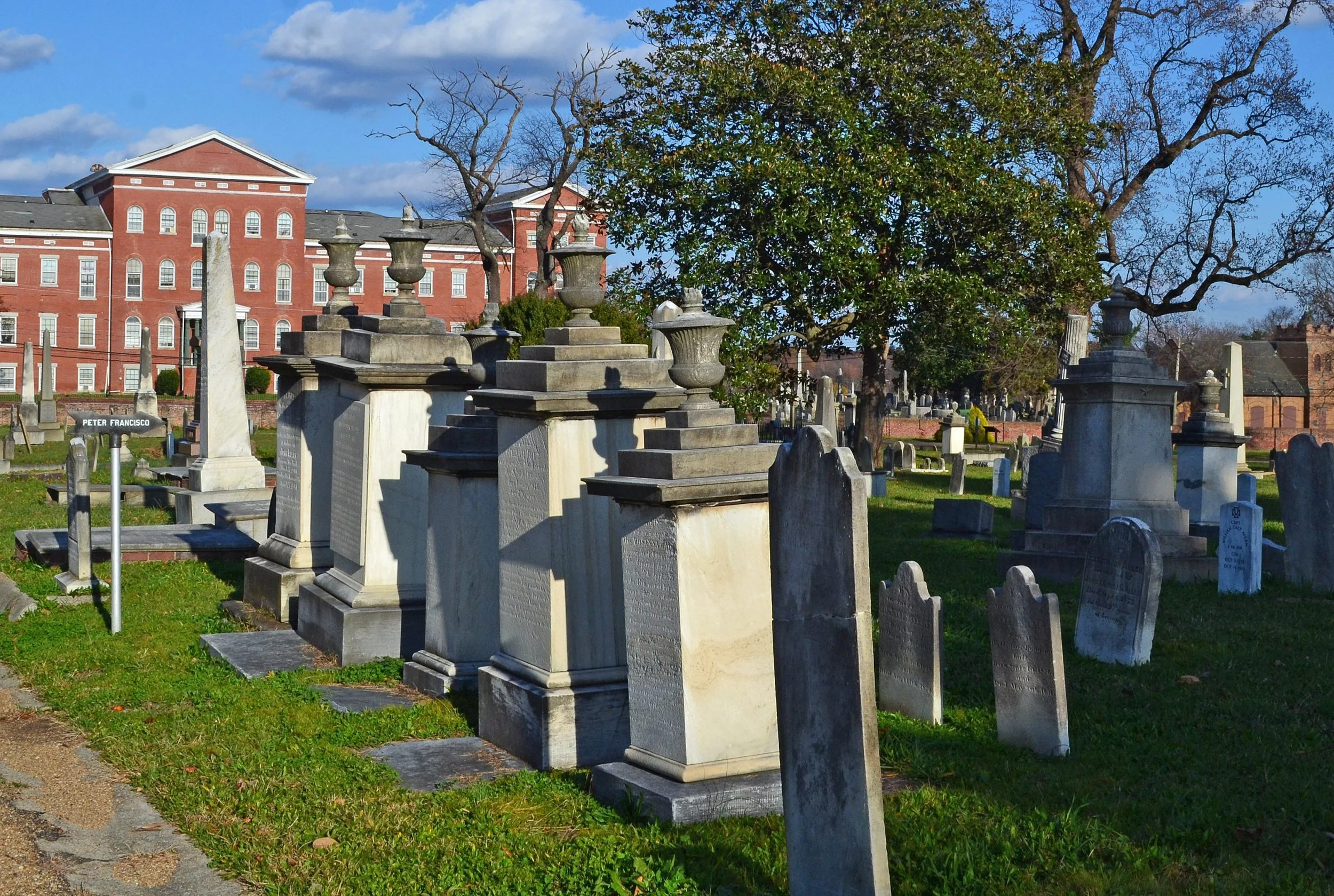
Shockoe Hill Cemetery in Richmond, Virginia. Photo courtesy of Calder Loth.
Shockoe Hill
Anselmn Bailey died in 1843, somewhere around the age of 85. He had outlived most of the men he served with. He was buried at Shockoe Hill Cemetery in Richmond, though his original grave was unknown. In more recent years, a veterans marker was placed inside Schockoe Hill Cemetery to memorialize Anselmn, although it doesn’t mark his exact burial site.
This project is made possible by readers like you.
Your support helps to pay for website costs, gas to travel to these sites, and cleaning supplies for the veteran stones that I’m working to restore.
If you believe this work is important, your support is so appreciated!
Citations
Pension Application of Ansolem Bailey, S37702, Southern Campaigns American Revolution Pension Statements and Rosters, transcribed and annotated by C. Leon Harris, revised 23 Feb. 2017. revwarapps.org/s37702.pdf.
Virginia documents pertaining to John Gregory, VAS3768, Southern Campaigns American Revolution Pension Statements and Rosters, transcribed and annotated by C. Leon Harris. Accessed at revwarapps.org/VAS3768.pdf. [Contains the 1833 affidavit of Ansolem Bailey and the 1830 affidavit of Peter Francisco submitted on Bailey's behalf.]
H. J. Eckenrode, List of the Revolutionary Soldiers of Virginia: Special Report of the Department of Archives and History for 1911 and 1912 (Richmond: Virginia State Library, 1912). "Bailey, Anselm (1 V. S. R.), W. D. 23, 1; (6 V. R.), W. D. 132, 2."
Genealogical, Burial, and Service Data for Revolutionary War Patriots Buried in Virginia, 2nd ed. (Virginia Society, Sons of the American Revolution, September 2022). Entry for Bailey, Ansel/Anselm/Ansolem/Anselem. virginiasar.org.
Virginians in the Revolutionary War Era, compiled by Bevin Creel. Entry for "Bailey, Anselm." varevwar.com/b/.
Virginia SAR Graves Registry, Virginia Society, Sons of the American Revolution. Entry for Bailey, Anselm. at virginia-sar.org.