Rev. Humphrey Hunter [5/250]
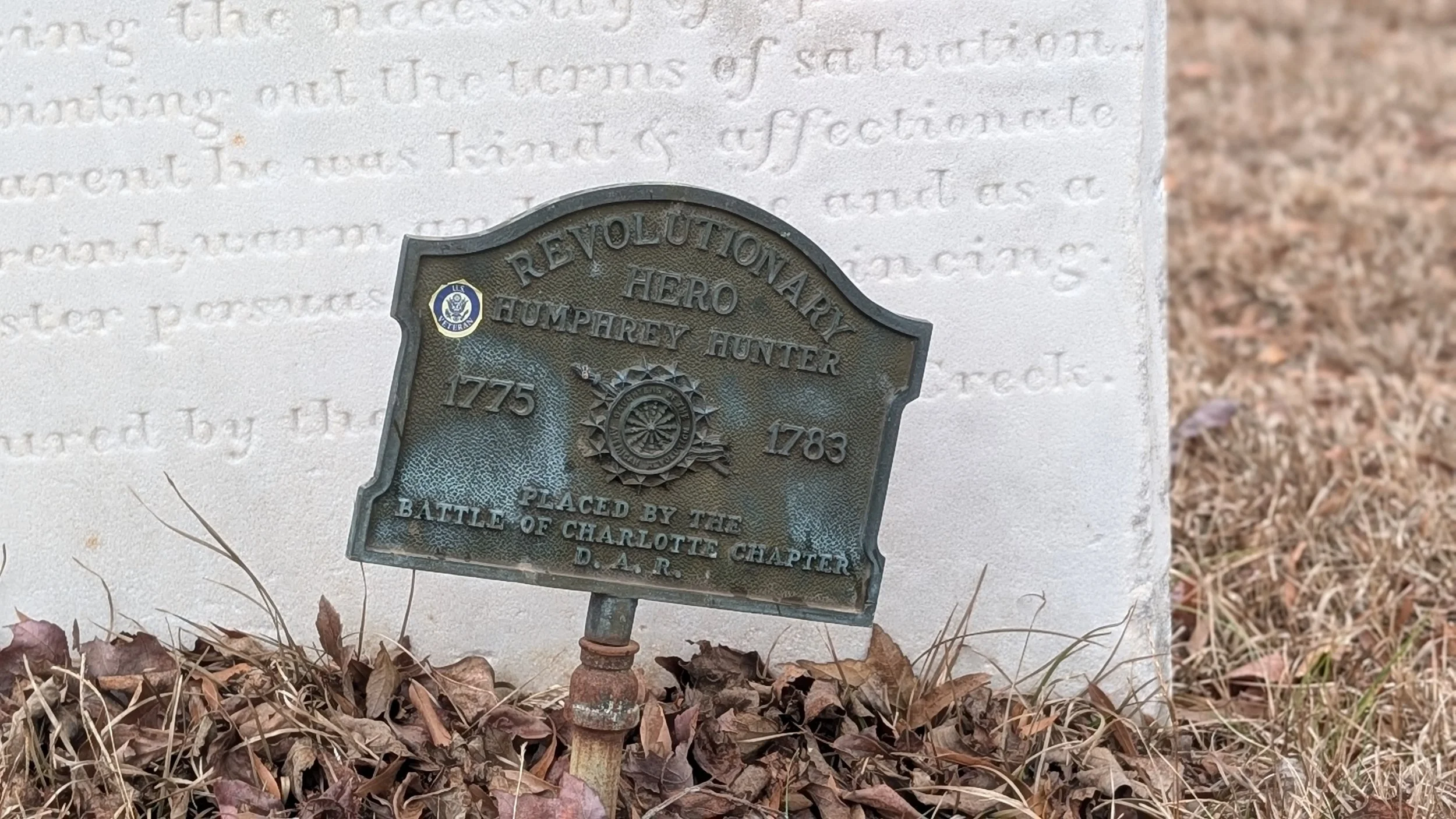
Rev. Humphrey Hunter 1755-1827
Buried at Steele Creek Presbyterian Church Cemetery in Mecklenburg County, North Carolina
Buried at the church he helped to nurture, Rev. Humphrey Hunter rests among the old stones at Steele Creek Presbyterian Church. As I learned more about his life, I discovered a story that bridges rebellion and rebuilding. Rev. Humphrey Hunter was an Irish-born immigrant, a cavalry officer in the American Revolution, and a long-serving Presbyterian minister who shaped religious life in Mecklenburg County during the early republic.
His headstone tells part of his story, proclaiming that he “early promoted the cause of freedom in Mecklenburg County, May 20, 1775,” and that he “took an active part in securing his country’s independence.” But what else can we learn about Humphrey?
From Ireland to the Carolina Backcountry
Family tradition maintains that Humphrey Hunter was born in 1755 in Ireland and that he came to America as a child in 1759 with his widowed mother, settling with relatives among the Scots-Irish Presbyterian communities of Mecklenburg County. One account suggests that he arrived via Charleston, though I have not yet been able to confirm that detail.
When they settled in the Carolina backcountry, it was a world shaped by frontier hardship and centered on tight-knit churches. A deep distrust of distant authority took root here and helped fuel resistance to British rule. By the time political tensions escalated in the mid-1770s, Hunter was a young man of military age living in one of the most politically radical regions of the southern colonies.
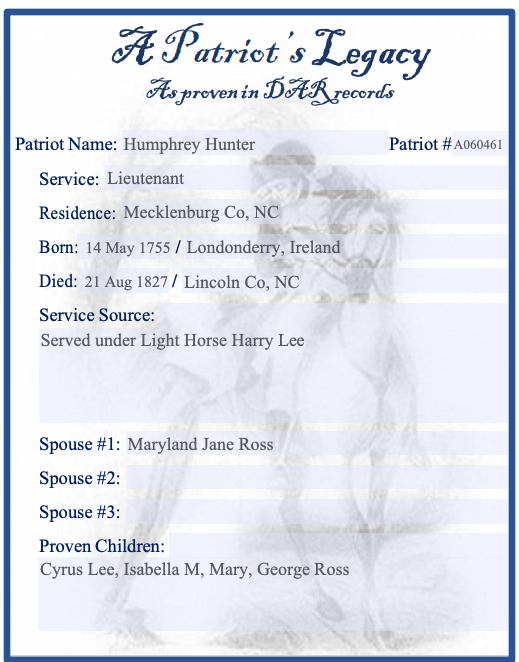
Humphrey Hunter’s Daughters of the American Revolution (DAR) Service Record
A Cavalry Officer in the American Revolution
In the 1820s, men who had served in the American Revolution were required to testify to their service in order to apply for war pensions. These applications provide fascinating details about the service records of thousands of men from this era. Fortunately, Hunter’s Revolutionary War pension application outlines a long and varied record that spanned much of the southern war, giving us a fuller picture of his military experience.
He first entered service in 1775 as a private in a mounted company raised in Mecklenburg County, called out to suppress Loyalist activity near Cross Creek, present-day Fayetteville. This early campaign highlights the brutal civil war conditions of the southern backcountry, where Whigs and Loyalists clashed long before major British armies arrived.
In 1776, Hunter returned to service, this time as a lieutenant in a cavalry company under Captain Robert Mebane. He marched with General Griffith Rutherford during the campaign against the Cherokee, part of a broader effort by revolutionary governments to secure their western frontiers during the opening years of the war.
His most dramatic service came later in the conflict. In 1780, Hunter again served as a lieutenant in mounted troops operating in the Carolinas. According to sworn testimony in his pension file, he was present at the Battle of Camden, one of the Revolution’s worst Patriot defeats. He was captured in the aftermath and spent roughly three months as a prisoner at Orangeburg, South Carolina.
By 1781, Hunter was back in the field. Supporting affidavits from fellow soldiers confirm that he was present at the Battle of Eutaw Springs, serving as a lieutenant in cavalry associated with Colonel Henry Lee. Eutaw Springs was the final major battle of the southern campaign and helped convince British commanders that holding the Carolinas would be impossible.
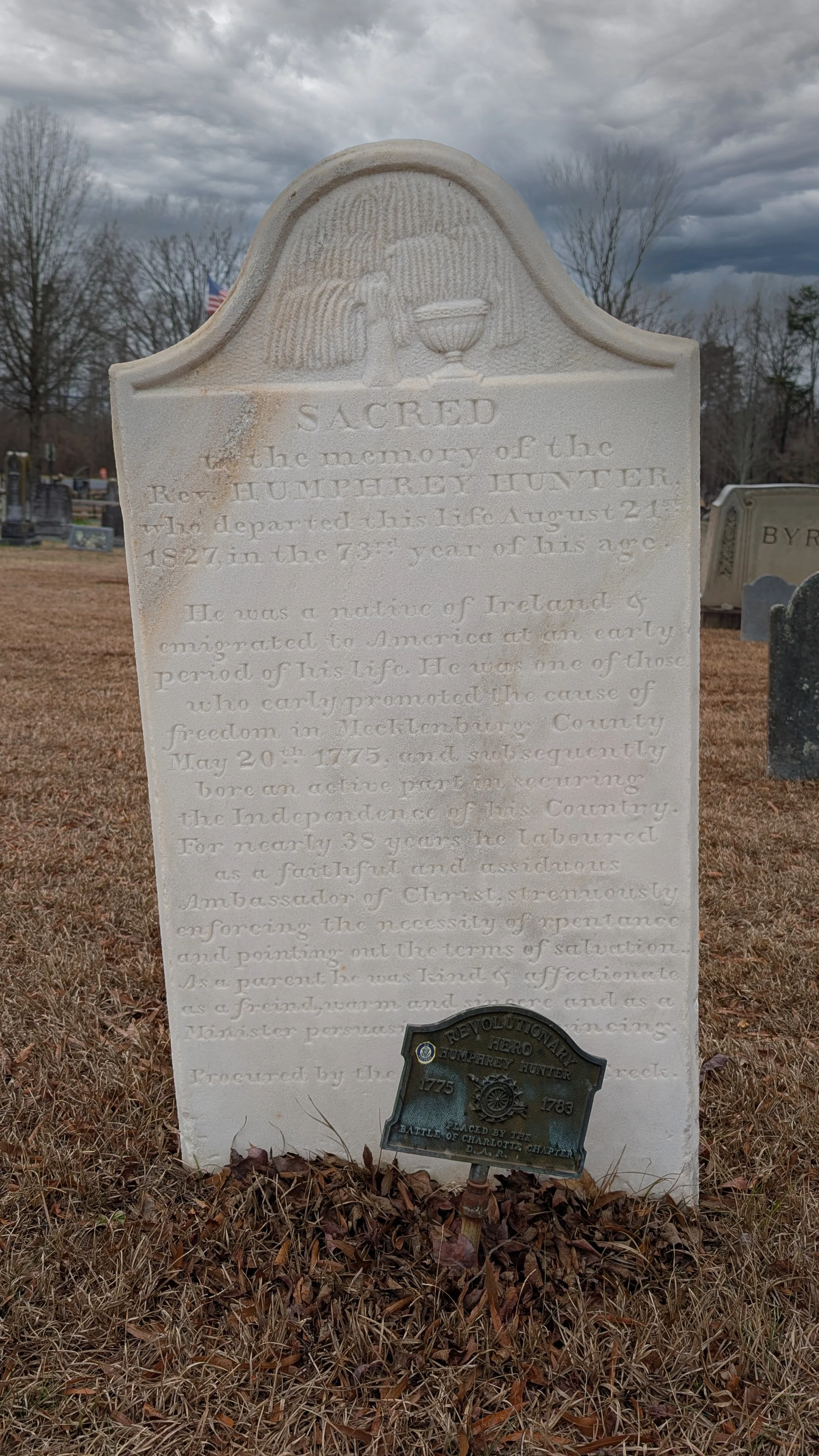
His inscription reads: "Sacred to the Memory of Rev. Humphrey Hunter, who departed this life August 21, 1827, in the 73rd year of his age. He was a native ot Ireland & emigrated to America at an early period of his life. He was one of those who early promoted the cause of freedom in Mecklenburg County, May 20th, 1775, and subsequently bore an active part in securing the Independence of his Country. For nearly 38 years, he laboured as a faithful and arduous ambassador of Christ, strenuously enforcing the necessity of repentance and pointing out the terms of salvation. As a parent, he was kind and affectionate, as a friend, warm & sincere, and as a minister, persuasive and convincing."
From Soldier to Minister
After the war, Hunter turned toward education and theology. He pursued formal studies and was licensed to preach in 1789, and that same year, he married Maryland Jane Ross (1771-1843). His path from cavalry officer to clergyman was not unusual among Revolutionary veterans, many of whom sought stability and moral order after years of upheaval.
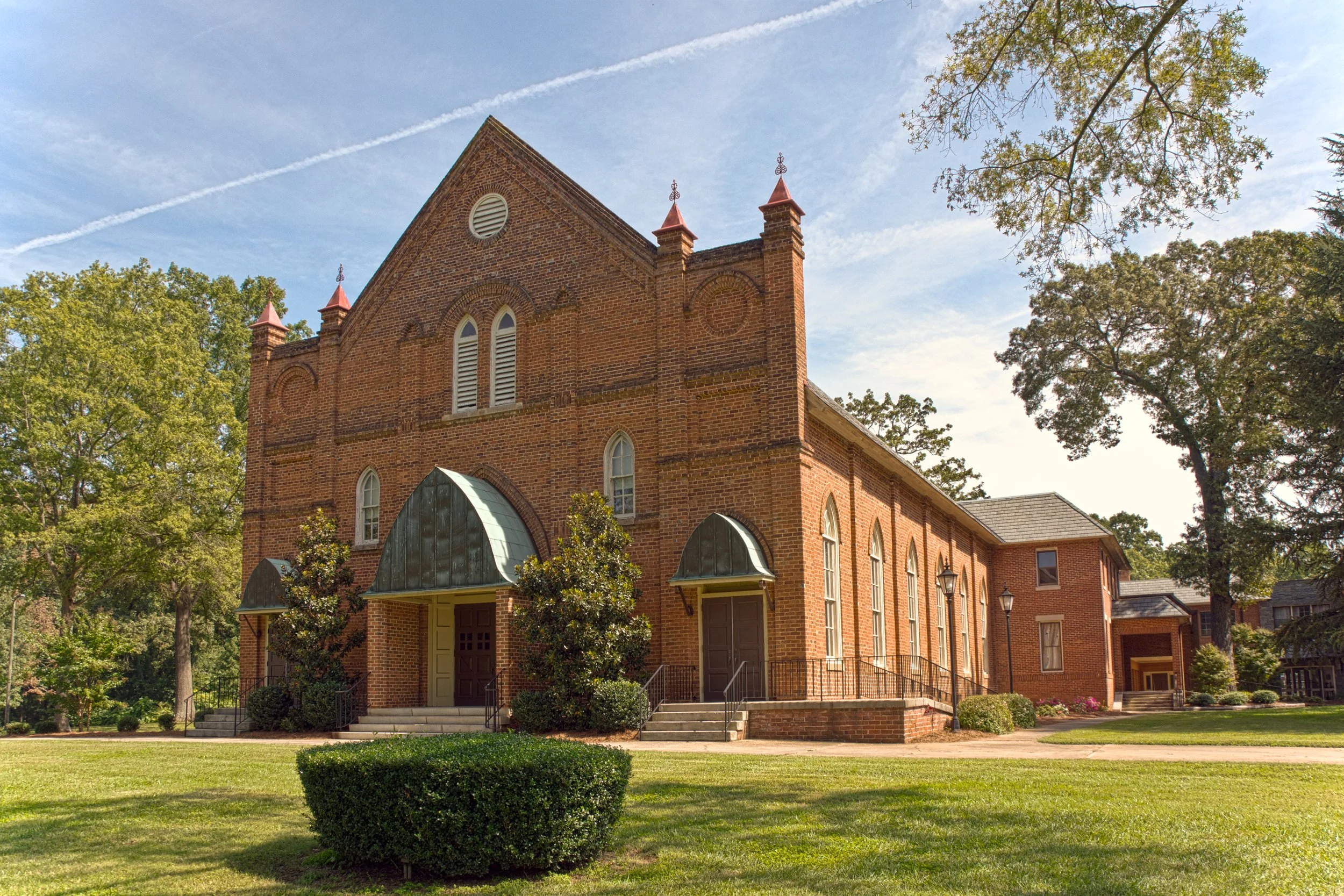
In 1804, Hunter accepted a call to Steele Creek Presbyterian Church, which had gone several years without a settled minister. He served there faithfully until his death in 1827, a tenure of more than two decades. During that time, he also served as a supply minister to nearby congregations, reflecting the itinerant nature of Presbyterian ministry in the early South.
As a pastor, Hunter ministered to a congregation shaped by war, migration, and generational change. He baptized children of Revolutionary veterans, buried members of the wartime generation, and preached to families adapting to a rapidly expanding nation.
Death and Legacy
Rev. Humphrey Hunter died on August 21, 1827, in his seventy-third year. He was buried at Steele Creek among the people he had served for so long. Today, his grave reminds us that the American Revolution was not only fought on battlefields, but carried forward in pulpits, communities, and local memory long after the guns fell silent.
This project is made possible by readers like you.
Your support helps to pay for website costs, gas to travel to these sites, and cleaning supplies for the veteran stones that I’m working to restore.
If you believe this work is important, your support is so appreciated!
Citations
Revolutionary War Pension File of Humphrey Hunter, W3998.
Gravestone Inscription of Rev. Humphrey Hunter (1755–1827).
Find A Grave Memorial: Rev. Humphrey Hunter.
Sketches of Western North Carolina, Historical and Biographical, by Hunter, C. L., 1877
Sketches of North Carolina, Historical and Biographical, by Foote, William Henry. , 1846
North Carolina State Records and Colonial/State Military Records.