The Eleanor and Robert Wilson Family [32-41/250]
Eleanor & Robert Wilson and Seven of their Sons
Eleanor Carothers Wilson (d. 1802) and Robert Wilson (d. 1794)
Buried at Steele Creek Presbyterian Church | Mecklenburg County, NC
(This story is one of an entire family who were involved in one way or another, with 9 confirmed Patriots, so I have decided to share each of their stories as one entry in this series)
I’ve researched the stories of hundreds of American Patriots and their families, but few have stayed with me like the Wilsons and the sacrifices they made in the name of American independence.
In the fall of 1780, Eleanor Wilson's husband was sitting in a British jail, her other grown sons were somewhere in the field fighting with Patriot militia, and the most powerful British general in the South was eating at her table. Gen. Charles Cornwallis had not been invited. His soldiers stripped her farm of food while his officers waited to be fed, and according to the family story, he used the visit to make Mrs. Wilson an offer: bring her sons over to the king's cause, and Cornwallis would set her husband free.
What Eleanor said next became one of the most repeated stories from the Revolution in North Carolina.
But the story behind the story, which was preserved in sworn testimony, is just as remarkable: a family that sent nearly every man it had to war, lost a father to captivity, watched a 15-year-old boy hauled off by the enemy, and still came out the other side.
From Pennsylvania to the Carolina Backcountry
Robert Wilson and Eleanor Carothers were both born in Pennsylvania, part of the wave of Scots-Irish Presbyterians whose families had come from Ulster in northern Ireland. Neither birth date is documented, but Robert was probably born around 1720, and Eleanor around 1724. They married in Pennsylvania in the late 1740s, and their first few children were likely born there.
Like thousands of their neighbors, the Wilsons eventually packed up and headed south along the Great Wagon Road, which ran from Pennsylvania through Virginia's Shenandoah Valley into the Carolina Piedmont. The land there was cheaper and more plentiful, and whole congregations moved together. The records I found place the Wilsons' arrival in the Carolina backcountry sometime between 1750 and 1760. The first solid record is a 1764 deed in which Robert, described as a 'planter,' bought 350 acres on both sides of Sugar Creek, south of the young village of Charlotte.
The family belonged to the Steele Creek Presbyterian congregation, organized in 1760 and one of the oldest Presbyterian churches in what became Mecklenburg County. Over the next two decades, Eleanor gave birth again and again. Family tradition says she had 11 sons; I was able to identify 10 by name.. It seems that the family's written record of births was lost during the war, so most of their birth years come from the memories of the sons themselves.
The Wilsons and the Mecklenburg Declaration
By the 1770s, the Presbyterian settlers around Charlotte had a reputation, among royal officials at least, as stubborn and independent-minded. In May 1775, weeks after the fighting at Lexington and Concord, Mecklenburg County leaders met in Charlotte and adopted resolutions rejecting royal authority. Local tradition holds that they went further, issuing a full "Mecklenburg Declaration of Independence" on May 20, 1775, more than a year before the one signed in Philadelphia. Historians still debate whether that document existed in the form later published, but the date is on the North Carolina state flag to this day.
Among the men named as signers of the Mecklenburg Declaration was Zaccheus Wilson, a surveyor and militia captain. He was closely related to Robert, though the sources disagree on exactly how: one history calls him Robert's brother, one of Robert's sons called him an uncle, and Robert's own will calls him 'my cousin.’
He was closely related to Robert, although one story says he was Robert’s uncle; another says Zaccheus was his cousin, but whatever their exact tie, the Wilsons were in the thick of Mecklenburg's revolutionary politics from the very beginning.
A War Between Neighbors
I think when many os us imagine the American Revolution, we picture long lines of uniformed soldiers facing each other across an open field, but in the Carolina backcountry, the war looked very different. There were few large armies and few clear front lines. Instead, the fighting was mostly done by local militia, made of farmers who turned out for a few weeks or months at a time, went home to tend their crops, and turned out again.
Just as important, many of the people they fought were their own neighbors. Backcountry families split between Patriots, who supported independence, and Loyalists, who stayed loyal to the British crown. Men who had attended the same churches and traded at the same mills ambushed each other on back roads, burned each other's barns, and sometimes recognized each other across a battlefield. Historians often describe the war in the Carolinas as a civil war, and for families like the Wilsons, it was exactly that.
For the first few years, the war in the South was fought at a distance from Charlotte, with militia marching off to campaigns against the Cherokee on the western frontier or to defend Charleston and Savannah. That changed in 1780. In May, the British captured Charleston, South Carolina, along with nearly the entire Southern Continental Army. In August, they crushed a second American army at Camden, South Carolina, about 70 miles south of Charlotte. Suddenly, almost nothing stood between the British and North Carolina except the local militia and a handful of partisan leaders such as South Carolina's Thomas Sumter.
In late September 1780, Cornwallis marched his army into Charlotte. He stayed only a few weeks. Local militia harassed his foraging parties so relentlessly that he reportedly called the town a "hornet's nest" of rebellion, a nickname Charlotte still proudly uses. Then, on Oct. 7, 1780, a Loyalist force under Maj. Patrick Ferguson was destroyed at Kings Mountain, about 30 miles to the west. Cornwallis pulled out of Charlotte and retreated south into South Carolina. The Wilson farm sat right in his path.
The Wilson Boys Go to War
According to family stories and military records, I learned that at least 7 of Eleanor’s sons fought for, served, or sacrificed for the cause of American independence. So far, no other mother I have documented in this project lent more sons to the cause. And we have a lot of information about the Wilson boys’ service, thanks to an interesting source.
Decades after the war, Congress began granting pensions to Revolutionary militia veterans and, later, to their widows. James Wilson applied for his own pension in 1833. Robert Wilson Jr. had died in 1819, so in 1848 and 1849 his widow, Jane McDowell Wilson, applied based on his service. To support her claim, the two youngest Wilson brothers, Josiah and Moses, gave sworn statements describing what they remembered of the war. They were boys at the time, old enough to remember but too young to fight.
Josiah named seven brothers who served: Joseph, Aaron, John, James, Robert, Samuel and Zaccheus. (Moses, in his own statement, listed six who were old enough to bear arms, leaving off Zaccheus, who was only about 15 when the fighting reached Charlotte.) Like most backcountry militia, they served in short tours, came home, and went out again. Josiah swore that his brothers took part in nearly every campaign of importance in the Carolinas from 1776 to 1783, and that he could not recall them all.
James's own pension application gives the clearest picture of what that looked like. In 1776, at 18, he was drafted for a three-month campaign against the Cherokee, marching over the Blue Ridge to destroy Cherokee towns in present-day western North Carolina. He later drove a supply wagon for the militia, chased Loyalist scouting parties along the Catawba River in 1779, and in the summer of 1780 fought under Thomas Sumter at the Battle of Hanging Rock, a fierce fight at a British outpost in South Carolina where his own captain, David Reed, was killed. That fall, he skirmished with the British advance guard as Cornwallis marched on Charlotte.
Other brothers saw the war at its worst. Aaron served as a lieutenant at the Battle of Stono Ferry near Charleston in June 1779. Joseph and Robert Jr. were inside Charleston during the long British siege of 1780 and became prisoners when the city surrendered on May 12. Like the other captured militia, they were released "on parole," a promise not to fight again until formally exchanged, and walked roughly 200 miles home. Within weeks, the British changed the rules, demanding that paroled men take up arms for the king. The Wilson brothers refused, considered their paroles void, and went straight to Sumter's camp.
At Hanging Rock that August, according to Moses's sworn statement, Joseph killed a Loyalist and carried off the man's rifle. Moses said he had seen that rifle many times and believed a descendant in Tennessee still owned it. A family story, recorded in 1852, adds that Joseph knew the man personally, and that during the same battle, Robert Jr. carried water in his hat to the dying Captain Reed, who was a relative. In the Carolina backcountry, even the enemy was often someone you knew.
According to Moses, all of the older brothers turned out during the Ramsour's Mill campaign in June 1780, a bloody clash between Patriot and Loyalist neighbors in present-day Lincoln County, and later, according to Josiah, at Cowpens and Guilford Courthouse in 1781. Robert Jr.'s last service came in the fall of 1781, in a campaign toward British-held Wilmington, the final major operation of the war in North Carolina.
Research almost any major fight in the Carolinas, and a Wilson seems to turn up.
Old Robin Is Taken
Robert Wilson, patriarch of the Wilson family and Eleanor’s husband, was known in the neighborhood as "Old Robin." He was about 60 years old when the British arrived in Charlotte in force. His sons later swore that he was too old and too frail to campaign and never served as a soldier. But he found another way to contribute. In the summer of 1780, Sumter's Patriots had camped on Sugar Creek, near the Wilson farm, and Robert became one of the neighbors who kept them fed.
On Aug. 18, 1780, two days after the disaster at Camden, British cavalry under Lt. Col. Banastre Tarleton surprised Sumter's camp at Fishing Creek, South Carolina, and scattered his men. Robert and his son John had loaded a wagon with provisions and forage gathered around Steele Creek and were bringing it to Sumter's men. They arrived just after the rout. Tarleton's dragoons captured them both, along with the supplies.
Josiah, who was about 13, remembered that his father was taken not as a soldier but as an "aged and influential citizen" with several sons fighting against the king. Robert and John were marched to Camden and crowded into the jail with other Patriot prisoners from Mecklenburg. They would be held prisoner for nearly three months.
Eleanor's Table
With her husband in a British jail at Camden, South Carolina, and most of her grown sons away with the militia, Eleanor Wilson, who was about 56, was left at home with the youngest boys.
Part of what happened next is documented (while some is unverified family tradition). Her son Moses, who was 11 at the time, swore in 1848 that the British army, with Cornwallis himself, took over his parents' house as they marched through the area. Moses recalled that he hid in the loft, afraid the soldiers would carry him off.
The rest of the story is a family tradition, first published in 1852 by Elizabeth Ellet in The Women of the American Revolution, based on an account from Milton Haynes, who was one of Eleanor's great-grandsons. As the family story goes, Cornwallis's army halted for the night at the Wilson plantation during its retreat from Charlotte in mid-October 1780. Cornwallis, his staff, and Tarleton moved into the house and required Eleanor to feed them as if they were friends, while soldiers seized every bit of food on the farm. Eleanor played the gracious hostess so well that Cornwallis assumed she might be sympathetic to the king.
When he learned whose house he was in and that her husband and son were in the custody of the crown, Cornwallis made her an offer. He reminded her that her loved ones were in jail, and more of her sons might soon be. He told her that if she would persuade her sons to fight for King George, he would see that they were given rank in the British army, and he would order her husband and son released from Camden at once.
According to the family's account, Eleanor told him that her husband and children were dear to her, but that they had joined the cause of liberty and had never wavered. Then, as the story goes, she said:
"I have seven sons who are now, or have been, bearing arms; indeed my seventh son, Zaccheus, who is only fifteen years old, I yesterday assisted to get ready to go and join his brothers in Sumter's army. Now, sooner than see one of my family turn back from the glorious enterprise, I would take these boys (pointing to three or four small sons) and with them would myself enlist under Sumter's standard, and show my husband and sons how to fight, and if necessary, to die for their country!"
In the same account, Tarleton assured Cornwallis that 'old Robin Wilson' would never come home from Camden.
We cannot know Eleanor's exact words. But we do know, from her son's sworn statement, that the commanding general of the British army in the South took over her home and ate from her table while her husband sat in his jail. And that whatever Eleanor said to Cornwallis, she said it to his face.
Zaccheus at the River
Eleanor's youngest soldier, Zaccheus, had a Revolutionary adventure of his own. Her son Moses swore that his brother Zaccheus, "although but a boy," was sent out to warn the neighborhood that the British were coming, was captured, and was held for several days. That part is documented in testimony. The rest comes from the family's 1852 account, which sets a dramatic scene. In this version, British scouts caught Zaccheus with his gun on the flank of the army the day after the dinner at his mother's house.
Cornwallis reportedly took the boy along and ordered him to guide the army to the best place to cross the Catawba River. When the lead troops waded in, they found themselves in deep, fast water and were swept downstream. Convinced he had been tricked, Cornwallis drew his sword and swore he would cut off the boy's head.
Zaccheus, in this telling, answered that the general certainly could, since he was unarmed and a prisoner, but asked whether it would not be a cowardly act to strike an unarmed boy. Impressed, Cornwallis calmed down, found a shallower crossing upstream, and eventually sent Zaccheus home with a message: go take care of your mother, and tell her to keep her boys at home. If the message was ever delivered to his mother, she certainly did not heed it.
Escape on the Road to Charleston
Old Robin Wilson, meanwhile, was still a prisoner. After about five weeks in the Camden jail, Robert, John, and 10 other prisoners were sent toward Charleston under a guard of 12 soldiers. Somewhere on the road, the prisoners overpowered their guards, took their guns, locked the soldiers in the house where they had stopped for the night, and scattered. Some made their way to Francis Marion's partisans; Robert and John walked home to Mecklenburg, roughly 200 miles through territory full of British troops.
After the War
By family estimate, the Wilson men's combined service and imprisonment added up to nearly 16 years. Remarkably, there is no record that any of them was killed. Peace brought new beginnings, and in the winter of 1784, Robert Jr. married Jane McDowell at her father's house in the Steele Creek community, with the Steele Creek pastor officiating. Jane's parents, William and Ellen McDowell, had their own Revolutionary story: by family tradition, Ellen nursed the wounded after Kings Mountain and secretly burned charcoal in her fireplace for the gunpowder her husband made in a hidden cave. Josiah and Moses, both teenagers, were at the wedding, and more than 60 years later they swore to it for Jane's widow’s pension.
Abby
While I was researching their story, I came across the name of a woman who is often omitted from the story: a woman named Abby who was enslaved by the Wilson family. She is known to us only through Robert Wilson's will and estate records from December 14, 1793. In this document, he left Eleanor, for the rest of her life, "my negro Abby" as he described her. If Abby outlived Eleanor, her value was to be divided among five of the sons, four of whom had fought for American independence. If they could not agree on what she was worth, three or four neighbors were to settle it. When Robert's executors divided the estate, their report listed "Negro Ibby" as delivered to Eleanor, in the same line as a bed and a mare that were conveyed to her in the will.
We do not know when Abby came into the Wilson household, how old she was, or whether she had family of her own. I can’t confirm if she was there during the war years, but it is possible that much of the cooking, preserving, and hauling that kept Sumter's men fed, and that Cornwallis's soldiers carried off, may have been her labor, or that of other enslaved individuals who worked to help Eleanor keep the plantation afloat while her husband and older sons were away. Abby is listed in Eleanor’s estate documents from 1802, but I haven’t been able to find any records for Abby or what came of her after 1802.
The Sons Go West
Robert Wilson died sometime between Dec. 14, 1793, when he signed his will, and January 1794, when it was proved in court. He left the home plantation to four sons, Aaron, Zaccheus, Moses and Thomas, with Zaccheus responsible for his mother's care. Robert also ordered that a room be added to the house for Eleanor so that she could live on there with her sons until her death, which was sometime before April 1802, when her son Zaccheus was appointed to settle her estate.
By then, most of her sons were gone. Starting around 1785, the Wilson brothers moved away in stages, first to Georgia, then across the mountains to Tennessee's Cumberland Valley, settling eventually in Williamson County. Robert Wilson Jr., according to his brother Josiah, was the first man to bring a wagon across the Cumberland Mountains. He served as a militia captain in frontier campaigns against Native nations in Georgia, took part in more frontier fighting after reaching Tennessee, and died in Williamson County in 1819. James collected his federal pension in Bedford County, Tennessee, and died in the 1840s. By 1852, the family estimated that Robert and Eleanor's descendants in Tennessee and the West numbered seven or eight hundred people.
Remembering the Wilsons
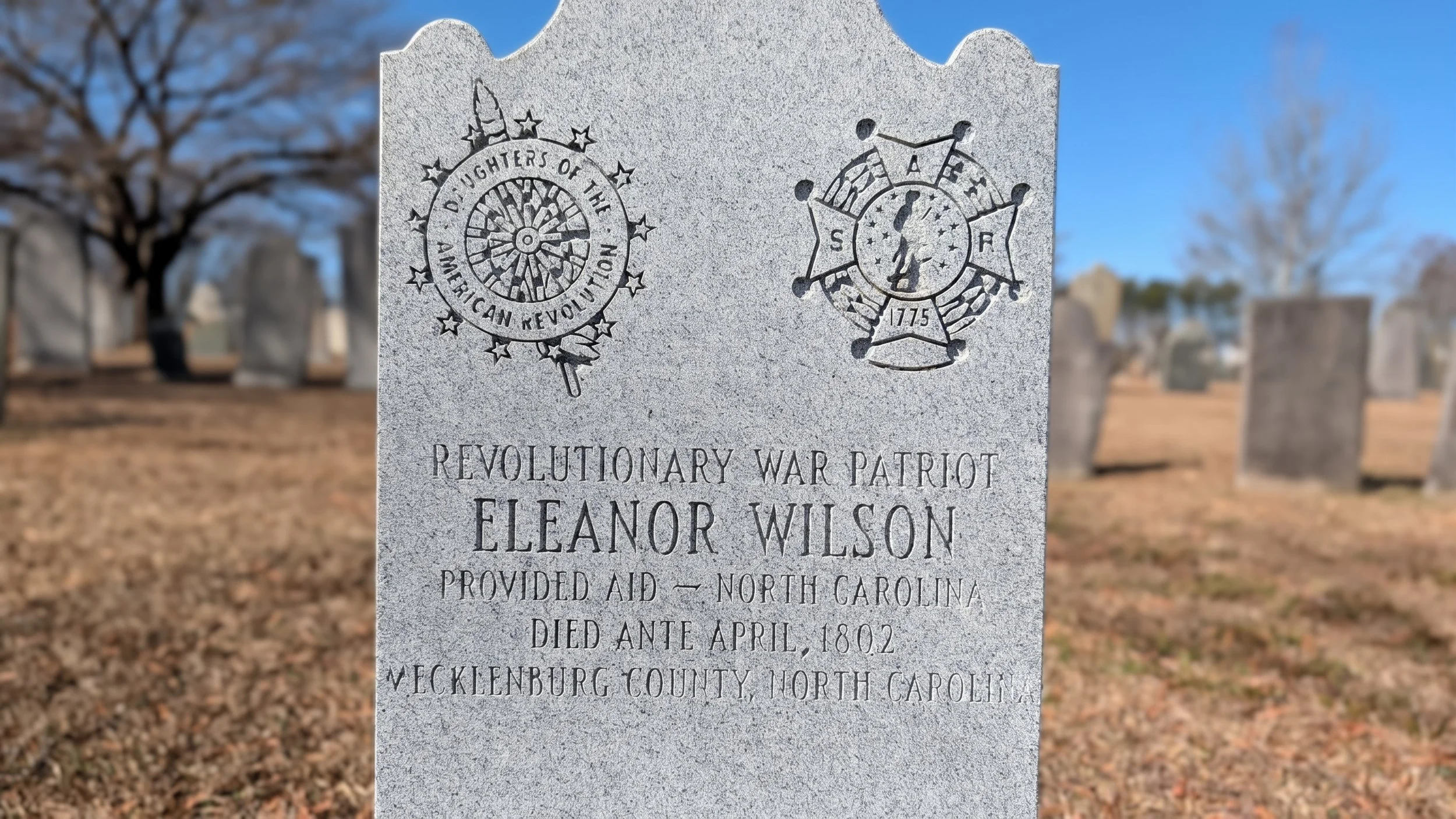
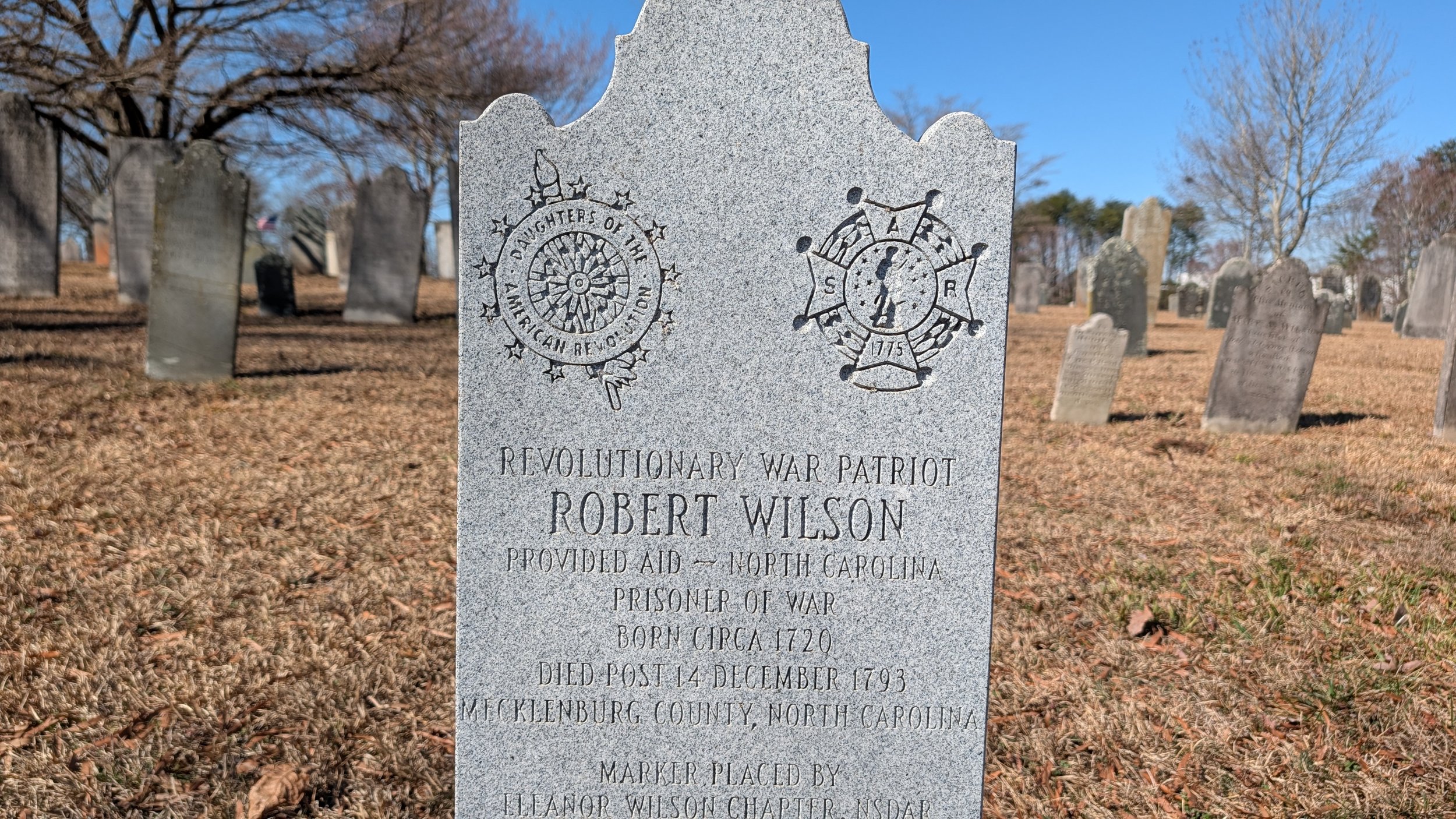
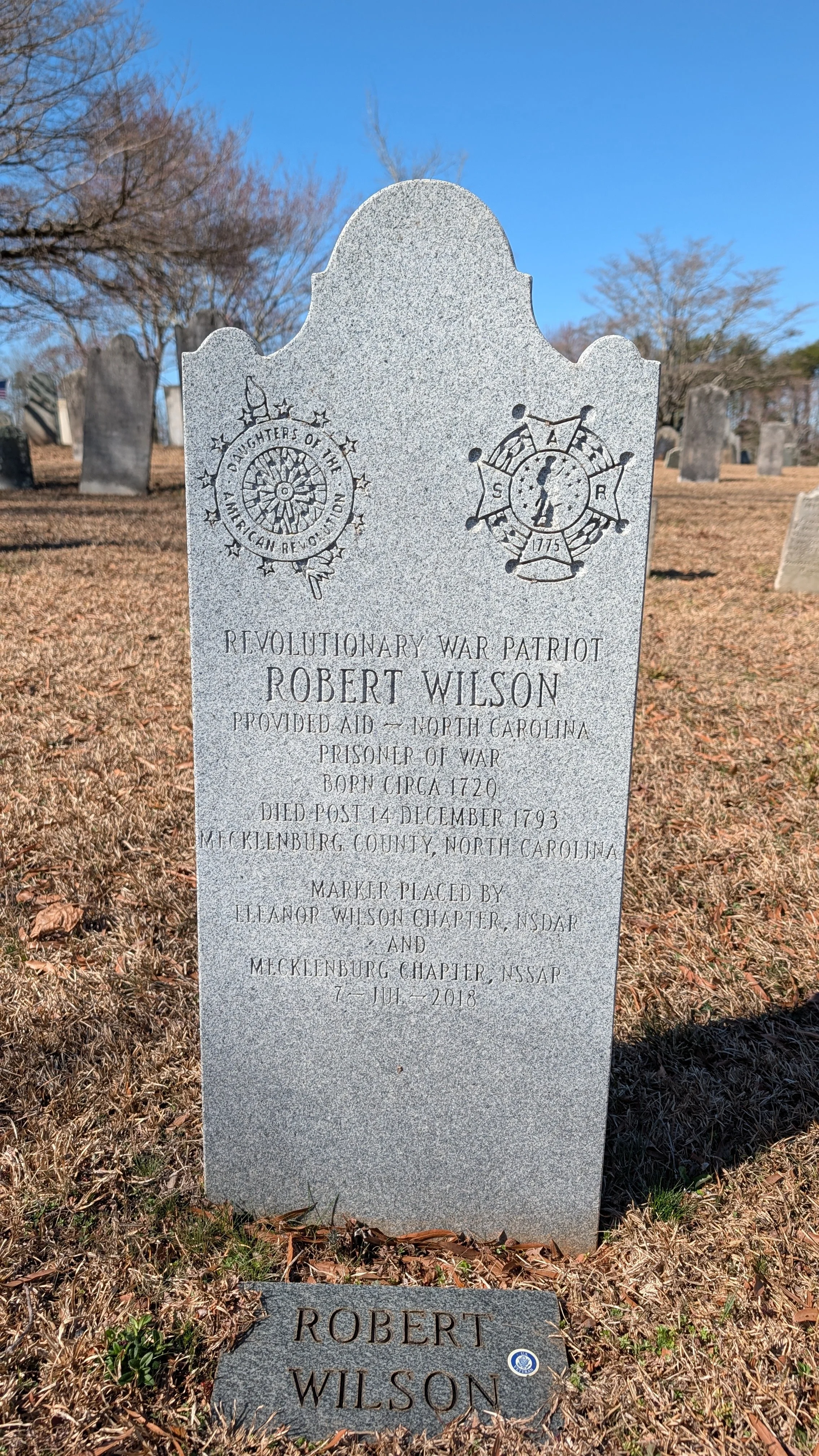
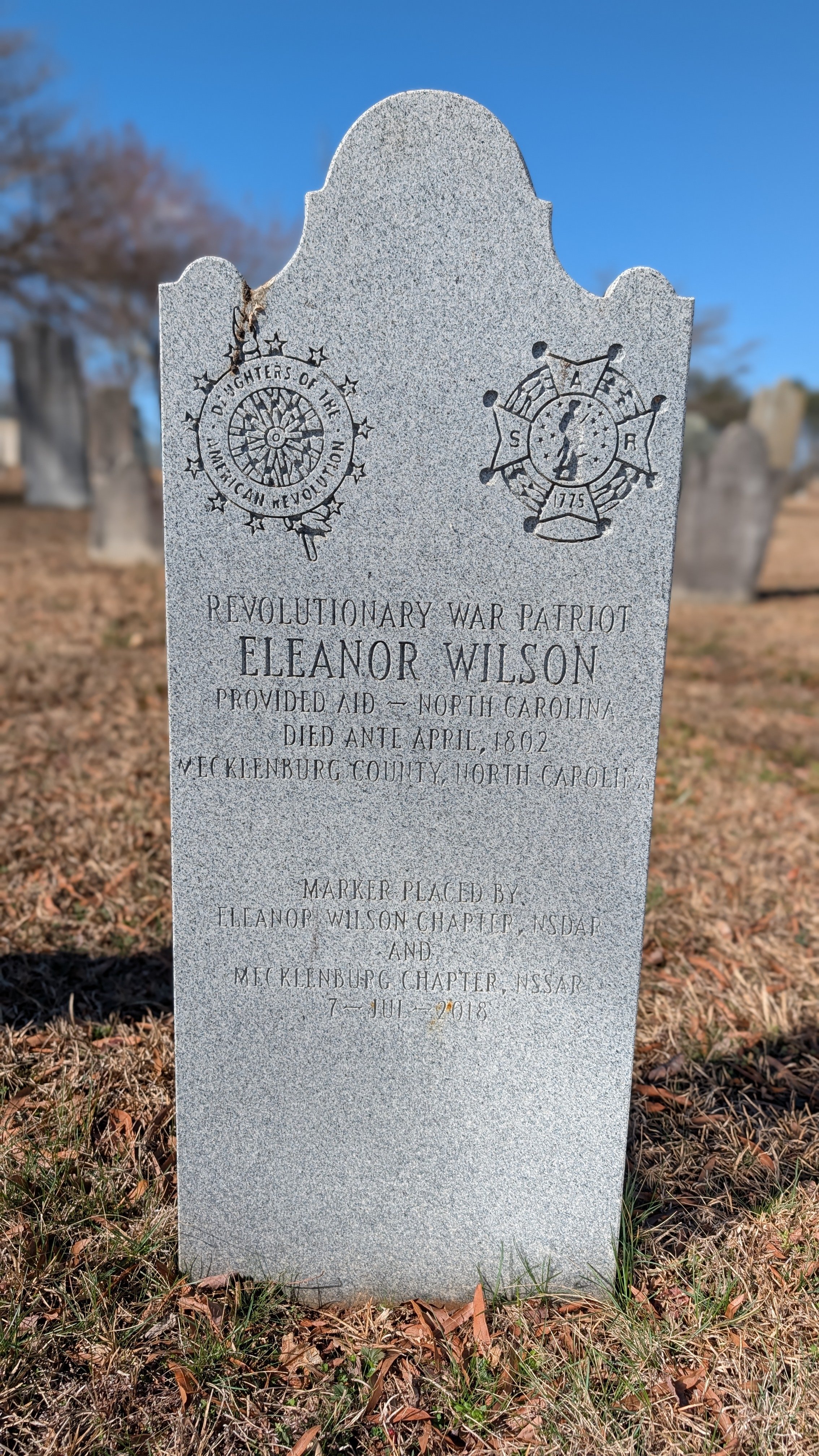
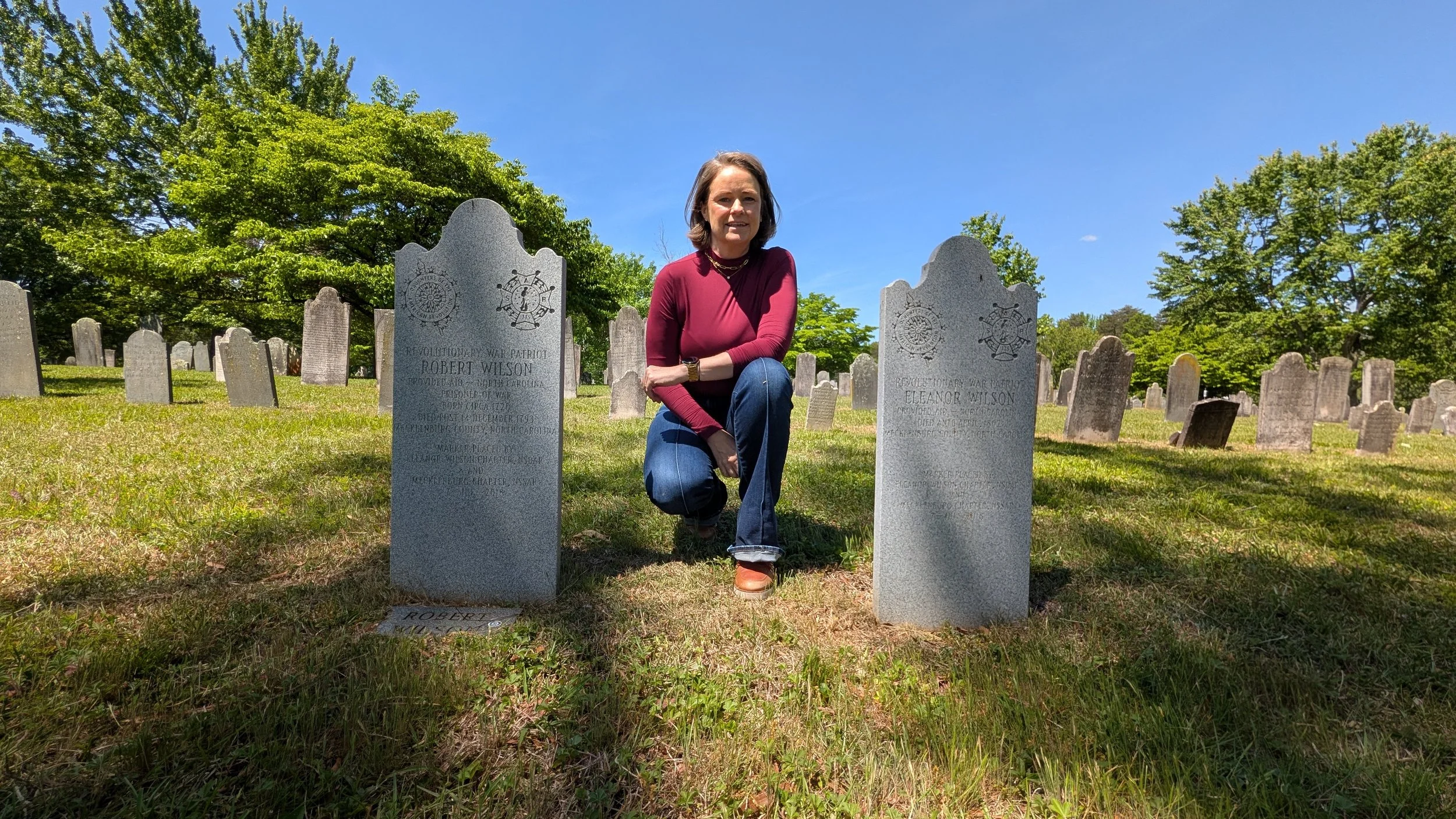
Robert and Eleanor are remembered today at Steele Creek Presbyterian Church Cemetery in southwest Charlotte, where a gravestone bearing both their names stands among some of the oldest burials in Mecklenburg County. But it is a modern stone that was dedicated on July 7, 2018, by the Eleanor Wilson Chapter of the Daughters of the American Revolution, a Washington, D.C., chapter founded by one of her descendants in 1918 and named in her honor, together with the Mecklenburg Chapter of the Sons of the American Revolution. It replaced an earlier DAR marker; the chapter's founding regent first marked Eleanor's grave in 1921.
Since no original 18th-century stone exists for either Robert or Eleanor and records don’t indicate exactly where they were laid to rest, this stone marks the general area the Wilsons are believed to be buried, rather than their exact graves.
Robert’s stone lists his contributions: “Provided Aid; Prisoner of War” and Eleanor’s lists hers: “Provided Aid. But these stones could never convey the full story of the sacrifices and bravery of the Wilson family in the literal face of the British crown. I’m grateful for the chance to bring their family story to light because it deserves to be told so we can better understand the contributions of individual families to the cause of American independence.
This project is made possible by readers like you.
Your support helps to pay for website costs, gas to travel to these sites, and cleaning supplies for the veteran stones that I’m working to restore.
If you believe this work is important, your support is so appreciated!
Citations
Pension application of Jane Wilson, widow of Robert Wilson Jr., W216, with depositions of Moses Wilson, Josiah Wilson and Phebe Reid. Transcribed by Paulette Haynes; annotated by Will Graves. Southern Campaigns American Revolution Pension Statements, revwarapps.org/w216.pdf.
Pension application of James Wilson, S3565. Transcribed by Paulette Haynes; annotated by Will Graves. revwarapps.org/s3565.pdf.
Will of Robert Wilson, Mecklenburg County Will Book F, p. 225 (1793), and estate records of Robert Wilson (1794 to 1795) and Eleanor Wilson (1802), as abstracted in Herman and Ralph Ferguson's Mecklenburg County will and court abstracts and transcribed by Paulette Haynes, A Wilson Family History and Genealogy. Originals not yet examined.
Elizabeth F. Ellet, The Women of the American Revolution, Vol. III (1852), ch. 20, pp. 347 to 356.
C. L. Hunter, Sketches of Western North Carolina, Historical and Biographical (1877), via AccessGenealogy.
Nancy Griffith, "One Family's Revolutionary War," News of Davidson, March 26, 2026.
Daughters of the American Revolution, Honoring Our Patriots: Eleanor Wilson, Ancestor A127330.
Eleanor Wilson Chapter NSDAR, chapter history; NC Society Sons of the American Revolution, 2018 grave marking announcement.
Find a Grave, Eleanor Carothers Wilson, Memorial 43583257.