Col. John Dooly & Diannah Dooly [#42-43/250]
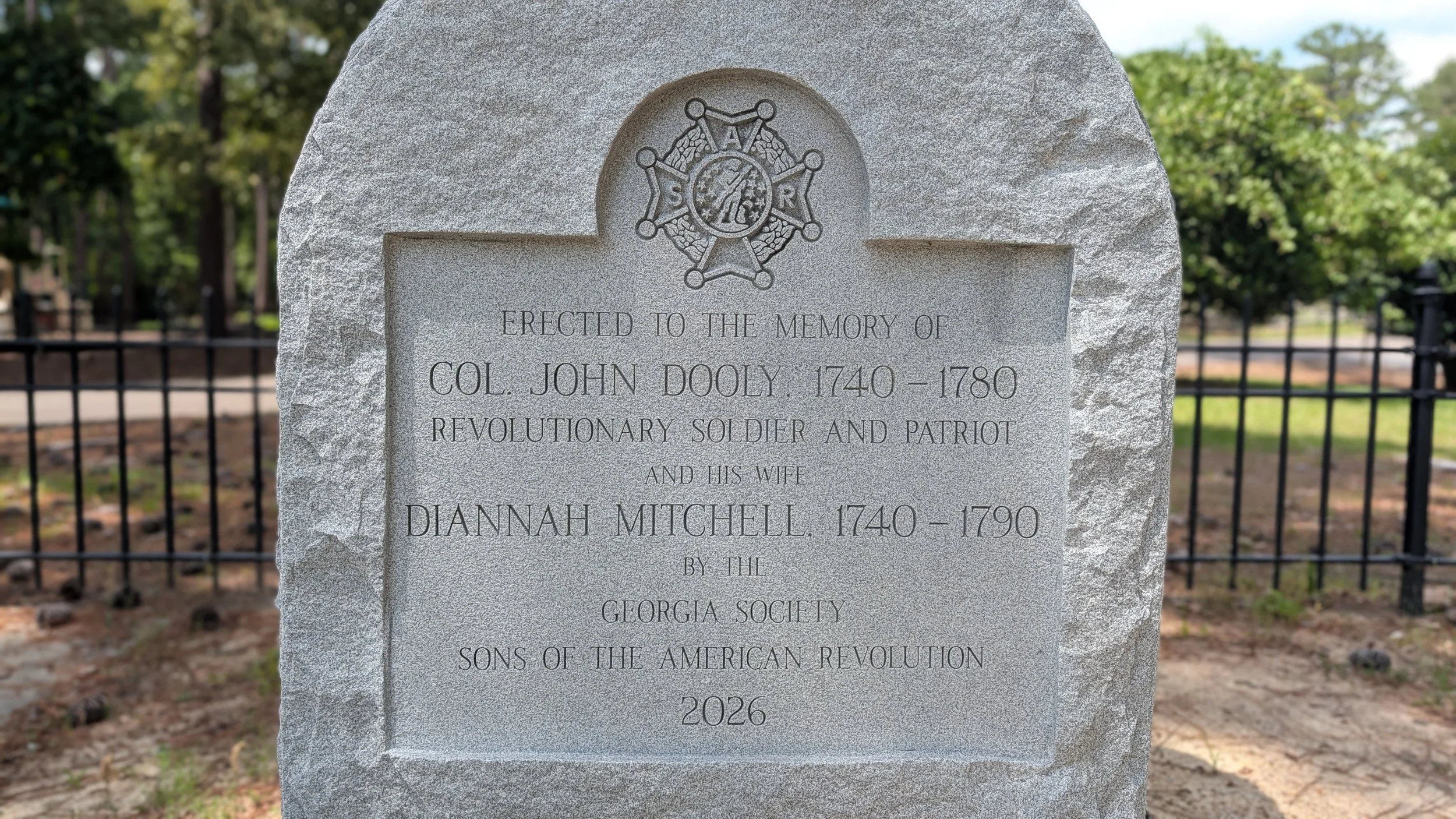
Col. John Dooly (1740-1780) & Diannah Dooly (1740-1790)
Memorialized at Elijah Clarke State Park | Jefferson County, GA
More than 250 years after the Revolution began, we still don't know where Col. John Dooly is buried or who murdered him, which is a strange fate for a man who helped lead Georgia Patriots to one of their first major victories in the backcountry. Dooly, a surveyor and merchant, was killed in his own home in 1780, and it was not until February 2026 that the Sons of the American Revolution dedicated a memorial marker in his honor at Elijah Clark State Park.
His wife, Diannah, like so many other women of the era, left far less of a paper trail, but what survives points to a story that is common and too often overlooked. While John was away commanding troops, she raised a family on a dangerous frontier. John's murder in 1780 left Diannah a widow with young children while the war was still being fought. The couple had at least three children, though the records don't say how many were living with her. In the years that followed, the family faced an eviction order and claims from creditors.
Together, their lives show that the Revolution in the South was fought in kitchens, forts, and courtrooms as well as on battlefields, over land, debt, and revenge. The Doolys were in the middle of all of it.
Moving Through the Southern Frontier
John Dooly's story starts with his father, Patrick, a probable Irish immigrant who appears in Frederick County, Virginia, land records as early as 1755. Like thousands of other families of Irish and Scots-Irish descent, Patrick moved south along the colonial frontier, likely in search of cheap land to develop and sell. Sometime between August 1764 and July 1765, he settled in the South Carolina backcountry, a rough, loosely governed region far from the colonial government in Charleston.
I haven't been able to confirm where John Dooly was born. Sources give years ranging from 1735 to 1744, with about 1740 the most common. By Dec. 6, 1768, Patrick and his wife, Anne, had both died, and John, by then an adult, traveled more than 150 miles to Charleston to settle the estate. The probate inventory, as described by historian Robert Scott Davis, listed household goods, books, the remains of a small wheelwright or blacksmith shop, and an enslaved woman and an enslaved child. John sold the last of his father's land. Neither of the enslaved people is named in the sources consulted for this entry, and what became of them is unknown. By 1772, John himself held seven enslaved people, according to Davis, though whether any were the woman and child from his father's estate is unknown.
Land and Lawlessness on the Frontier
On Feb. 3, 1768, John Dooly received a commission as a deputy surveyor, a job that put him at the center of the frontier's most important source of wealth: land. Patrick's estate included the remains of a wheelwright or blacksmith shop, so where John learned surveying is unknown. By 1771, South Carolina was employing him, quite likely on the expedition to mark the boundary between North and South Carolina. He also became a merchant. A Scottish traveler wrote in 1774 that frontier families found store prices high, a complaint that applied to merchants like Dooly.
Court records also offer a glimpse of frontier life. In 1771, Dooly traveled to Charleston to defend himself against a debt claim based on a note bearing a crudely forged copy of his signature, made two years earlier. In another case, a man named William Thomson sued Dooly for allegedly beating him with swords and staves. Dooly answered that Thomson had repeatedly threatened his life. Disputes like these show why backcountry settlers pushed so hard for courts, towns, and the rule of law.
Diannah Mitchell Dooly
At some point in these years, John married Diannah (also spelled Dianna) Mitchell. I haven't been able to find their marriage date, her parents, or her birthplace. Her dates are listed as 1740 to 1790, but I haven't found a document confirming either year.
Historian Robert Scott Davis considers her "quite likely" related to the Mitchell family of South Carolina surveyors, which included the deputy surveyor Thomas Mitchell. That is an educated guess, not a documented fact, but the two families were clearly connected. Thomas Mitchell became the first husband of John's sister, Elizabeth, and in 1777 the brothers-in-law traveled to Virginia and North Carolina together to recruit soldiers for the Georgia forces, with Mitchell serving as a lieutenant. If Davis is right, the Mitchells and Doolys were joined by two marriages, as well as by land surveying and, later, military service in the Revolution.
By 1773, John and Diannah had a growing family. It eventually included at least three children: two sons, John Mitchell and Thomas, and a daughter, Susannah.
Betting Everything on the Ceded Lands
In January 1772, John mortgaged 2,050 acres of his South Carolina land to Charles Pinckney of Charleston, raising capital for a major investment. A few months later, he petitioned for land across the Savannah River in Georgia and obtained a Georgia surveyor's commission.
Then, in 1773, Georgia's royal governor, James Wright, persuaded the Creek and Cherokee nations to hand over about 1.5 million acres, known as the Ceded Lands, to cover debts they allegedly owed to white traders. The land lay northwest of Augusta, and Wright wanted it filled with settlers from other colonies who could add to Georgia's population and militia. Some Creek bitterly resented the cession, and raiding parties attacked the new settlements in 1773 and 1774, even defeating the local militia.
The Doolys arrived in 1773 or 1774, while those attacks were underway. John first built a cabin on Fishing Creek, then abandoned it and claimed 500 acres, including a 200-acre tract on the Savannah River known as "Lee's Old Place," or Leesburg. He named the property "Egypt," though history remembers it as Leesburg. He borrowed heavily to pay for it, including from a wealthy neighbor named Thomas Waters. One biographical entry lists a mill, a fort, a ferry, and a plantation on the property. According to Davis, John held seven enslaved people by 1772 and sold at least three of them to help finance improvements.
There were problems from the beginning. The land had been taken from the Creek and Cherokee, and some Creek raiders were fighting to take it back. The Leesburg tract also came with a legal problem: Thomas Lee had obtained a warrant of survey for it in 1759, never received a formal grant, and never stopped claiming it. John was now deeply in debt, with a contested title to the land he had gone into debt to improve.
Signing for the King
Here's a twist that surprised me: in 1774, John Dooly put his name on a petition supporting the British Crown.
Anger over taxes and tea was spreading through the colonies, and Georgia's most outspoken Patriots, concentrated along the coast, gathered at Tondee's Tavern in Savannah to discuss resistance. A group of backcountry settlers, including Dooly, arrived with a letter of their own. Their message was that Boston's troubles weren't Georgia's troubles, and that the colony needed the king's protection from nearby Native nations. The Savannah radicals refused to compromise.
So the backcountry men went public instead. Dooly, future Patriot leader Elijah Clarke, and hundreds of their neighbors signed petitions backing British rule, and the Georgia Gazette printed them.
So in other words, a man who would later become a Patriot martyr started out as a signer for the king. Historians infer that this was more about practical self-interest than hypocrisy, as these families lived on a dangerous frontier of the colony.
What eventually won them over was the chance to run their own affairs. The Patriot cause offered local control, and for people like John Dooly, that mattered more than anything else.
Georgia Goes to War
Georgia in 1775 was the youngest and most thinly settled of the 13 colonies, with most of its people clustered along the coast and the Savannah River. Many Georgians, especially in the backcountry, felt loyal to Royal Governor James Wright. The Patriot movement was strongest in the port city of Savannah, but out near Augusta and in the Ceded Lands, where the Doolys lived, people were divided, and the region could have gone either way.
By the end of 1775, John Dooly had chosen a side. He helped organize a militia with his neighbors, and in December, he was commissioned captain of his local company. Georgia's Patriots had divided the countryside into districts, each with its own justice of the peace, political committee, and militia company. Dooly served as a justice of the peace and a captain, and likely sat on his district's committee as well.
Militia were part-time citizen soldiers who could be called up whenever a threat arose, and Georgia had threats on every side. In February 1776, Governor Wright fled to a British warship after frontiersmen fired at him and missed. With British vessels now threatening Savannah, Dooly marched his company four days from the Ceded Lands to the coast. That summer, the danger came from the frontier instead, when Cherokee raids on settlements brought another call for militia. Dooly and his company joined an expedition that destroyed two Cherokee villages, part of a much larger campaign in which Virginia and both Carolinas sent thousands more men.
Militia alone were not enough. Congress authorized five regiments of full-time Continental soldiers to defend Georgia, but the colony had so few people that the recruits had to come from elsewhere. By 1777, Dooly held a commission as captain in the Georgia Continental Regiment of Horse, a full-time cavalry unit. That year he went to Virginia and North Carolina to find men, along with his brothers Thomas and George and his brother-in-law Thomas Mitchell. They signed up 97 men, though some were deserters from other military units whom the recruiters had no right to enlist. To pay for the trip, John had borrowed £400 from a man named Peter Perkins, a debt he never repaid.
The war then hit the Dooly family directly. On July 22, 1777, John's brother Thomas Dooly, a captain, was leading 21 men back to their frontier post when about 50 Creek warriors ambushed them near Skull Shoals on the Oconee River. According to historian Robert Scott Davis, Thomas was wounded in the heel and could not move, and his fleeing comrades left him behind. He did not survive.
His brother John's response made things worse. A fur trader named George Galphin had been working as the Patriots' go-between with the Creek Tribe, trying to keep them out of the war on the British side. When a Creek delegation came to visit Galphin, Dooly seized them as hostages, demanding satisfaction for his brother's death.
Georgia's leaders forced him to let them go, and he had to give up the fort where he and his supporters had barricaded themselves. The incident played into the plans of British agents who were trying to turn the Creek against the Americans. Dooly stood trial in Savannah and resigned his captain’s commission that fall.
Life Back Home: Diannah's War
While her husband was in Savannah in early 1776, on campaign that summer, recruiting in Virginia and North Carolina in 1777, and in near-constant militia service from 1778 on, the record on Diannah’s life during this time is incredibly thin. Someone kept the household and the plantation running through all of it. It is reasonable to assume Diannah, along with enslaved people, carried much of that load, though no document says so.
What we can say comes from descriptions of backcountry women in general, not Diannah in particular. A Scottish traveler named William Mylne, who lived near the Doolys in 1774, wrote that the men followed their livestock while the women stayed home to plant a wide variety of grains, vegetables, and fruits. Neighborhoods also built log stockades and blockhouses as refuges from raids, and for some women and children, a fort became a permanent home while the men spent days scouting the countryside. One backcountry woman later recalled being too frightened to open her door once it was shut and too frightened to shut it once it was open. Whether the Dooly family sheltered in a fort, and which one, is not documented.
By 1778 John Dooly had risen in the new state government. Wilkes County had been created in 1777, and he served as its representative, its first sheriff, and eventually commander of its militia. That year he led his neighbors to a victory over Creek raiders at Newsome's Ponds. He was also one of the commissioners who laid out the town of Washington as the county seat. In December 1778, his neighbors voted him colonel, with Elijah Clarke as his lieutenant colonel.
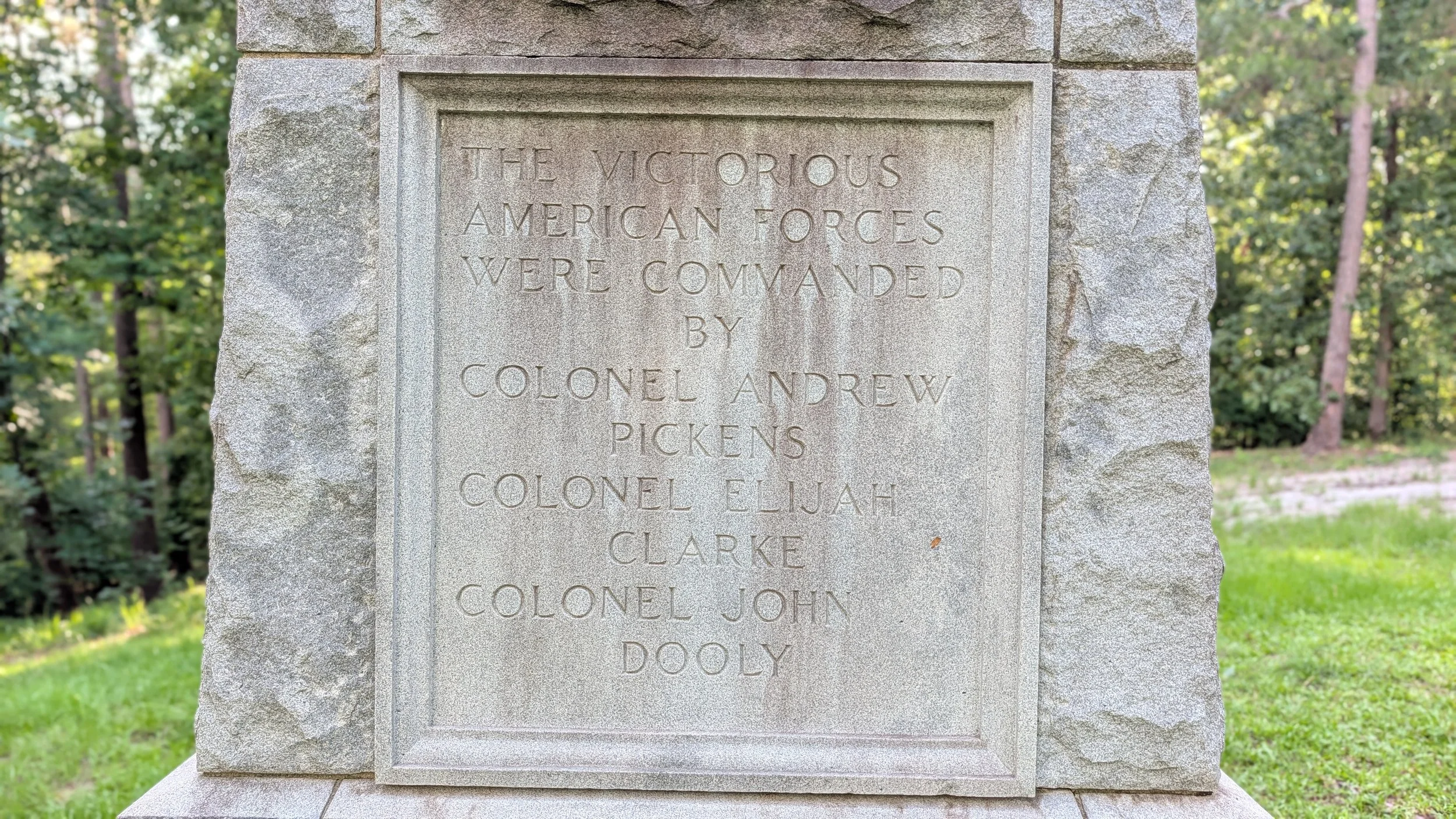
Memorial erected at Kettle Creek Battleground: “The Victorious American Forces Were Commanded By: Colonel Andrew Pickens, Colonel Elijah Clarke, Colonel John Dooly.”
The Battle of Kettle Creek
The timing of his new appointment was serendipitous, and that same month, a British force captured Savannah. By late January 1779, British troops occupied Augusta. They sent Loyalist horsemen (Americans who sided with the Crown, often called Tories) into Wilkes County to collect oaths of allegiance. Many settlers swore the oath, while Dooly and whoever would follow him fled across the river into South Carolina to ask for help.
He found help in Colonel Andrew Pickens, who brought 200 men and, once in Georgia, insisted on commanding the combined force. They chased the Loyalist horsemen across Wilkes County and besieged them at Carr's Fort. Then Pickens learned that a much larger Loyalist column, hundreds of men from the Carolinas under Colonel James Boyd, was marching toward Augusta to join the British. He gave up the siege and raced to intercept them.
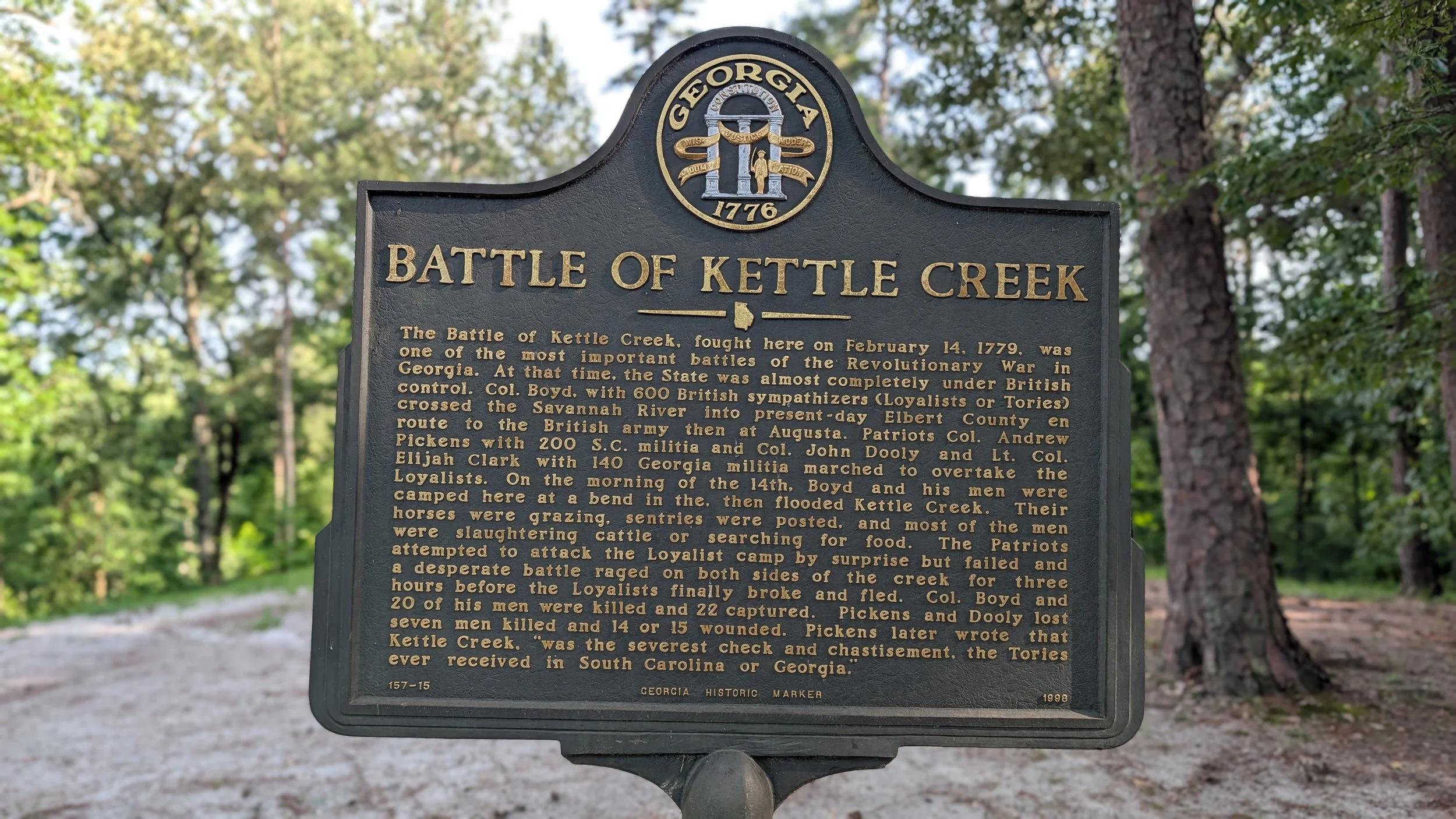
On Sunday, Feb. 14, 1779, Pickens's roughly 340 men found Boyd's force, camped on a hill in a bend of swampy Kettle Creek. Pickens sent Dooly and Clarke through the woods to hit the flanks while he pushed up the center. The attack was messy and nearly went badly, but Boyd was mortally wounded, reportedly by three of Dooly's riflemen. Clarke had a horse shot from under him and led a charge across the creek.
Kettle Creek was the first major Patriot victory in the Georgia backcountry. It destroyed the expected reinforcements for the British in Augusta, who withdrew from the town almost at once.
Georgia's Darkest Year
Dooly's troubles piled up in the summer of 1779. General Benjamin Lincoln, the American commander in the South, complained that Dooly had never sent receipts for the money advanced to him. Dooly also had a fellow officer, George Wells, court-martialed during a dispute over who outranked whom. In October, Dooly and his militia joined a failed Franco-American attack on the British lines at Savannah, one of the deadliest allied defeats of the war. That December, Georgia voters elected a rival faction to power, and Wells, the officer Dooly had court-martialed, became governor.
In February 1780, exactly one year after Kettle Creek, the new government sided with Thomas Lee in the long-running dispute over Leesburg. It ordered Elijah Clarke, Dooly's own lieutenant colonel, to evict the Dooly family by force if necessary. Officials suspended the order when they learned Lee had never held a formal grant. The family facing eviction presumably included Diannah and the children.
Then came the worst blow. In May 1780, the British captured Charleston and the main American army in the South. Dooly and Clarke wanted to keep fighting, but most of the militia chose to give up. In June, Dooly surrendered about 400 men (some accounts say 300) to William Manson, who was acting for the Loyalist commander at Augusta. The men were released on parole, which meant they promised not to fight again in exchange for going home. A small group, between 30 and 100 men depending on the source, refused and followed Clarke into South Carolina.
Georgia now became the only state returned to British colonial rule. The restored royal assembly named Dooly among former rebels barred from public office, and his property was at risk of being seized. Creditors were pressing him, too.
Murder at Leesburg
This part of Dooly's story reads like a true crime mystery, and it was never solved. No account of his death was written at the time, and the earliest surviving versions came years or decades later and disagree with each other. Here is what we can say.
Sometime after early August 1780, John Dooly was killed at his home. He was still alive on Aug. 8, when he wrote a letter about his debts. The latest clue comes from Sept. 23, when Loyalist Lt. Col. John Harris Cruger wrote from the Dooly house while sweeping through Wilkes County, burning about 100 farms, the local forts, and the courthouse. His letter doesn't mention Dooly, which suggests, but doesn't prove, that Dooly was already dead. That leaves a window of roughly early August to late September. Where Diannah and the children were at that time is unknown.
The sources name several different suspects, and none has been confirmed. Hugh McCall, Georgia's first historian, wrote that Loyalists under a Captain Corker were responsible, though a William Corker survived the war and was later taken off the state's banishment list. Dooly's first biographer, in 1828, blamed a McCorkle of South Carolina, whom Dooly's brother George is said to have killed in revenge. A pension applicant named John Smith, who lived with the Dooly family, stated years later that a Loyalist Captain Wilder and his company killed Dooly in his own house despite his parole, and that Smith narrowly escaped. That's the closest thing we have to an eyewitness account, but it was written long after the fact. Another pensioner said one of Dooly's own men killed him.
As for motive, historian Robert Davis suggests several possibilities: retaliation for Dooly's prosecutions of Loyalists, revenge for Clarke's September attack on Augusta, fear that paroled men like Dooly were only waiting for an excuse to fight again, or even an older feud. One of Dooly's pre-war lawsuits had reportedly led to threats on his life.
Legends and Later Stories
Over the years, local legend and later writers added details that have never been confirmed. One version says Diannah and her son John Mitchell watched the killing. George R. Gilmer's 1855 memoir adds that the boy hid under a bed and grew up to avenge his father by killing nine of the murderers.
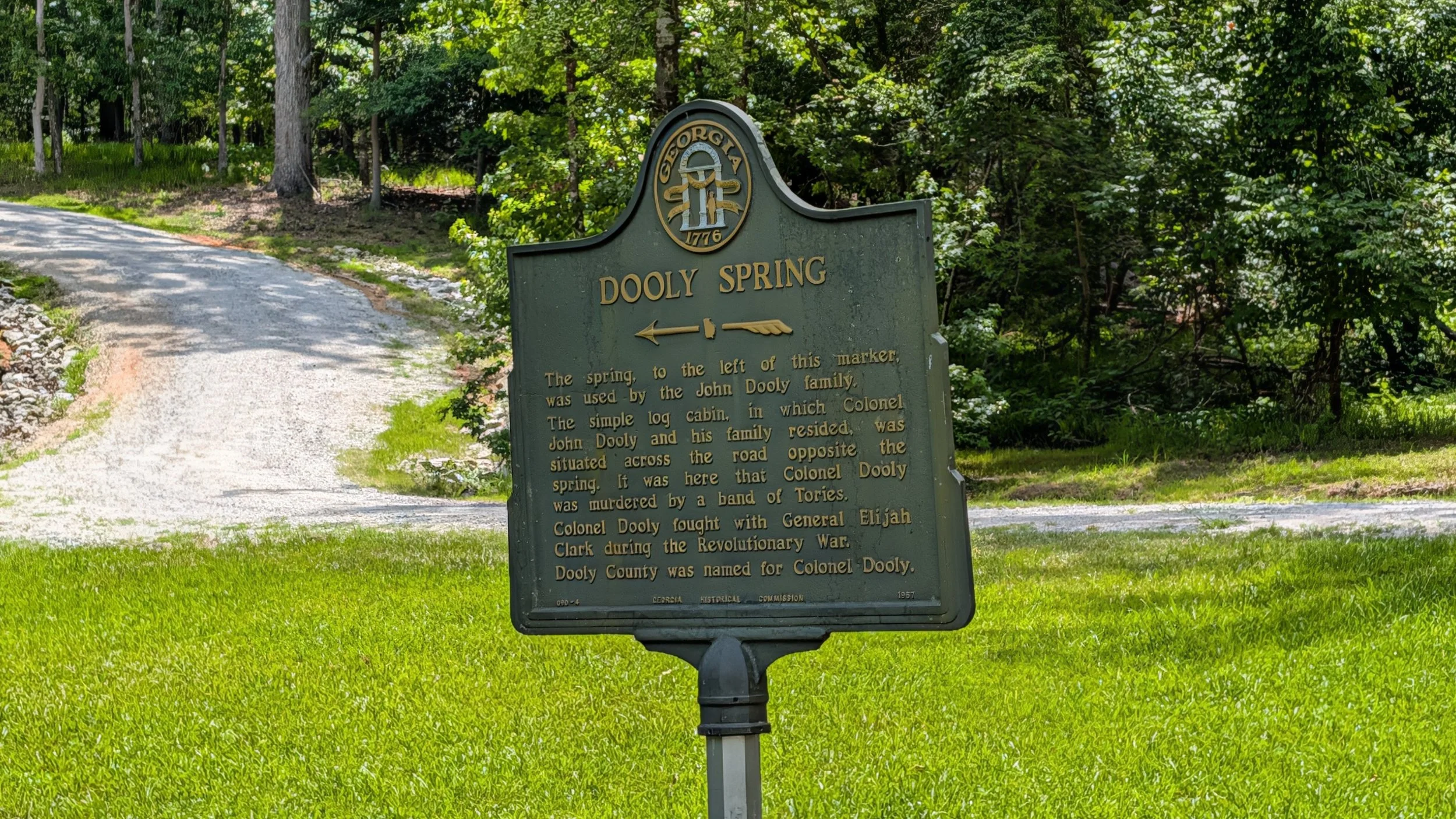
Another tradition says that Elijah Clarke and his wife, Hannah, buried Dooly near Dooly Spring. A Georgia SAR chapter research note doubts it, since Clarke appears to have been fighting in South Carolina for much of that summer, though the uncertain date of death keeps the question open.
A third legend holds that the frontier heroine Nancy Hart captured six of the killers, shot one, and hanged the rest. None of these stories comes from records written at the time, which makes them part of the mystery rather than answers to it.
A Widow's Fight
After the war, the family's troubles continued. The British evacuated Savannah in July 1782, but Georgia's restored Patriot government granted land to Dooly's minor children for his service and then, in response to Thomas Lee's claim, ordered Clarke to evict the widow and orphans from Leesburg anyway.
Creditors, including the exiled Loyalist, Thomas Waters, made claims against the estate. The family reportedly delayed applying for the military bounty land until after 1796, reportedly to keep it out of creditors' reach. A record of the Dooly estate in Wilkes County exists for April 4, 1787, and legal notices about it ran in an Augusta newspaper in 1790 and 1801. Whether Diannah managed the estate is the question I would most like to answer.
Diannah's own story ends with the biggest question mark. Her death is usually placed in 1790, but I couldn’t find any record of where or how she died, and no source says where she is buried.
Despite the family’s poverty, her son, John Mitchell Dooly, studied law and became a prominent Georgia judge and politician, remembered in state literary history for his wit. He is credited with helping win a county for his father's name. Dooly County, Georgia, was created in 1821. Judge Dooly died in 1827 in Lincolnton, Georgia, and is said to be buried in a family plot behind his home, itself now below Lake Blackshear.
Visiting the Marker
John Dooly is remembered at Elijah Clark State Park in Lincolnton, Georgia, on the western shore of Clarks Hill Lake. On Feb. 13, 2026, the Sons of the American Revolution dedicated a memorial marker to him there, with his fifth great-grandson, Felton Bohannan, taking part. It is a memorial, not a grave marker, because John Dooly's burial place has never been found. Some accounts place it somewhere near Dooly Spring, but a Georgia SAR chapter research note reports that a search with human-remains-detection dogs near the spring found no burial and no foundation stones. The same note says his home site probably lies beneath the reservoir, which was created in the 1950s.
An older marker near the spring says the Dooly family used it and that their log cabin stood across the road. It also states as fact that Dooly was murdered there by Tories, though the killers and the exact location remain unsettled.
The park also holds the graves of Elijah and Hannah Clarke and other family members, which were moved as well. They were first relocated in 1952 from their original burial places near Graball, about 10 miles north, to the Community House grounds in Lincolnton, to avoid flooding from the new reservoir. In 1955, with special permission from the Army Corps of Engineers, they were moved again to the park's cemetery enclosure, where they remain.
Why Their Story Matters
John Dooly was no flawless hero. He was a debtor, a quarreler, an enslaver, and a man who took hostages in a fit of grief.
He also signed petitions for the king and then turned around to help win one of Georgia's most important early Patriot victories.
Diannah Mitchell Dooly, whose voice never made it into the record, undoubtedly held the family together through war, debt, and loss. Their story shows what the Revolution looked like in the Georgia backcountry.
This project is made possible by readers like you.
Your support helps to pay for website costs, gas to travel to these sites, and cleaning supplies for the veteran stones that I’m working to restore.
If you believe this work is important, your support is so appreciated!
Citations
Davis, Robert Scott. "The Murder of Colonel Dooly of Georgia: A Revolutionary War Mystery." Journal of the American Revolution, May 3, 2017. https://allthingsliberty.com/2017/05/murder-colonel-dooly-georgia-revolutionary-war-mystery/
Davis, Robert Scott. "A Frontier for Pioneer Revolutionaries: John Dooly and the Beginnings of Popular Democracy in Original Wilkes County." Georgia Historical Quarterly 90, no. 3 (Fall 2006): 315 to 349.
"Dooly, John." Encyclopedia.com. https://www.encyclopedia.com/history/encyclopedias-almanacs-transcripts-and-maps/dooly-john
Georgia Historical Society. "Marker Monday: Dooly County." Jan. 22, 2024. https://www.georgiahistory.com/marker-monday-dooly-county/
American Battlefield Trust. "John Dooly." https://www.battlefields.org/learn/biographies/john-dooly
Sons of the American Revolution chapter research note. "A Possible Resolution to the Mystery of Col. John Dooly's Death." http://www.saratlanta.org/wp-content/uploads/2017/05/DoolyDeath.pdf
Cordele Dispatch. "Sons of the American Revolution Dedicated a Memorial Marker to John Dooly." Feb. 18, 2026. https://cordeledispatch.com/2026/02/18/sons-of-the-american-revolution-dedicated-a-memorial-marker-to-john-dooly/