Capt. Alexander Pagan [27/250]
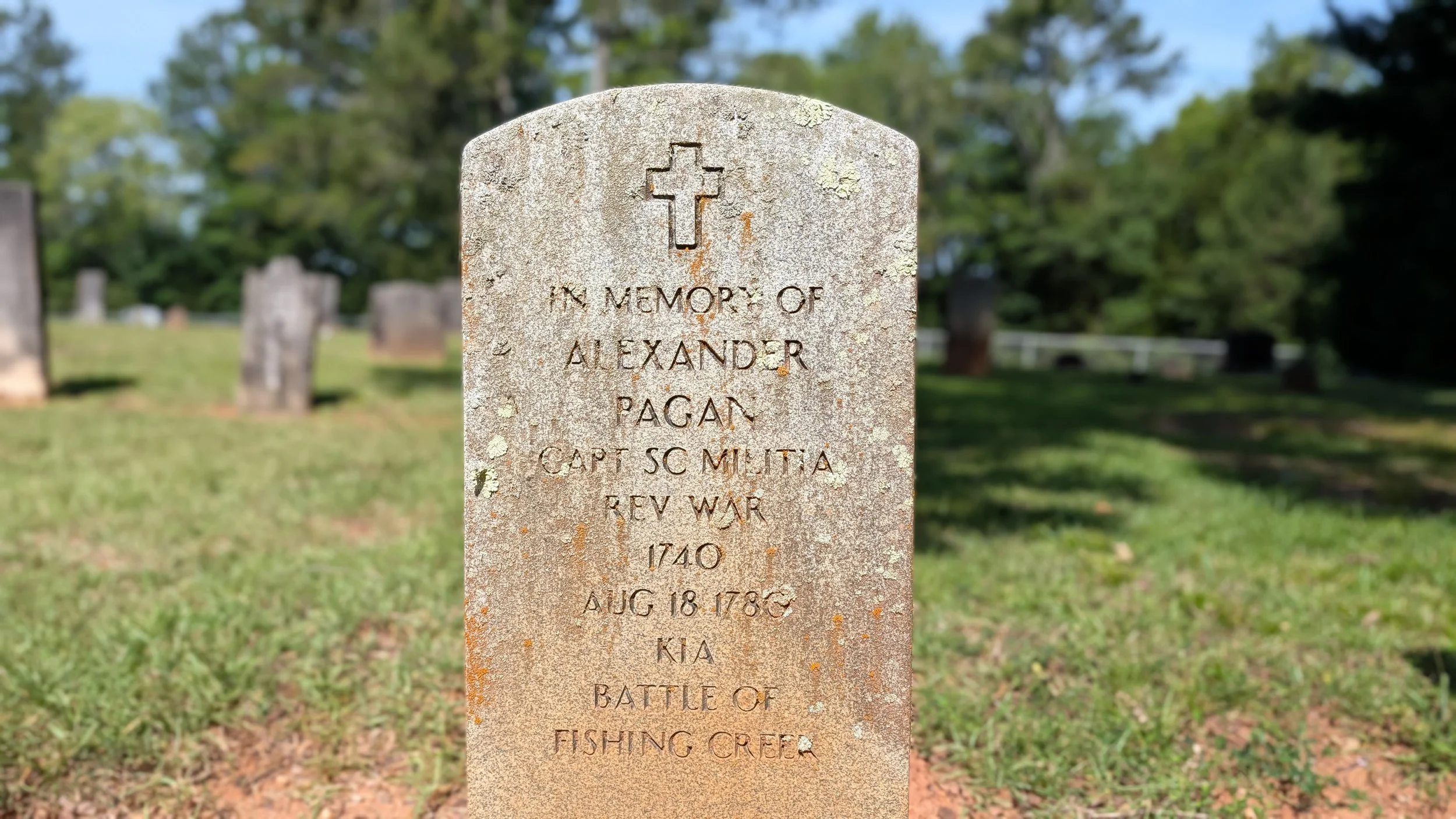
Capt. Alexander Pagan (1740-1780)
Buried at Fishing Creek Presbyterian Church | Chester County, South Carolina
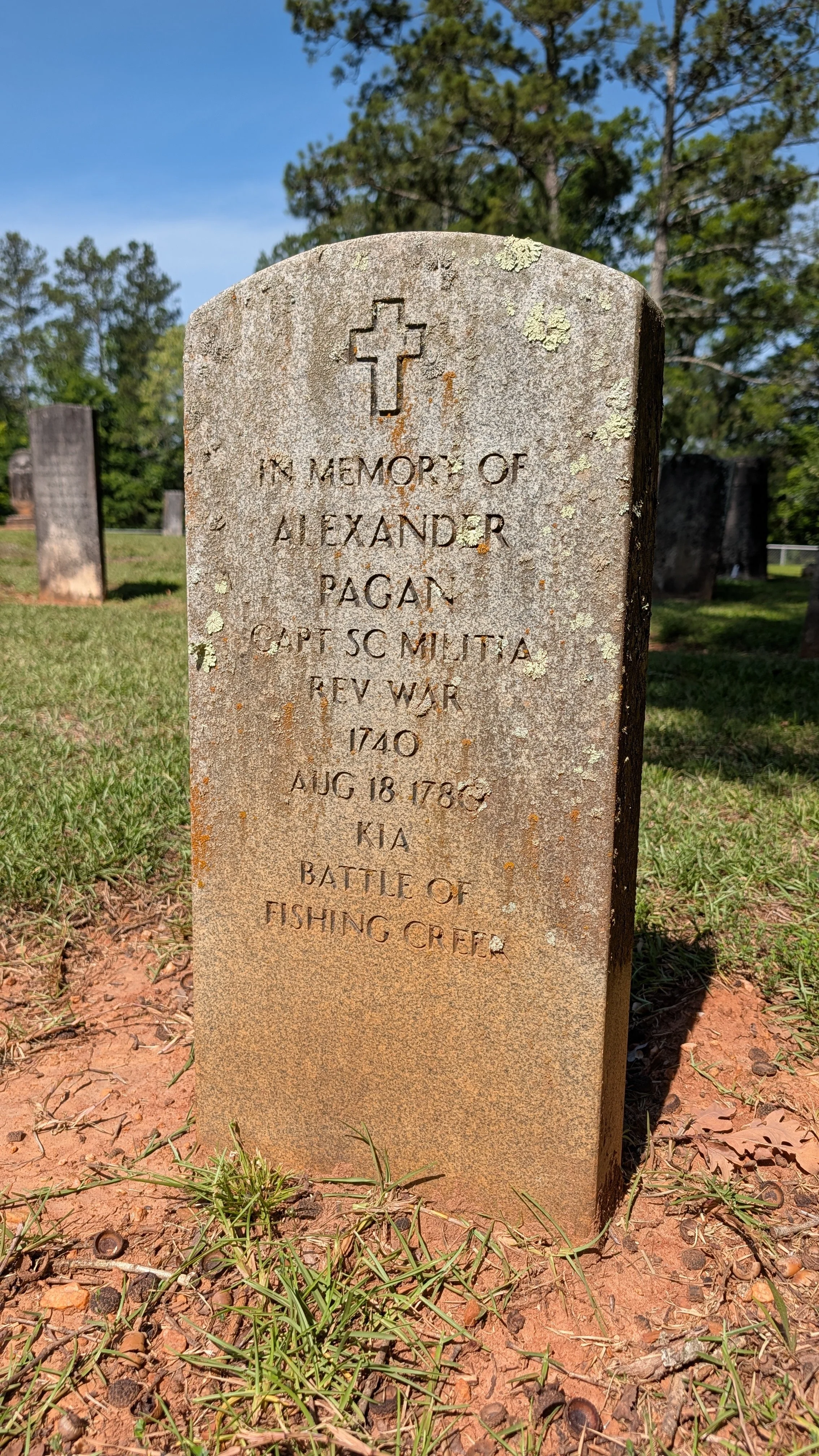
Walking through the graveyard at Fishing Creek Presbyterian Church, you'll notice many veteran markers from the American Revolution. One after another in row after row. Dozens of Patriot names are carved into the stone, and it's obvious that something was happening out here in Chester County that so many were willing to take up arms against the British Crown. And many of them paid dearly for that, like Capt. Alexander Pagan. The inscription on his stone says he was "Killed in Action at the Battle of Fishing Creek." But what is the rest of his story?
Early Life
Researching his story, I found discrepancies on whether he was born in 1740 or 1746, but in either case, family trees maintain that he was born in County Antrim, Ulster. His family traveled across the ocean to settle in America, and while it's not clear where they landed initially, we do know that they eventually settled in a tight-knit Scots-Irish Presbyterian settlement that filled in along Fishing Creek during the 1750s and 1760s. By 1770, this group had organized a Presbyterian church; Rev. John Simpson was installed as its pastor in 1774. Pagan married Jannet Kelso (1751-1826), and family trees credit the couple with two children in total, a daughter named Susannah (b. 1778) and a son, Alexander Pagan, Jr (born c. 1780 or 81).
Alexander Pagan and most of his neighbors were ordinary farmers, who found themselves in a land far from home, looking for religious freedom and better opportunities for their children. They would've been content to live an ordinary farming life, but destiny had something else planned for Alexander Pagan and his neighbors.
When the War Came South
After the Second Continental Congress adopted the Declaration of Independence on July 4, 1776, the fighting to that point had been concentrated far from South Carolina, mostly in New England and the mid-Atlantic colonies (except for a failed British attempt to take Charleston in 1776). That changed once the British settled on a new approach to winning the war. They had failed to crush the rebellion in the North, and Gen. George Washington's Continental Army, though often battered, refused to disappear. So British strategy shifted attention to the Southern colonies, betting that Georgia, South Carolina, and the Carolina backcountry held enough Loyalist sympathy to let them reclaim the South county by county and squeeze the rebellion from the bottom up.
The plan started well for the Crown, with British forces capturing Savannah, Georgia, in December 1778. With Georgia secured, British commander Sir Henry Clinton set his sights on Charleston, the wealthiest and most important port city in the South, landing thousands of troops south of Charleston in February 1780. They spent the following months tightening a siege around the city, trapping the Southern Continental Army with nowhere to retreat. Gen. Benjamin Lincoln surrendered the city, and his army with it, on May 12, 1780. It remains one of the worst defeats American forces suffered in the entire war: more than 5,000 Continental soldiers and militia captured in a single stroke, and with them, the only organized American army left in the South.
For farmers like Alexander Pagan, more than 200 miles inland in the Fishing Creek settlement, the fall of Charleston was a turning point.
The Summer It All Changed
With Charleston in British hands, Lord Cornwallis pushed his army into the backcountry, planting an outpost 20 miles from Fishing Creek at Rocky Mount, South Carolina, which was garrisoned in part by a troop of dragoons under a young captain named Christian Huck. Huck had earned a bitter reputation in this neighborhood within weeks. Then, that June, the British ordered every man in the district to swear allegiance to the Crown or be treated as an enemy. Alexander Pagan was among the men of this congregation who chose to fight. He raised a company, first under the New Acquisition District Regiment, which folded that summer into Col. Edward Lacey's Turkey Creek Regiment, and spent the next four months fighting almost without pause.
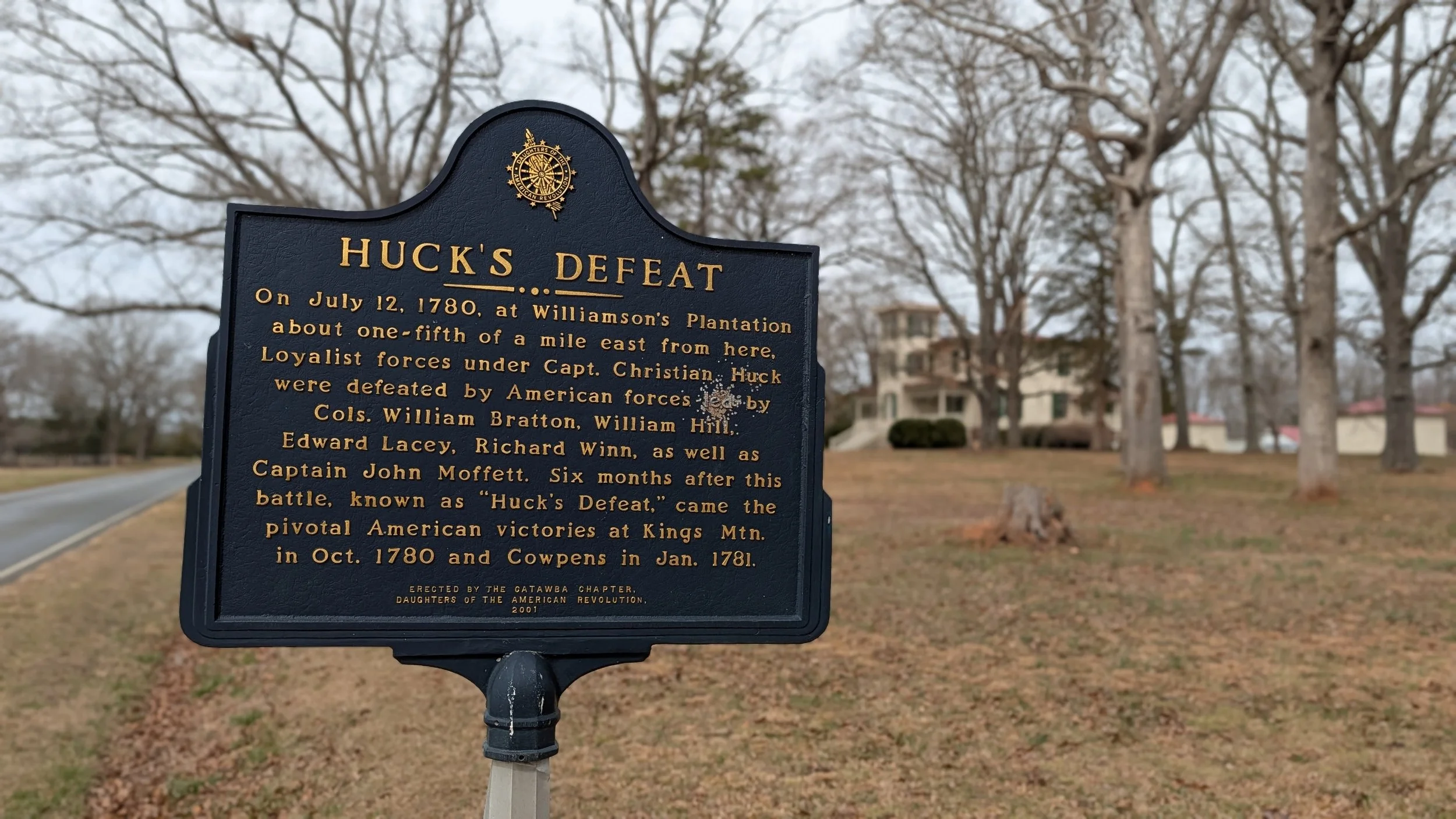
Four battles in six weeks
His company was in the fight at Williamson's Plantation on July 12, the engagement remembered ever since as Huck's Defeat, where a surprise dawn attack broke the Loyalist force and killed the captain who had spent weeks terrorizing this neighborhood. It was one of the first real Patriot victories in the South Carolina backcountry after Charleston fell, and it sent recruits flooding into Gen. Thomas Sumter's Patriot brigade, Pagan's company among them.
Eighteen days later, on July 30, his men were at Rocky Mount, part of Sumter's unsuccessful assault on the British post that had loomed over their homes all summer. One week after that, on Aug. 6, Pagan's troops fought again at Hanging Rock, a brutal, close-quarters battle that thinned the ranks of nearly every Fishing Creek family with a son or husband in the field. Pagan survived all three battles, but he would not survive the fourth.
Part of the Fishing Creek battlefield has been flooded by damming on the Catawba River. This excerpt from Mills' 1825 atlas of South Carolina was used to roughly locate the original banks of the Catawba River in the above battlefield map. Islands shown in the 1825 atlas were not included in the battlefield map. Note that Mills' map designates the "Battle of F. C."
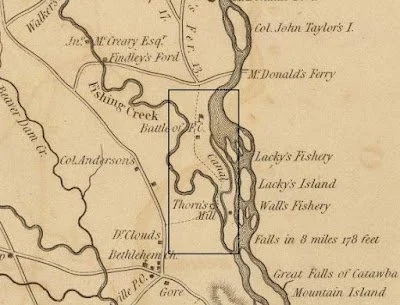
Excerpt of 1825 Mills Map, showing Fishing Creek, with notation that includes: “Battle of F.C.”
The Battle of Fishing Creek, Aug. 18, 1780
The Battle of Fishing Creek, also called the Battle of Catawba Ford, or the War on Sugar Creek, was fought north of Great Falls, between American Patriots and British Forces, on August, 18, 1780. That morning, Banastre Tarleton's dragoons caught Sumter's exhausted brigade resting near the mouth of Fishing Creek at Catawba Ford, the same creek that gave this church and this community their names. The surprise was total. More than 150 Patriot militia were killed and roughly 300 captured in a matter of minutes. Alexander Pagan was among the dead, cut down at the end of a brutal summer he had fought valiantly through.
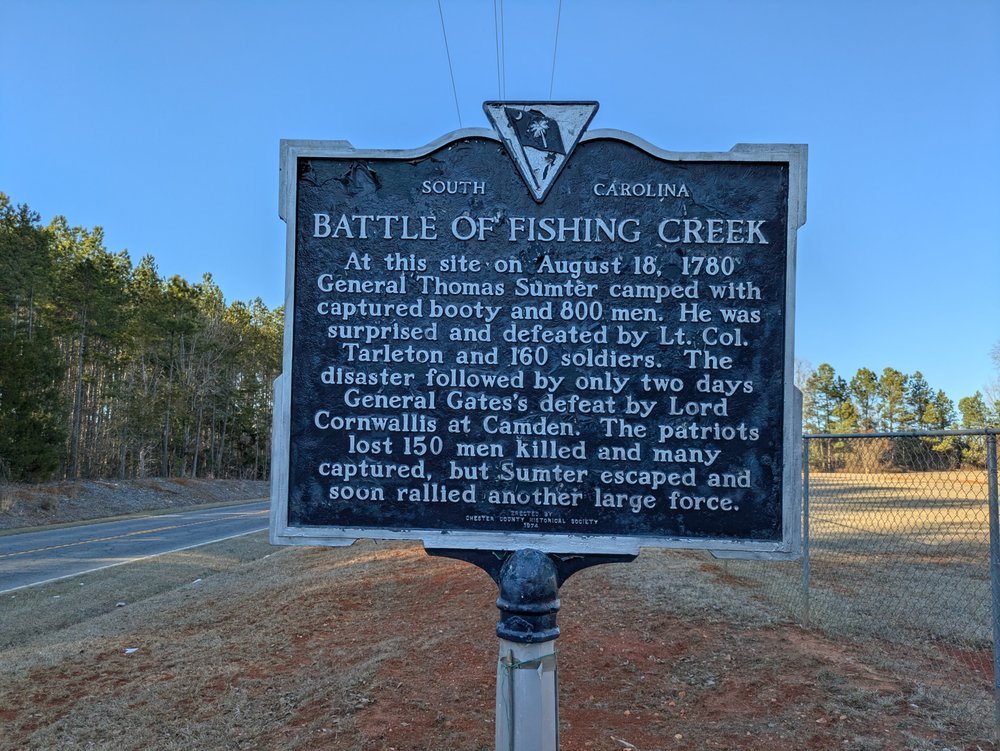
Photo courtesy of Bruce K.
What he left behind
When Capt. Alexander Pagan died, he left a pregnant wife behind. Family sources indicate his will specifically named the child Jannet was carrying, an unborn son he would never meet. That son, Alexander Pagan Jr., was born later that year in Chester County.
Cenotaph or actual grave?
His marker stands today on the grounds of Fishing Creek Presbyterian Church, one of dozens of names cut into stone honoring the Revolutionary soldiers connected to this congregation. Unlike most of the veterans remembered beside him, though, Pagan almost certainly never came home to be buried here.
When Alexander was killed in action, he was 25 or 30 miles from home. In the chaos of battle, those who died were rarely recovered and carried back for burial, and my guess is that Alexander was among the men who were left at Catawba Ford. Although this is just a hunch, there isn't any record that his body was ever transported here, so it's more likely that his marker at Fishing Creek Presbyterian Church is a cenotaph, meant to memorialize a person, though not a true marker of their grave.
This man fought through the brutal battles of the summer and was killed in action. His body was likely never returned, but a cenotaph marks his memory at the church he called home.
This project is made possible by readers like you.
Your support helps to pay for website costs, gas to travel to these sites, and cleaning supplies for the veteran stones that I’m working to restore.
If you believe this work is important, your support is so appreciated!
Citations
Sources
Moss, Bobby Gilmer. Roster of South Carolina Patriots in the American Revolution. Baltimore: Genealogical Publishing Co., 1983.
Scoggins, Michael C. "Three Months in 1780." New Acquisition Militia. York County Culture and Heritage Commission, June 2003. https://newacquisitionmilitia.com/three-months-1780/.
"Williamson's Plantation, Battle of." South Carolina Encyclopedia. University of South Carolina Institute for Southern Studies. https://www.scencyclopedia.org/sce/entries/williamson's-plantation-battle-of/
Lewis, J.D. "Capt. Alexander Pagan." The American Revolution in South Carolina. Carolana.com. https://www.carolana.com/SC/Revolution/patriots_sc_capt_alexander_pagan.html.
"Alexander Pagan Jr. (1780-1862)." Find a Grave, memorial no. 8551579. https://www.findagrave.com/memorial/8551579/alexander-pagan.
"Battle of Fishing Creek, Battlegrounds in Great Falls, South Carolina." Find a Grave Cemetery, no. 2433324. https://www.findagrave.com/cemetery/2433324.
"Uncovering History: 3 Revolutionary Battle Sites That Shaped Chester County, SC." Visit Chester County, SC. https://visitchestercountysc.com/uncovering-history-3-revolutionary-battle-sites-that-shaped-chester-county-sc/.