John Penn [25/250]
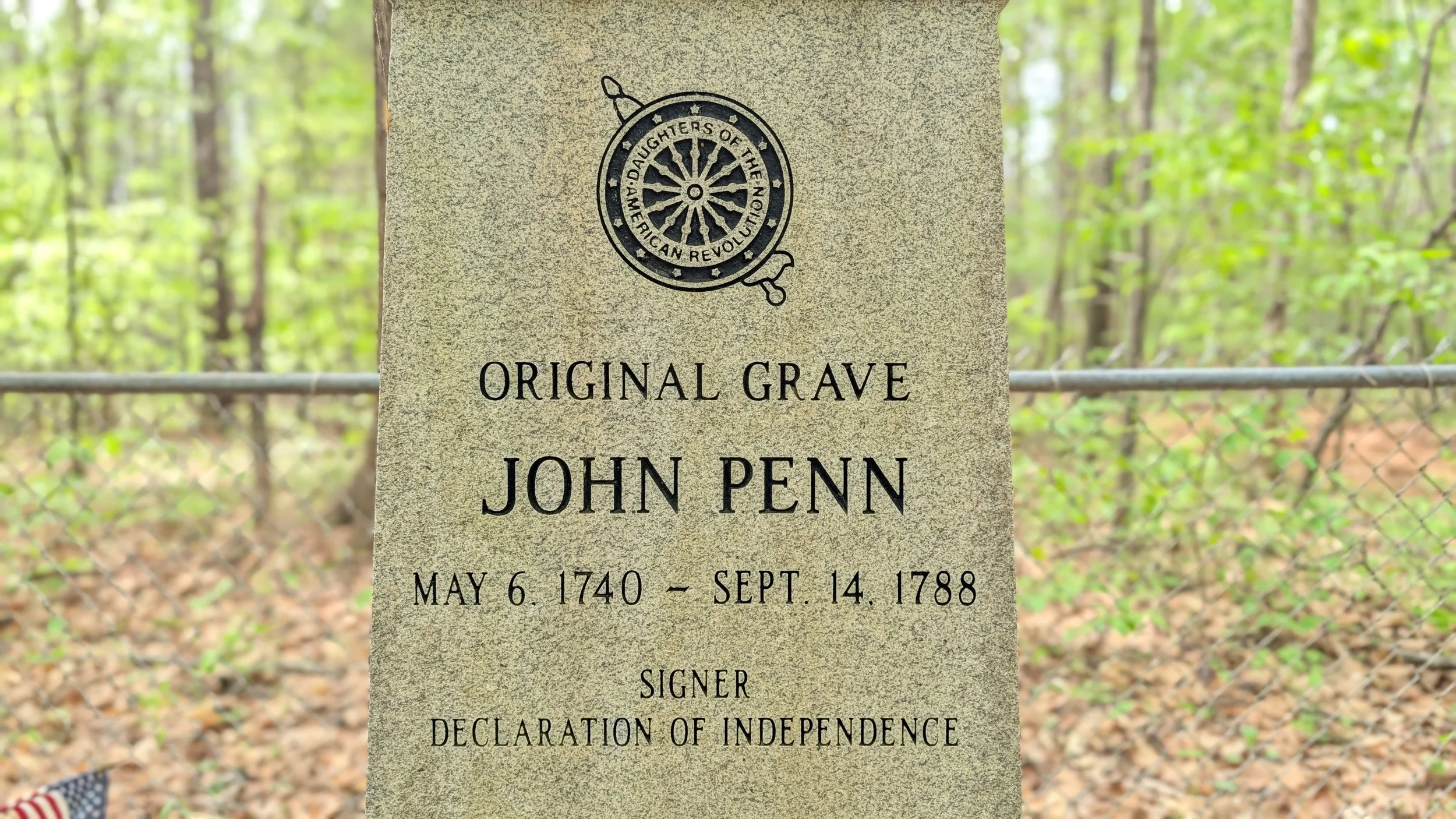
John Penn, Signer of the Declaration of Independence, 1741-1788
Originally buried at his family plantation in Granville County, NC; Retinterred at Guilford Courthouse Battlefield in the 1930s
When I set out to visit John Penn’s grave, I had no idea how far the trek would take me into the countryside. His grave is isolated, situated amidst hundreds of acres of hunting land that was previously his plantation. Once you leave the paved road, there are a few miles of gravel and then dirt paths through the woods to get to this remote memorial. So remote, in fact, that I’d be surprised if it gets even 100 visitors a year. Which is not very many for the grave of a signer of the Declaration of Independence. (Although I’m sure many more pay their respects to him at Guilford Courthouse, 100 miles away, where his partial remains were reinterred.)
When it came time to sign that founding document, North Carolina sent three men: William Hooper, Joseph Hewes, and John Penn. Each has an interesting story of how they rose to such a position, and today, I’d like to tell you about Penn’s life, which started in Virginia.
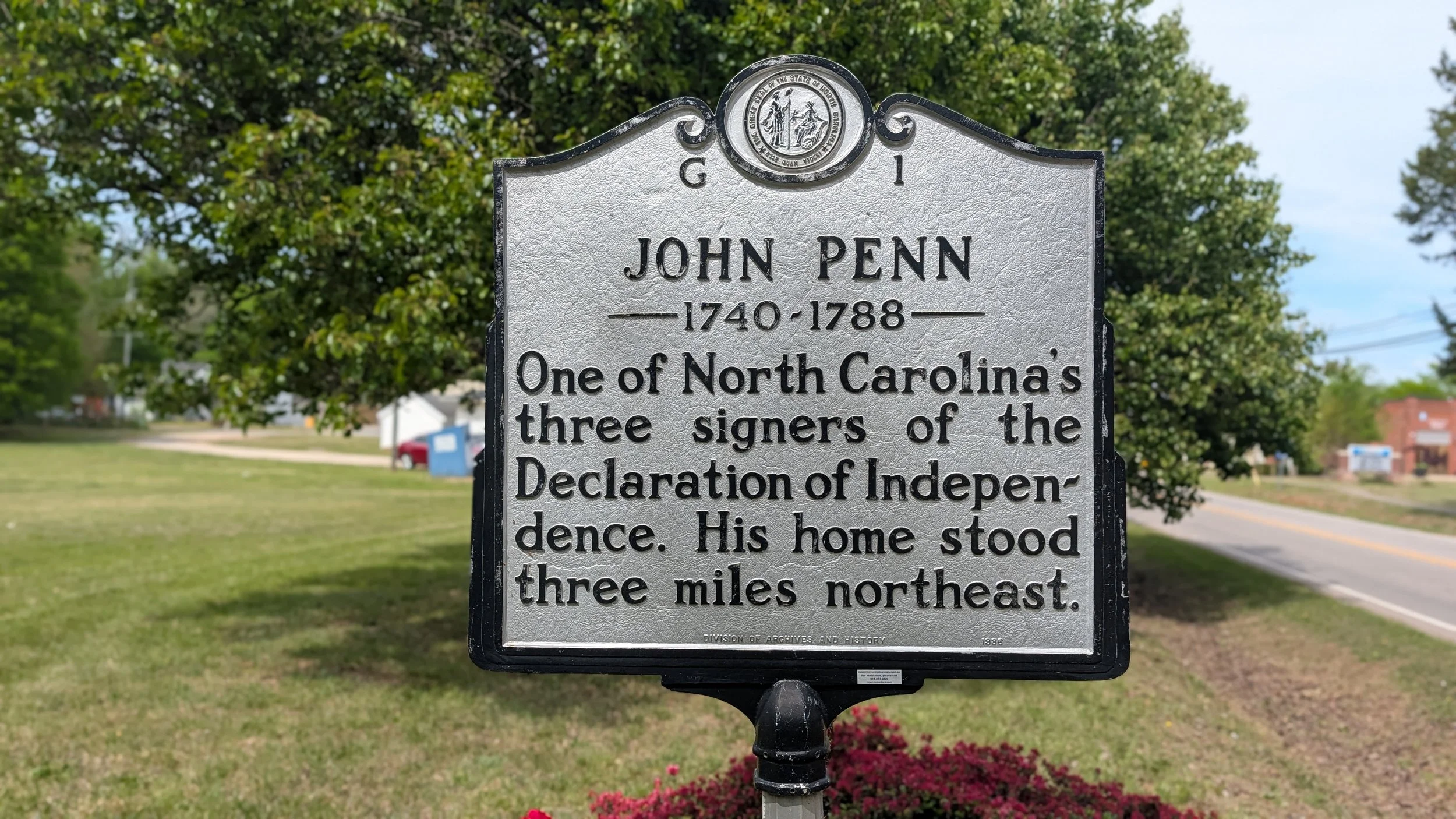
A Farm Boy With Almost No Education
John Penn was born on a modest farm in Caroline County, VA, the only son of Moses and Catherine Taylor Penn. Some records give his birthdate as May 6, 1740, while others list May 17, 1741. Even the National Park Service, writing Penn's own official biography, was unable to resolve that discrepancy, so I'm not going to try to resolve it here. What everyone agrees on is his death date, September 14, 1788, so at least we know how long the story runs, even if we're not entirely sure when it starts.
Penn's father wasn't a believer in schooling, and as a young boy, John received only a year or two of formal instruction at a local country school before he was put to work on his father’s farm. A farmer's life seemed like the most likely path for John, but that all changed when his father died suddenly. John was 18 and left with a modest inheritance. Looking for guidance about the next steps in his life, John wandered into the library of Edmund Pendleton, Penn’s neighbor and kinsman (possibly his uncle or cousin). Pendleton was an acclaimed Virginia lawyer, and when he took a young John Penn under his wing, he handed him access to his personal collection of books in what was reportedly one of the finest private libraries in the colonies.
Penn must’ve been an ambitious young man, because he set out to teach himself law, which he studied in the books of Pendleton’s library and under his mentorship. In 1762, at age 21, Penn was licensed to practice law in Virginia, and thus began his career and path to becoming a signer of the Declaration of Independence.
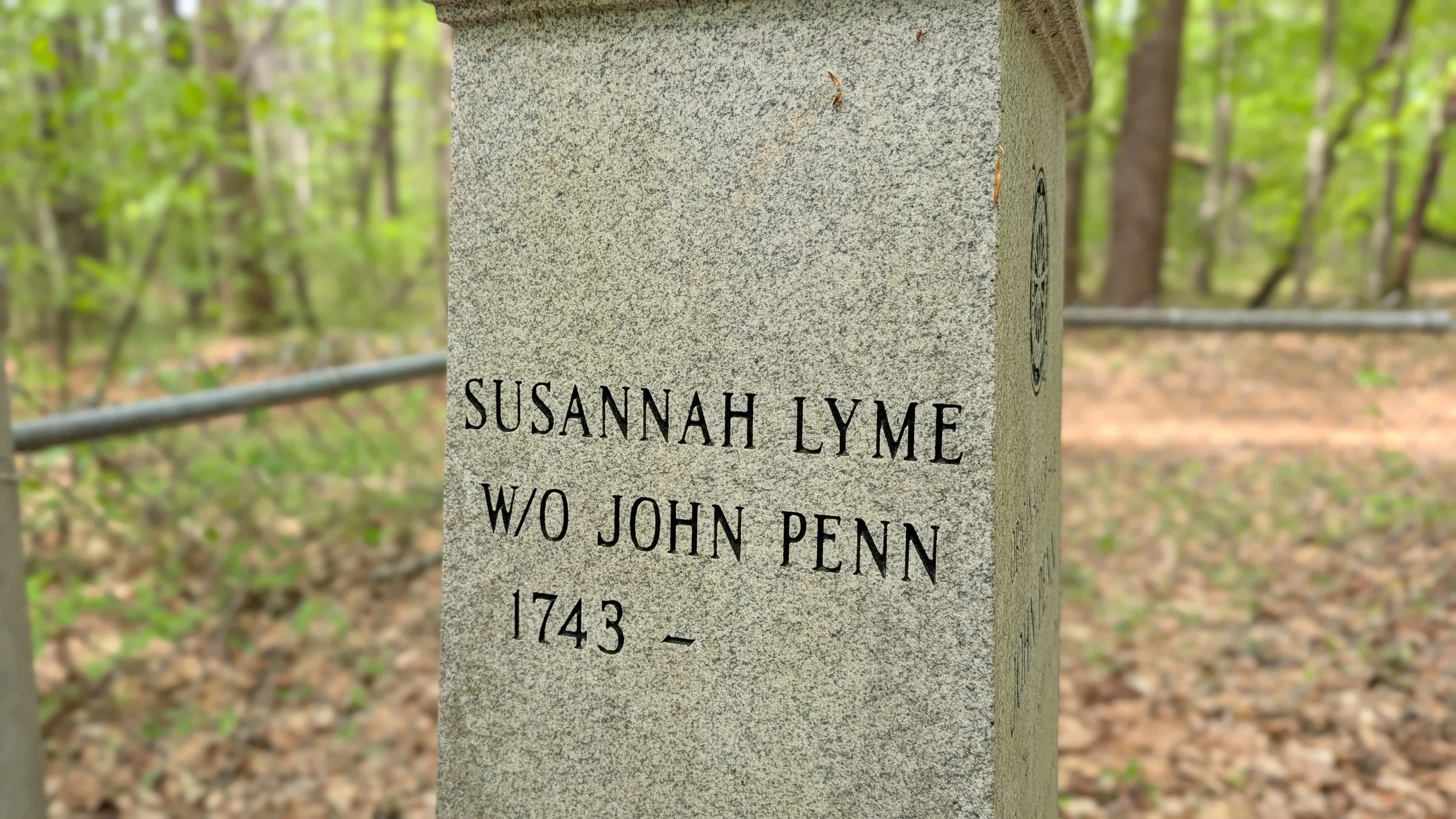
In 1763, he married a young woman named Susannah Lyne (1743-1795), whose family had ties to Granville County, North Carolina, which would eventually pull the Penns south.
From Virginia Lawyer to Backcountry Radical
In 1774, Penn packed up his family and moved to the Williamsboro area of Granville County, North Carolina, not far from where several of his relatives had already settled. I wondered why they made this move, and the more I read about their family, the more I learned that there may have been many reasons for the relocation to North Carolina
One obvious reason is Susannah Lyne Penn’s family connections to the area; however, another fascinating tale turned up as I was researching John Penn. I'm not sure how true this account is, since it's mostly family legend, but it paints a picture of how he was regarded
The story goes that in early 1774, Penn had made some unfavorable remarks in public about King George, was reported to royal authorities, and was hauled into court on charges bordering on sedition. This story claims that a judge was sympathetic to Penn’s position, and fined him a single penny, but Penn refused to pay on principle. In this account, Penn left Virginia rather than pay the one-cent fine for slandering the King.
Whatever brought them south, North Carolina was a good fit for Penn. Granville County in the mid-1770s was exactly the kind of place where a man with strong opinions about liberty could make a name for himself fast, and Penn did. Within months of arriving, his law practice was thriving, and he'd caught the attention of local Patriot leaders, including Thomas Person, who was a prominent backcountry political figure. In August 1775, Penn was elected to North Carolina's Third Provincial Congress at Hillsborough, and within weeks, he was elected to fill a vacancy in the Continental Congress left by Richard Caswell.
The Vote for Independence
Penn took his seat in Philadelphia in October 1775, and from the start, he was more committed to independence than either of his North Carolina colleagues. Hooper still hoped for reconciliation with England. Hewes changed his mind a few times. But Penn didn't. By February 1776, he was writing home that he was prepared to accept total separation from Great Britain if that's what it took. Decades later, an aging Thomas Jefferson, writing to an equally aging John Adams, remembered it the same way: Hooper had Tory leanings, Hewes changed his mind constantly, but Penn had always been steady in his resolve.
When North Carolina's Fourth Provincial Congress passed the Halifax Resolves on April 12, 1776, the first formal instruction by any colony authorizing its delegates to vote for independence, Penn wasn't even there to hear it. He and Hooper were riding hard for Halifax and arrived three days late. He headed back to Philadelphia that June, and on July 2, with Hooper absent, Penn and Hewes cast North Carolina's vote for independence. All three North Carolinians signed the final Declaration on August 2, 1776. Penn was about 35 years old.
Congress, a Near-Duel, and the War Years
Penn stayed in Congress far longer than most delegates managed, having been reelected in 1777, 1778, and 1779, and signing the Articles of Confederation in 1778. He developed a reputation as a hard worker and someone who rarely spoke on the floor of Congress but who was, by every account, likeable, courteous, and relentlessly loyal to his friends.
That loyalty nearly got him killed. In January 1779, Penn got into a political dispute defending financier Robert Morris against accusations from Henry Laurens of South Carolina, and Laurens challenged him to a duel. Almost comically, the two men were staying at the same boardinghouse and had been eating breakfast together every morning, including the morning of the scheduled duel.
Walking together to the dueling ground, they came to a muddy ditch, and Penn, without thinking, offered his hand to help the much older Laurens across. Somewhere in that small, human gesture, both men realized how ridiculous the whole thing was, apologized, and called it off. I love this story because it paints a human picture of both men, and Penn, who seems a little impulsive, but not at all interested in dying over a political argument.
By 1780, with the British war effort turning south, Penn left Congress for good and came home to Granville County. Governor Abner Nash appointed him to a newly formed three-member Board of War, and Penn turned out to be the only member who actually showed up and did the work. From that post, he personally coordinated supplies for Nathanael Greene's Continentals and Francis Marion's guerrilla fighters during the critical Southern Campaign, which led to Cornwallis’ eventual surrender at Yorktown. Some historians credit Penn's supply efforts as a real, material factor in that eventual victory.
The Board was dissolved by the state legislature in early 1781, reportedly after some political maneuvering by a rival who resented how effective and influential Penn had become.
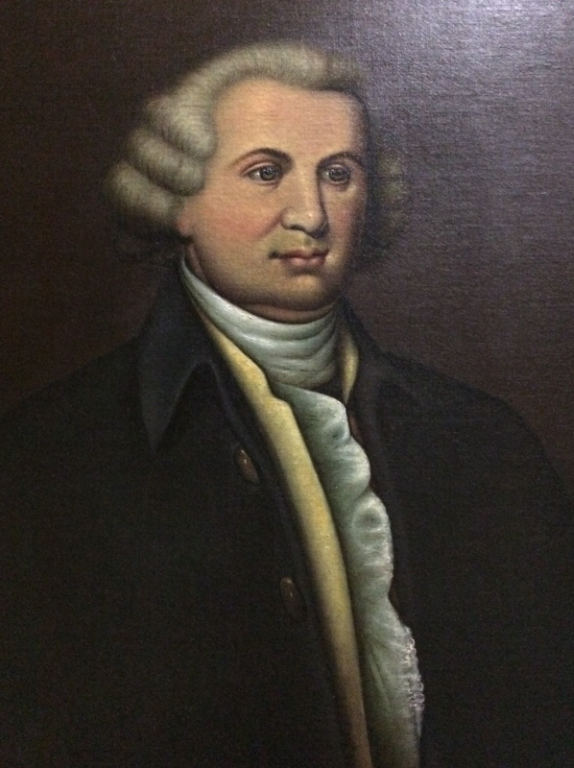
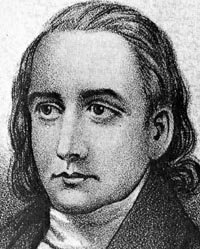
Portrait of John Penn
A Quiet Retirement and an Early Death
After the war, Penn's public career wound down fast. In 1783, Robert Morris appointed him North Carolina's receiver of taxes for the young government, but Penn resigned within a month, frustrated that he'd been given no real authority to actually collect anything. After that, he returned home to Granville County to practice law.
He died on September 14, 1788, near Williamsboro on his plantation, at 47 or 48 years old depending on which birth year you believe. He was buried on that farm near Island Creek, which is a few miles northeast of present-day Stovall.
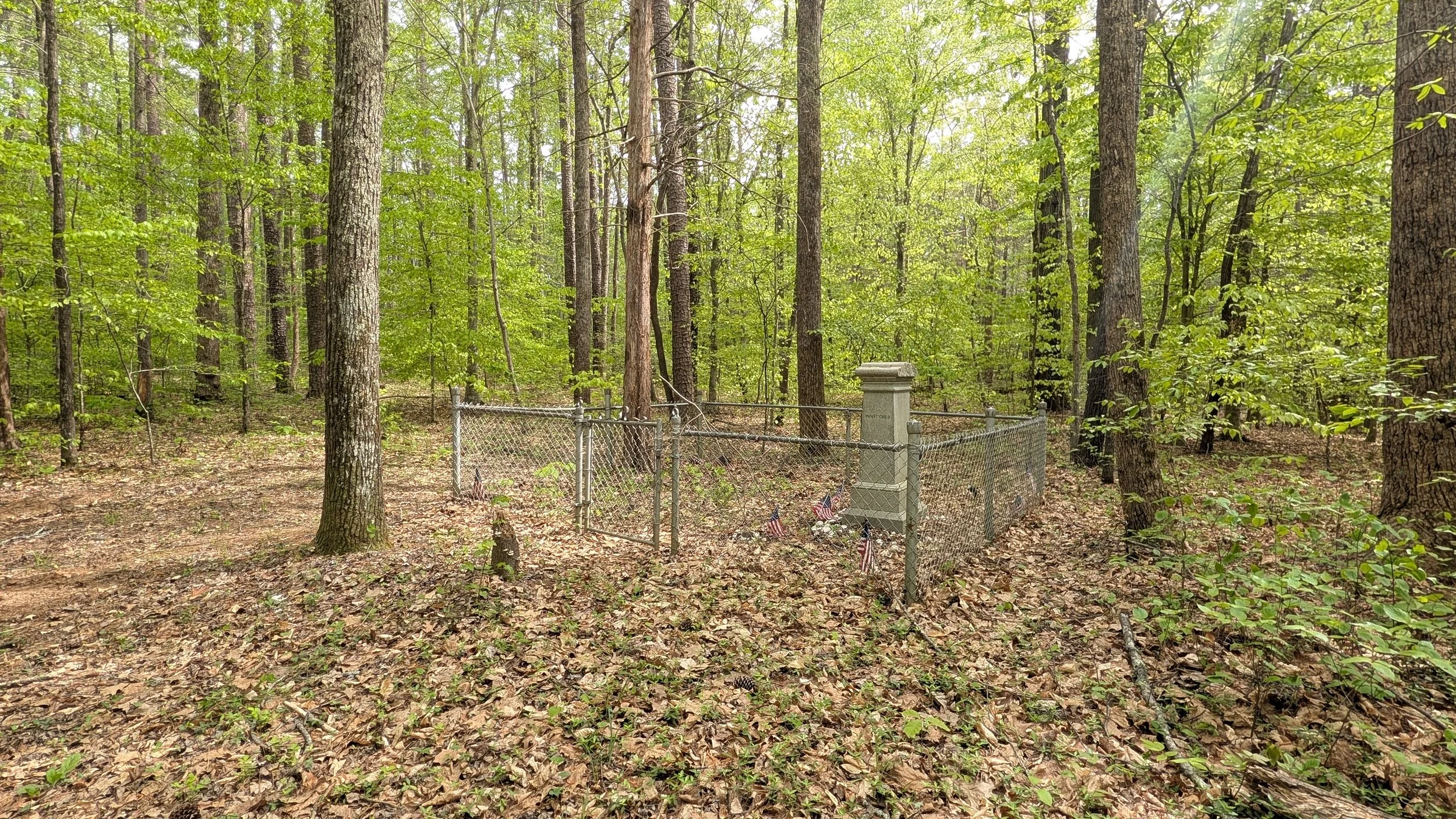
The location of the original family graveyard in Granville County, NC, where Susannah Lyne Penn and an unnamed Penn infant still rest today. John Penn’s remains were relocated, but a marker in his honor was placed here in 2014.
Two Burials: Island Creek and Guilford Courthouse
But his remains would not be allowed to rest there forever, and like his peer, William Hooper, John Penn’s grave was dug up in 1894 to be relocated 100 miles away. More than a century after his death, a private preservation group called the Guilford Battleground Company set out to gather North Carolina's three Declaration signers and rebury them together at the site of the Battle of Guilford Courthouse, near Greensboro. This was an interesting decision since none of the three men had any actual connection to that battle, but the company wanted North Carolina to have a symbolic Revolutionary shrine, and Guilford Courthouse was already becoming one.
On April 25, 1894, Penn's remains were reinterred at Guilford Courthouse beside Hooper's, near the equestrian statue of Nathanael Greene. The granite base of what's now called the Signers Monument was dedicated that same year on July 4, and a bronze statue of a colonial man, holding the Declaration aloft, was added and dedicated on July 3, 1897.
Then in 1976, the National Park Service moved the entire monument, statue, and both sets of remains a short distance into the woods, after complaints that the original site created a blind spot for drivers. John Penn has now been buried three separate times in three separate centuries.
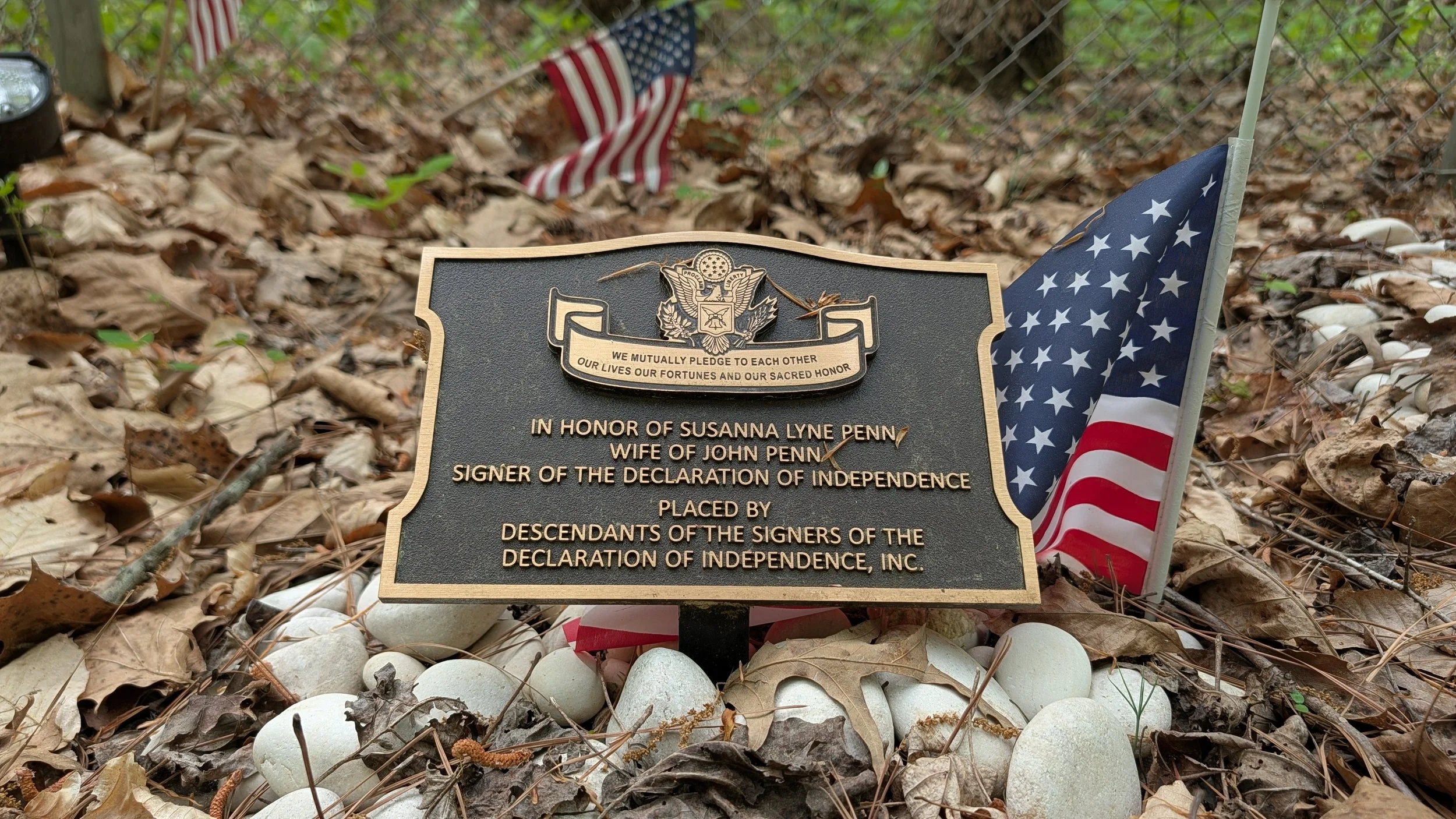
What Was Left Behind
So while very few people make it to visit John Penn’s original gravesite in Granville County, I’m guessing that many more pay their respects at his second burial site at the battlefield park in Greensboro. But his original gravesite still exists and is maintained today by the Daughters of the American Revolution. His wife, Susannah, still rests there, along with an unnamed infant child.
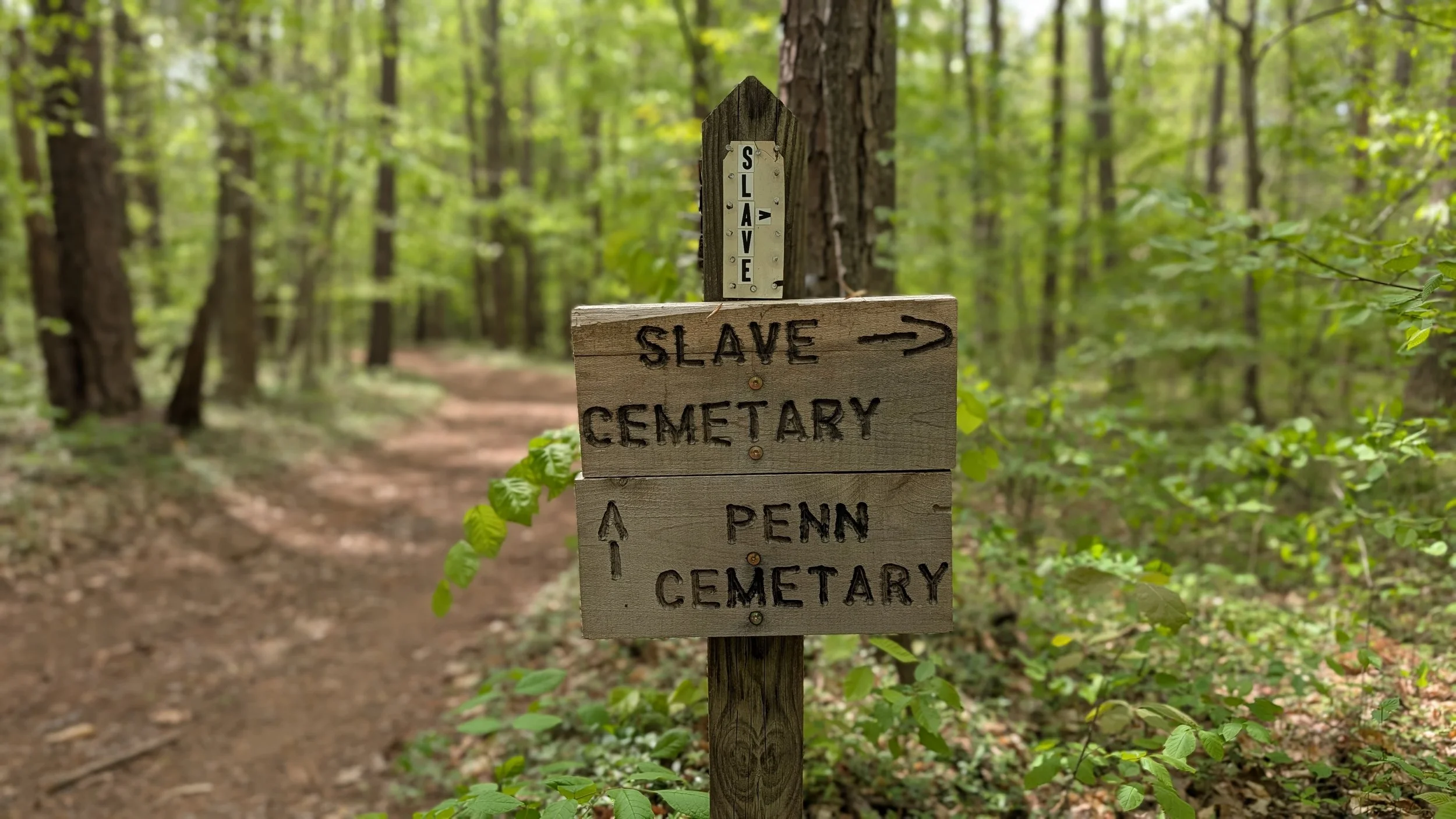
It is there at the family cemetery on their Granville County Plantation that you can also visit the final resting place of countless enslaved people, who were buried just a few hundred feet from John and Susannah Penn. None of their graves have inscriptions (except one with the letters ‘PJ’), and I haven’t found any records of their names or dates of birth or death, but there in the woods along the creek, dozens of flags mark the place where the people who kept John Penn’s plantation afloat rest.
Penn's own will, in his handwriting, references enslaved people he had transferred to his son-in-law. With enough time and effort, a better account could be made of their story through will and estate records, and I hope to contribute to that scholarship one day. But for now, I mention this because it highlights the contradictions of the era and these men: Men who risked their necks for the idea that all men are created equal, while enslaving other human beings. These people were complicated individuals, just as we are now, and I think it’s only fair to address these nuances.
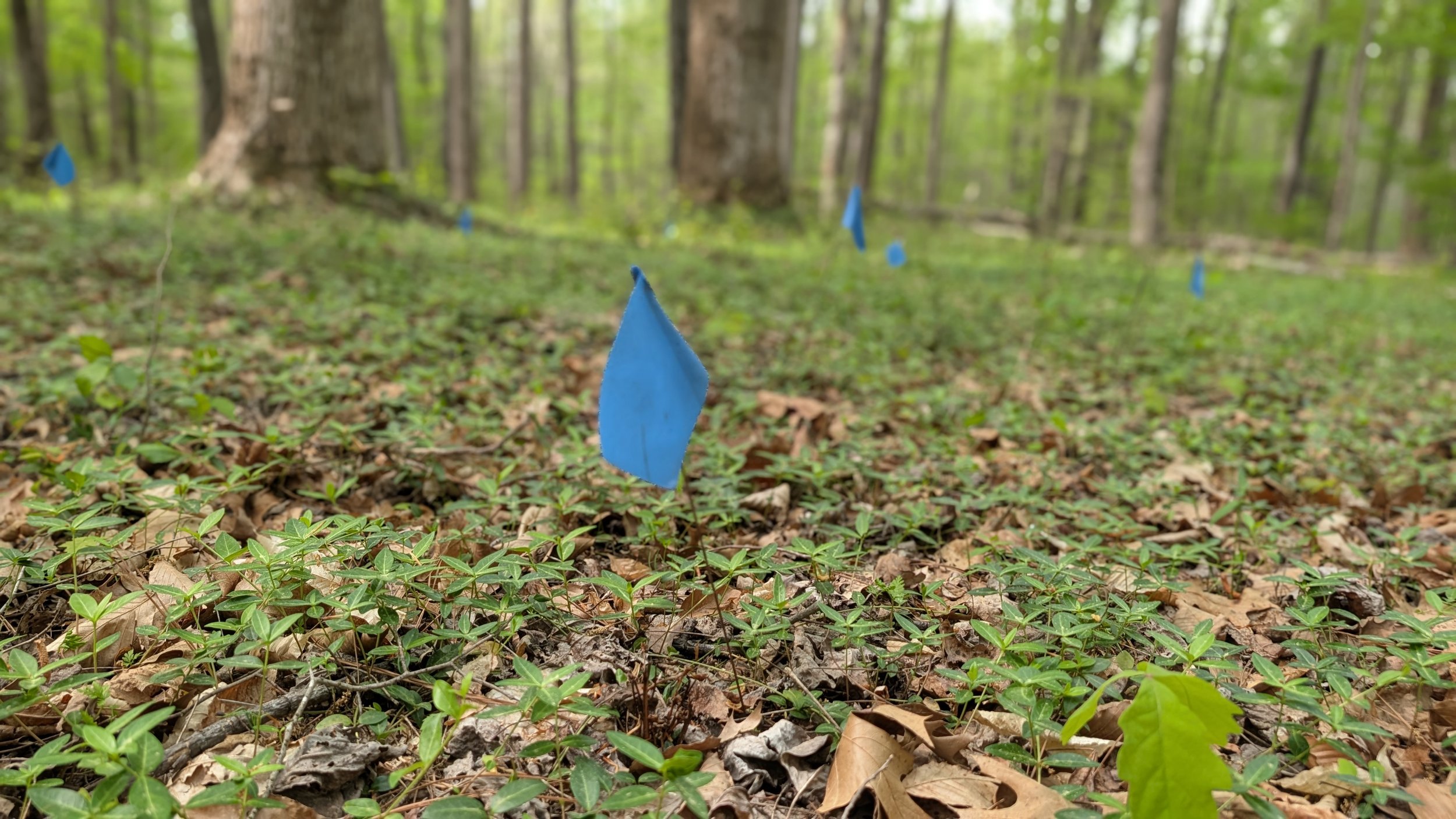
Blue flags blanket the floor of the woods here, marking the graves of enslaved individuals from the Penn plantation.
Visiting Information
How to visit the original grave site in Granville County:
John Penn Rd, Oxford, North Carolina (just outside of Stovall, NC)
How to visit the final gravesite at Guilford Courthouse Battlefield:
Guilford Courthouse Battlefield: 2332 New Garden Rd, Greensboro, NC 27410
This project is made possible by readers like you.
Your support helps to pay for website costs, gas to travel to these sites, and cleaning supplies for the veteran stones that I’m working to restore.
If you believe this work is important, your support is so appreciated!
Citations
North Carolina State Archives. Holograph Will of John Penn, Granville County, 1784. VC.23.2. North Carolina Digital Collections.
North Carolina Office of Archives and History. "Penn, John." NCpedia. Dictionary of North Carolina Biography, edited by William S. Powell. Sketch by George Troxler. https://www.ncpedia.org/biography/penn-john.
National Park Service. "Signers of the Declaration: John Penn." Signers of the Declaration Historic Resource Study. https://www.nps.gov/parkhistory/online_books/declaration/bio38.htm.
National Park Service. "Guilford Courthouse National Military Park's Monuments." https://home.nps.gov/thingstodo/guilford-courthouse-national-military-park-s-monuments.htm.
National Constitution Center. "John Penn." Signers of the Declaration series. https://constitutioncenter.org/signers/john-penn.
Declaration Resources Project, Harvard University. "Guilford Courthouse National Military Park." https://declaration.fas.harvard.edu/resources/destinations/guilford.
Descendants of the Signers of the Declaration of Independence. "John Penn." https://www.dsdi1776.com/signer/john-penn/.
University of North Carolina at Chapel Hill, University Libraries. "William Hooper and John Penn, Guilford Courthouse." Commemorative Landscapes of North Carolina. https://www.docsouth.unc.edu/commland/monument/127.
Granville County Genealogical Society. "084 John Penn." Granville County North Carolina Cemeteries, Cemetery Census. https://cemeterycensus.com/nc/gran/cem084.htm.
Northcarolinahistory.org. "John Penn (1741-1788)." North Carolina History Project, John Locke Foundation. https://northcarolinahistory.org/encyclopedia/john-penn-1741-1788/.